ISRAEL-DIASPORA RELATIONS
URJ to host record 570 Israelis across 14 camps this summer as it ‘doubles down’ on Israel
The goal is 'bringing Israeli and Diaspora peers together in authentic relationships in joyfully Jewish spaces,' URJ's Melissa Frey says
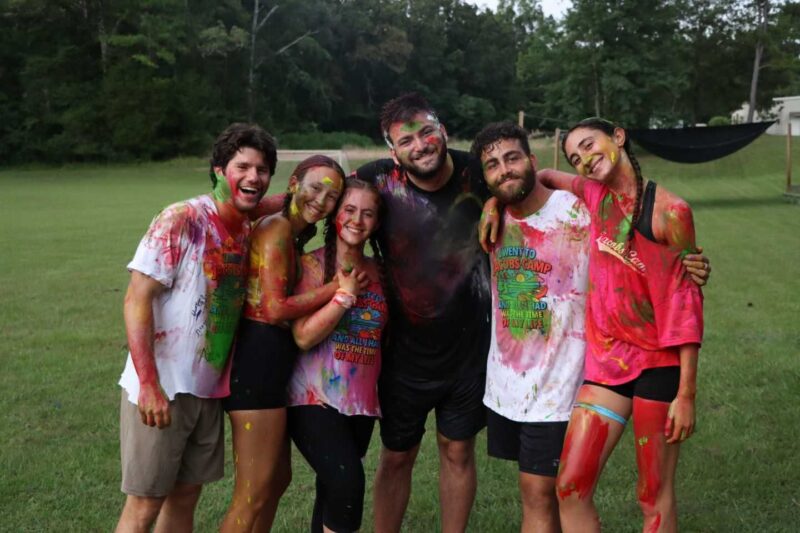
courtesy/noam avrahami
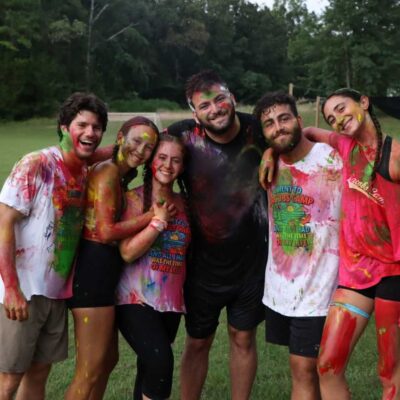
Noam Avrahami (left) stands with other counselor's at the Union for Reform Judaism's Henry S. Jacobs Camp in Utica, Miss., last summer.




 Add EJP on Google
There are no direct flights from Israel’s Ben Gurion Airport to southern Mississippi.
So for Noam Avrahami, 24, the trek from his home in the central Israeli town of Matan to the Union for Reform Judaism’s Henry S. Jacobs Camp in Utica, Miss., took nearly a full 24 hours. But he was happy to do it; it felt like coming home. And he slept most of that time anyway.
And Avrahami is just one of more than 570 Israelis who will call a URJ camp home — nearly double the number who came in 2024 — across the movement’s 14 facilities in North America.
Of these, 300 will serve as shlichim (Israeli emissaries), and 270 Israeli teens will come to URJ camps as campers. For Melissa Frey, the URJ’s executive director of camps and immersive Israel experiences, the increase in Israeli participation in URJ summer camps reflects a deliberate choice.
“We are doubling down on Israel,” she said, “at a critical moment for Israelis, for North American Jewry, and for the sometimes challenging bridge between these two communities.” This summer, 9,000 URJ campers are registered across camps and Israel programs — making camp one of the movement’s most significant settings for Israel engagement.
As the URJ sees it, Frey said, it all comes back to one core goal: “bringing Israeli and Diaspora peers together in authentic relationships in joyfully Jewish spaces.”
Avrahami is returning for his second summer as a shliach. “I am not so religious,” he said, “but coming into a URJ camp and doing all of the prayers in a fun way with singing and dancing, respecting the values [of] Judaism but not in a forceful way was [a] really nice to express my Judaism.”
His campers, in turn, have been shaped by him. “Many of them were really interested in my Israeli culture, my service in the IDF, and my views,” he said. “They respected my point of view and my opinions on Israel.”
That core exchange between Israelis and campers, Frey said, is exactly the goal. “When you hear things on the news or social media that feel complicated, when you have a friend in Israel it feels different than if you have no connection at all.”
The URJ does not think of Jewish camp as a one-summer “checked box,” Frey was quick to emphasize, but instead what she referred to as “an arc of opportunities” — a through line that extends well beyond the summer session. For Israeli shlichim and Israeli campers alike, this means being connected to Reform movement synagogues in Israel after camp ends. The URJ views Jewish camp as an on-ramp to what Frey describes as “a trajectory of an international Jewish journey.” The arc, she said, is for both Israeli and American campers and counselors alike.
Building that arc means navigating a moment of real strain between Israeli and Diaspora Jewish communities. Recent polling by the Jewish Electorate Institute found that while American Jews broadly affirm Israel’s right to exist, only a third actively identify as Zionists — reflecting the complex and often divided relationship with Israel among the very demographic that fills URJ camps.
Last week’s Re-Charging Reform Judaism Conference, convened by leading Reform Rabbi Ammiel Hirsch, which the URJ was not involved in planning but had a number of representatives who participated in it, was a direct response to growing anti-Zionist trends within and around the movement. The gathering signaled that senior Reform leaders are actively engaging the question of Israel’s place within the movement.
Frey did not sidestep the complexity. “The world changed after Oct. 7,” she said, “and so did our approach.” In the months before the 2024 summer — the first since the attacks — URJ leadership grappled openly with what it would mean to welcome shlichim coming out of IDF service onto the same grounds as North American college students who had spent the spring navigating charged campus environments. “How were we going to hold space for all of that in a safe, loving, caring, meaningful way for everyone?” Frey wondered.
The answer involved an intense investment in preparation. URJ conducted staff training in holding difficult conversations, navigating multiple truths and supporting mental health. The movement this year ensured that every camp will have a mental health professional fluent in Hebrew — so that Israeli campers and shlichim can access support in their own language. For Israeli campers and shlichim still carrying the weight of the past 2 ½ years of conflict, the challenges of being Israeli don’t dissipate when they are 6,733 miles away in Utica.
Reflecting on the long journey back to Mississippi — a world away from his hometown of Matan — Avrahami is matter-of-fact about what the return felt like. “I slept for most of the flight from Tel Aviv to New York,” he said, “and arriving at camp was so natural for me, like I had only left for a couple of weeks and came back. It was good to be back. Just like coming home.”
Related News
EXCLUSIVE
Detroit-based philanthropists Nancy, James Grosfeld donate $8M to renovate JDC’s Israel campus

MAGICAL EXPERIENCE
Shefa launches psychedelics retreat for Jewish professionals suffering burnout
PRESIDENTIAL REBUKE
Israel’s Herzog: Mamdani ‘makes no effort’ to hide disdain for Israel, Jews must fight back
EXIT INTERVIEW
Elizabeth Sokolsky, longtime EVP of Birthright Israel, to retire next year

MAJOR GIFTS
Center for Jewish History celebrates 25 years with a $25M matching grant