POLAR OPPOSITE
‘From Blueprints to Life’ showcases first year of Israeli president Herzog’s Voice of the People
Members of the initiative, which launched last year, highlight their program ideas to combat antisemitism, connect global Jewry, deepen Jewish identity, boost ties to non-Jewish and — most importantly — reduce polarization
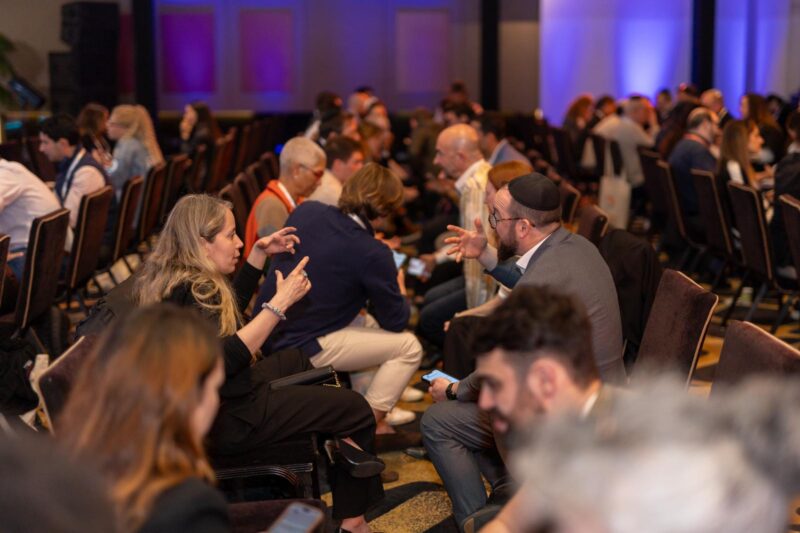
Courtesy/Dor Pazuelo
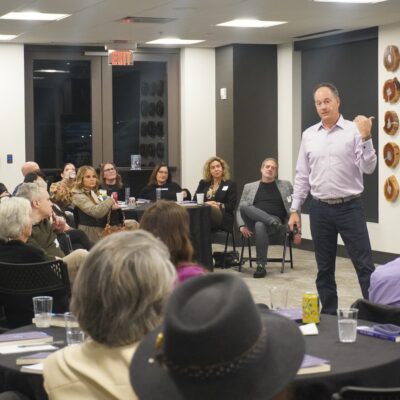
Members of the Voice of the People council speak about issues facing the Jewish people during its first in-person meeting in Haifa, Israel, in March 2025.




 Add EJP on Google
One hundred fifty Jews and the president of Israel walked into a hotel…
“It sounds like the beginning of a joke, but I promise you it was no laughing matter,” according to Ryan Turkienicz, a self-described “Toronto-based humorist, entrepreneur and disappointment to my parents.”
Turkienicz made his quip at Wednesday’s “From Blueprints to Life” virtual event showcasing the first year-and-a-half of Israeli President Isaac Herzog’s Voice of the People initiative. Turkienicz was describing the first in-person meeting of the initial cohort at the Dan Carmel Hotel in Haifa last March.
The Voice of the People initiative selected 150 Jewish leaders — 50 from Israel, 50 from the United States and Canada and 50 from across the globe — who were divided into 10 cohorts. Those 10 cohorts were then focused on five key issues — combating antisemitism, polarization, Israel and global Jewry, relations between Jews and non-Jews, and identity and heritage — with two cohorts tackling each topic. “From Blueprints to Life” highlighted seven of the 38 initiatives that have been spawned in the 15 months since the inaugural meeting.
First announced at the Jewish Federations of North America General Assembly in April 2023 and then delayed following the Oct. 7 terror attacks, the program launched in January 2025. The world changed significantly between the initial announcement and the actual launch, with the Oct. 7 terror attacks, wars in Gaza, Lebanon and Iran, and the deadly rise in global antisemitism, alongside the rapid emergence of artificial intelligence. One issue that has remained consistent throughout this period, however, has been polarization, particularly within the Jewish People — the original reason why Herzog conceived of the idea.
Herzog said at Wednesday’s event that his biggest fear is still that the Jewish people “choke each other. I don’t sleep at night sometimes, and I say it seriously; I see it as the mission of my life, definitely in my term as president, to do whatever I can to lower the tension within our people.”
Sticking together, especially during times of polarization, was a theme of the event.
“I truly see myself not only as the president of Israel, but as the president who cares and needs a lot of the Jewish world,” Herzog said. “We have responsibilities for the Jewish world. It’s something that matters, and therefore, if we work together and build it together, we will also build things for the future. That is the real gist of the greatness of Voice of the People.”
The initiative is a partnership between The President’s House, the World Zionist Organization and the Jewish Agency for Israel as well as philanthropic partners the Wilf Foundation, the Azrieli Foundation and the Patrick and Lina Drahi Foundation.
Combating AI was a theme for two of the initiatives showcased. AI represents “the biggest threat and opportunity to the Jewish People,” Herzog said.
“Since 2023, antisemitism and AI have risen in tandem,” Maya Ackerman, an AI expert who presented on the One Five Seven initiative — named for the world’s 15.7 million Jews — said at the event. “We all know that digital spaces, like social media, have been a large part of the strategy of the people actively working against us, but with AI, we have an incredible opportunity. It’s becoming the most trusted source of information, a source of information that people trust more than social media, and even more than search engines.”
AI is trained on the internet, which can be a breeding ground for antisemitism, so it often perpetuates existing biases while inventing new ones, Ackerman said. “But we have an opportunity right now, if we get in early enough, if we don’t wait the way that we did with social media and Wikipedia, we can actually turn [AI] into a really, really important part of the solution.”
This is especially true as AI companies try to rein in control over their models and are open to partnerships, which One Five Seven hopes to create. So too does the other tech-based Voice of the People initiative, Hack the Hate, which connects Israeli tech founders with Diaspora groups, experts and funders to combat antisemitism online.
Another Voice of the People cohort launched the Jewish and Indian Alliance as a way to cultivate cultural connection and combat both antisemitism and anti-Indian hate.
“What we learned very quickly was as much as we don’t know them, they actually did not know us,” Rabbi Erez Sherman said about connecting with Los Angeles Indian communities. “I remember one [program] participant saying, ‘I’ve walked by or I’ve driven by your synagogue so many times, I did not realize that I could enter.’”
Another initiative, MTT — M’Tzion Tetzeh Torah (From Zion will come Torah) — brought together teens from 170 Israeli schools to combat polarization through a program called “Don’t Feed the Monster,” where teens studied how outrage was rewarded in media, politics and social media. Israeli children are uniquely skilled at overcoming polarization, MTT organizers said, adding that many Israeli social revolutions were led by children, including initiatives to save wildflowers, advocate for seatbelts and recycle.
“Science tells us that 90% of brain development happens by age 5,” Erin Schrode, an activist and social entrepreneur, said, introducing her initiative, Tiny Tribe. “More than 1 million neural connections form every second in those first few years, yet traditional Jewish programming usually doesn’t start until preschool or Hebrew school.”
Tiny Tribe, inspired by PJ Library, plans to deliver Montessori-based screen-free play sets such as Hebrew letter sensory cards and wooden tzedakah boxes directly to families every three months from birth, with the goal to launch in fall 2027.
“When my son takes out his wooden candlesticks and covers his eyes exactly the way my grandmother once did, I see the future,” Schrode said. “Identity isn’t built overnight, it is forged through small, joyful moments that root and stay for a lifetime.”
The most philanthropy-focused initiative announced was Otzera — The Global Sovereign Fund for the Jewish People, a combination of the word otzar, meaning “treasure,” and zera, meaning “seed.” This initiative seeks to create an endowment for global Jewry with annual returns distributed to initiatives targeting identity, security, education and leadership.
“We are permanent and enduring people, and we need permanent capital,” Serge Touati, a financial entrepreneur, said. “That’s the reality. It’s capital that lasts and grows.”
As for that comedian and the 150 Jews strolling into the hotel.
Out of that first meeting came his initiative, Ironic Dome — a play on Israel’s Iron Dome missile-defense system — that holds monthly meetings for comics to brainstorm material and quarterly showcases for them to spread laughs.
In the past nine months, Turkienicz said, “We’ve committed ourselves to having a deeply unserious time” with dozens of comedians performing for hundreds of audience members, raising thousands of dollars, much of which was donated to Jewish causes.
“If the 3,000-year history of Jewish humor has taught us anything,” Turkienicz said, “it’s that a community which laughs together can get through any challenge.”
Related News
CLOSING WORDS
In AZM address, Cosgrove links communal ‘orthodoxy’ on Israel to rising anti-Zionism among young Jews
ADVANCING A VISION
N.Y. federation donates $1M toward building shared-society center named for peace activist killed on 10/7

MAGICAL EXPERIENCE
Shefa launches psychedelics retreat for Jewish professionals suffering burnout

MAJOR GIFTS
Center for Jewish History celebrates 25 years with a $25M matching grant
PRESIDENTIAL REBUKE
Israel’s Herzog: Mamdani ‘makes no effort’ to hide disdain for Israel, Jews must fight back