Opinion
DOLLARS AND SENSE
An eroding dollar is a quiet crisis for Israel’s third sector




 Add EJP on Google
I recently met with representatives of an Israeli nonprofit in the health care field that secured a commitment last year for a donation of roughly $5 million. Between the commitment date and the date the money was actually received, the dollar exchange rate fell sharply; as a result, in shekel terms, millions of shekels disappeared from the organization’s operating budget. I’ve also witnessed the opposite situation: a nonprofit that received a multimillion-dollar commitment in 2008 and benefited from the dollar’s rise over the course of the next year, the exchange-rate gains funding the construction of an impressive new rehabilitation facility. Unfortunately, the first case is more common these days — and above all, more painful.
Much has been written about the impact of the dollar’s depreciation on Israeli high tech, and rightly so. But the public debate is missing a quieter sector, one no less sensitive and often far more essential to daily life in Israel: the ‘third sector,” Israel’s nonprofits.
Nati Shohat/Flash90
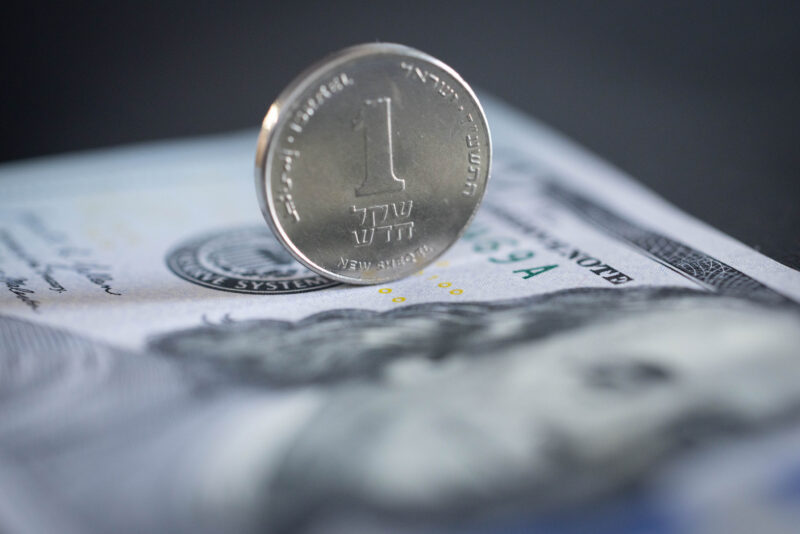
Illustrative. A shekel stands on top of a U.S. dollar on April 13, 2026.
Various estimates place philanthropy from abroad at roughly one-half to two-thirds of all giving in Israel, about $4 to $5 billion a year. As a matter of policy, this resource is the financial backbone of education, welfare, health, security, and culture in the country, as well as the social infrastructure on which the state relies. As a result, when the dollar erodes, service to the public erodes with it — by billions of shekels.
Sometimes the loss is compounded by the fact that many Israeli foundations and donors operate through matching mechanisms, with one shekel of philanthropy being matched by one shekel of state funding. When the dollar-denominated gift loses value, the corresponding shekel support shrinks as well.
This is not merely an accounting issue. It is a cash-flow and budgeting problem. Financial statements show balances, revaluations and exchange-rate differences at defined points in time. Real life, however, happens in the cash flow: when the donation comes in, when salaries and suppliers must be paid, when services must be delivered to beneficiaries who cannot wait for a convenient exchange rate and how delays damage reputation and objectives. The harm may therefore be far more severe than what appears in the audited financial statements. A project planned for three years may need to make cuts in its first year. A nonprofit that raises funds in foreign currency and spends in shekels, or the reverse, is exposed to inherent currency risk. A nonprofit that does not manage that risk is speculating on it.
It is also important to make clear that responsibility here does not end with the CFO. In the past, currency-risk management was seen as a matter for universities, hospitals and very large NGOs. Reality has changed.
The strengthening of the shekel is not necessarily a temporary event, and even a small nonprofit may carry significant foreign-exchange exposure. As part of sound corporate governance, the board and audit committee must ask: What is the scope of the exposure, in which currencies and at what dates? What happens if the dollar falls further? Is there a policy? Who is authorized to make decisions? Is the organization complying with regulatory limits? A nonprofit does not need to become a trading desk, but it must know what risk it is carrying. Many nonprofits lack sufficient expertise, and regulatory constraints limit their investment options. It is therefore essential to seek advice, formulate a hedging policy, define execution authorities and update them regularly.
The road map should rest on three layers of protection:
The first is natural hedges. This includes a conservative dual-currency budget in which dollar-denominated sources are planned at an exchange rate below the market rate, while dollar-denominated uses are planned at a higher rate, creating a safety cushion; and ongoing management of the share of foreign-currency sources, their shekel value and the budgetary meaning of each fluctuation. Additionally, sources and uses should be matched so that dollar expenses are paid directly from dollars rather than after conversion.
The second layer is financial hedging. When exposure is material and subject to advice, regulation and board approval, several common solutions are available. Forward contracts lock in a future exchange rate and provide certainty, but prevent the organization from benefiting if the dollar rises and sometimes require a credit line. Foreign-currency options, such as a put on the dollar, create a protective floor but involve a premium. A collar/cylinder strategy combines buying a put and selling a call, defines a protected exchange-rate range and is sometimes available at no net cost. Staggered hedging, monthly or quarterly, spreads decisions over time and suits organizations with stable cash flows.
The third layer, and the most important of all, is adapting the operating model. Donation agreements can include indexation or compensation mechanisms, or define the commitment as a fixed shekel amount even if payment is made in foreign currency. Donors often understand that this is responsible thinking that protects the impact of the gift and are willing to absorb the currency risk themselves.
With suppliers and partners paid in dollars, organizations can set shekel-denominated contracts or consciously allocate the risk. In addition, budgets should be updated quarterly, sources should be diversified across shekels, dollars, euros and pounds, and firm receipt dates should be established. These steps do not eliminate risk, but they make it visible, measurable and managed. They also allow managers to present donors with a credible picture, rather than discovering after the fact that a generous commitment is no longer enough to fund the activity promised to the public.
No one can consistently predict the dollar exchange rate. The goal of risk management is not to profit from speculation but to protect operating capacity and continuity; a nonprofit is measured by its public mission, not by its financial return. If a currency fluctuation can erase part of an operating budget, then this is a strategic problem. In a period of political and security uncertainty, interest-rate gaps and market volatility, currency risk management must become part of the third sector’s regular management routine. A decision not to hedge may also be legitimate, but only after mapping, examination and orderly reporting. Israeli regulators — first and foremost, the Nonprofit and Public Benefit Company Unit at the Corporations Authority — are also expected to address this issue.
The question is not whether the dollar will rise or fall, but whether the third sector is prepared. As the Talmud teaches, “penny joins penny into a large account” (Bava Batra 9b). In the third sector, every agora eroded by the exchange rate ultimately translates into fewer services, less certainty and less ability to fulfill an essential social mission.
Uriel Dagan is the chief financial officer of Startup Nation Central.