Opinion
READER RESPONDS
Before we can speak with one voice, we must help more Jews discover theirs




 Add EJP on Google
In Short
Jewish resilience and antisemitism cease to be abstractions when people discover a personal connection to the Jewish People in their family history.
The call for a coordinated Jewish strategy in Hadera Ishak’s recent opinion piece in eJewishPhilanthropy (“The Jewish community doesn’t have a funding problem. It has a strategy problem.” July 23) is both timely and necessary. Jewish organizations cannot continue responding to systemic challenges through isolated programs, competing messages and perpetual emergency campaigns. We need shared language, sustained investment and a clearer vision of the Jewish future we hope to build.
But there is another form of fragmentation we must confront. Before the Jewish community can speak with one voice, we should ask a more fundamental question: Who has been invited to recognize that voice as their own?
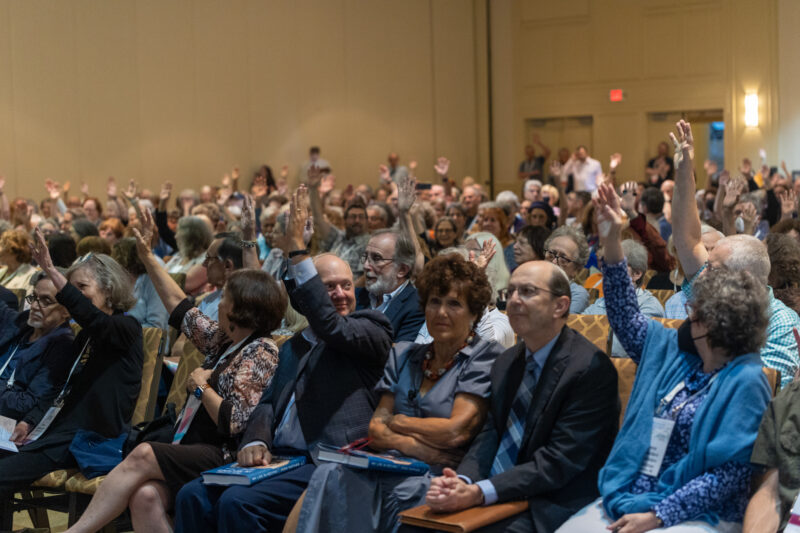
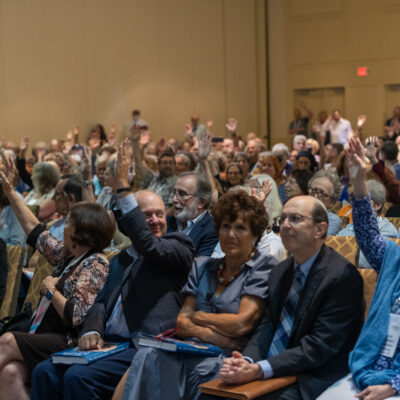
Courtesy/International Association for Jewish Genealogical Societies
participants at the Participants at the 2024 International Association for Jewish Genealogical Societies international conference.
Across the United States and around the world are people with a Jewish grandparent, a family story, an old photograph or a fragment of memory they were never taught how to understand. Some descend from families divided by migration, assimilation, persecution or the Holocaust. Others simply grew up with little Jewish education but a lingering curiosity about where their family came from. Many are not members of synagogues or Jewish organizations. Some would hesitate to call themselves Jewish.
Yet many are searching for connection.
Jewish genealogy and family history offer one of the most underused pathways to that connection. Far more than a hobby devoted to names and dates, family history enables people to enter the Jewish story through the most personal doorway possible: their own family.
A single discovery — a great-grandmother’s immigration record, an ancestral town or a forgotten family photograph — can transform Jewish history from an abstract narrative into a personal inheritance.
The current philanthropic conversation rightly emphasizes strengthening public understanding of Jewish identity and Jewish contributions. But we must also strengthen understanding within the Jewish community itself — and among those standing just beyond its traditional boundaries.
We cannot expect people to defend a Jewish story they have never been helped to discover.
Fragmentation doesn’t exist only in our messaging — it also exists in our memory
For decades, Jewish philanthropy has sustained indispensable institutions serving established communities. The next stage of Jewish engagement must also reach those who have never entered through conventional institutional doors. That requires stronger coordination among genealogical societies, historical organizations, museums, archives and Jewish communal institutions. Together, they preserve the records, photographs and stories that document Jewish life, but too many collections remain fragmented, underfunded and difficult to access.
A coordinated investment in Jewish family history could begin to repair that fragmentation. Local societies could digitize vulnerable collections. Museums and archives could make their holdings more accessible to descendants. Community organizations could invite unaffiliated and partially Jewish families into programs of discovery rather than waiting for them to walk through institutional doors.
An international Jewish genealogy conference could likewise serve as a broader convening point for archivists, historians, educators, technologists and communal leaders committed to transforming Jewish memory into Jewish engagement. This would not require building another institution, but it would still need coordination, shared purpose and sustained philanthropic commitment.
The return on that investment would extend far beyond preservation.
When people discover an ancestor lost to history, Jewish memory becomes personal. When they learn where their family lived, history acquires emotional meaning. When they uncover relatives who built communities, created businesses, served their countries or endured persecution, Jewish resilience and antisemitism cease to be abstractions.
Family history creates belonging through evidence. It also reaches people whom traditional engagement often misses: interfaith families, adoptees, descendants of hidden Jews, younger adults skeptical of institutions and those whose Jewish identity has been obscured by assimilation or family silence.
These people are not peripheral to the Jewish future. They are part of it.
The Jewish community has become highly skilled at mobilizing after crises, but the deeper work of identity must happen before the next crisis. People are more likely to stand publicly as Jews (or with Jews) when they understand how they belong to the Jewish story. They are more likely to challenge distorted narratives when that history has become their own. Genealogy will not solve antisemitism or communal division, but it can strengthen the human foundation upon which every broader strategy depends.
Philanthropic leaders should therefore ask another question: How much are we investing in helping people discover that they are part of the Jewish story?
The answer should include sustained support for preservation, digitization, archival access, educational programming and international collaboration. More than anything, it should recognize that Jewish family history is not simply about looking backward, but bringing people forward.
The Jewish world does not lack stories. It lacks a coordinated way to connect those stories with the people searching for them.
We have the records. We have the institutions. We have the historians, educators and volunteers. What we need is the vision to recognize that helping people discover their own Jewish story is not incidental to Jewish continuity. It is one of its strongest foundations.
When people discover where they come from, they begin to understand where they belong; and when enough people recognize themselves within the Jewish story, they will not merely listen when the Jewish community speaks.
They will give it another voice.
Susan Weinberg is the president of the International Association for Jewish Genealogical Societies.