GOING TO COLLEGE
Hadar expands onto campus with rabbis at Rutgers, UMass Amherst and NYU
By placing rabbis at three universities in the Northeast, Hadar plans to grow its university presence and reach more students

Courtesy/Hadar
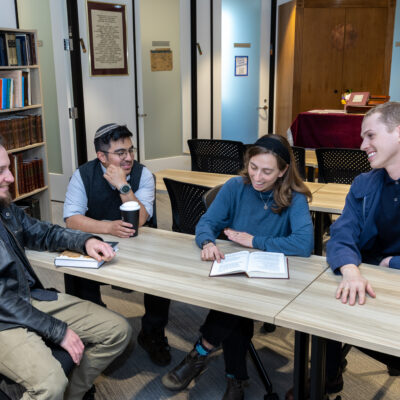
University students participate in Hadar Insittute's Manger Winter Learning Seminar in January 2026.




 Add EJP on Google
The Hadar Institute is making a push into Jewish campus life, announcing on Wednesday that it will place rabbis at three major universities across the Northeast for the coming academic year. The university expansion comes as part of an ongoing effort by the nondenominational egalitarian movement to extend access to its programming across every stage of Jewish life.
The three “Hadar campus rabbis” will be installed at Rutgers University, University of Massachusetts Amherst and New York University, in partnership with Hillel, the organization said. Beginning their roles this summer, the Hadar rabbis will be embedded within their local Hillel’s staff, an arrangement intended to complement existing Jewish student programming while expanding opportunities for Hadar-style egalitarian Jewish learning, prayer and other forms of communal life.
“There’s really no substitute for being on a campus in order to have a direct and sustained relationship and connection with college students,” Rabbi Elie Kaunfer, president and CEO of the Hadar Institute, told eJewishPhilanthropy. “So we reached out to some longtime partners on campus, and they were also excited about having more rabbinic support to bolster Hillel’s presence and work with students. It was the right moment to take this next step for a deeper connection to campus life.”
Founded in 2006 by Rabbis Kaunfer, Shai Held and Ethan Tucker, Hadar typically rejects conventional denominational labels, instead presenting itself as a values-based traditional egalitarian educational institution and movement.
With this expansion, Hadar will join the landscape of Jewish organizations active on university campuses. While university Hillel centers are typically nondenominational or pluralistic environments, other major campus Jewish organizations — including the Jewish Learning Initiative on Campus, Chabad and Meor — operate within an Orthodox framework or are affiliated with Orthodox institutions.
According to its five-year strategic plan, Hadar plans to have rabbis at five universities by 2028. Placing three instead of two in its first year puts the organization ahead of schedule, said Kaunfer, though the goal remains the same. In the coming years, Hadar also plans to launch a gap-year program and expand its community groups — small, peer-led, grassroots gatherings aimed at creating egalitarian “micro-communities.”
“College students are hungry for Jewish experiences that are both intellectually serious and genuinely welcoming, and that’s precisely what this partnership delivers. Having a Hadar campus rabbi as part of our team has enriched what we’re able to offer students in ways that feel organic and lasting, and we’re thrilled to see Hadar deepen its investment here,” Lisa Harris Glass, CEO of Rutgers Hillel, said in a statement.
Rabbi Noam Blauer, the incoming Hadar campus rabbi at Rutgers University, described his role as centered on relationship-building and empowering students from a range of observance levels to access Torah learning. Transitioning from a part-time role at Rutgers Hillel, said Blauer, he already has a close relationship with the Hillel community, where he will be embedded as part of the campus staff while remaining formally employed by Hadar, and will attend staff meetings for both organizations and serve in a liaison role between them.
“I will have an office at Hillel, a Hillel email, and a Hadar email,” he told eJP. “I really see myself wearing these two hats, which is amazing for me because I see them as two really incredible organizations, and I just feel blessed that I get to be a part of both of them.”
Related News
EXCLUSIVE
Detroit-based philanthropists Nancy, James Grosfeld donate $8M to renovate JDC’s Israel campus

PRESIDENTIAL REBUKE
Israel’s Herzog: Mamdani ‘makes no effort’ to hide disdain for Israel, Jews must fight back
CLOSING WORDS
In AZM address, Cosgrove links communal ‘orthodoxy’ on Israel to rising anti-Zionism among young Jews

EXIT INTERVIEW
Elizabeth Sokolsky, longtime EVP of Birthright Israel, to retire next year

MAJOR GIFTS
Center for Jewish History celebrates 25 years with a $25M matching grant