ONE YEAR LATER
A year post-USAID cuts, Jewish international aid groups still trembling from aftershocks
While private donors can't fill the role of government, for Jewish groups, 'philanthropy can actually step up to ensure that that ecosystem can continue to exist and can weather this difficult period and then come out stronger on the other end,' OLAM's CEO says
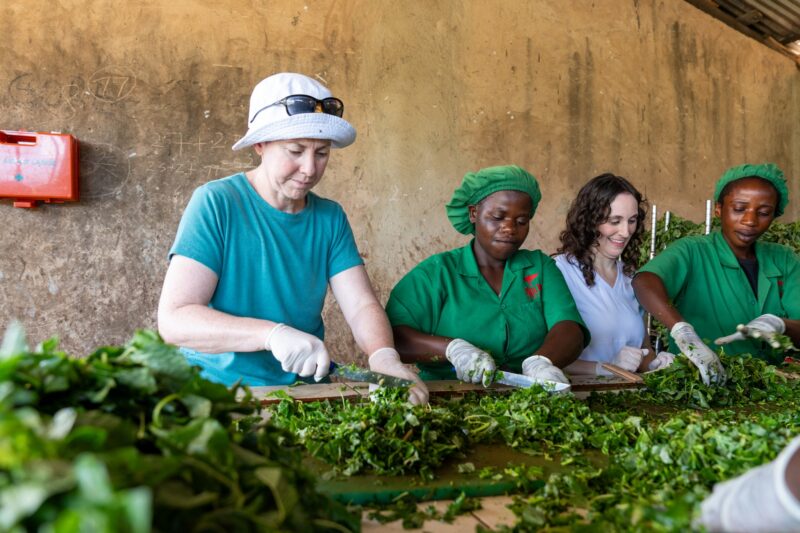
OLAM/Facebook
Members of an OLAM delegation volunteer with the hunger prevention nonprofit Soli d'Africa in Rwanda in March 2025.




 Add EJP on Google
On Jan. 20, 2025, Donald Trump was inaugurated for a second term and almost immediately issued an executive order freezing foreign aid for 90 days. Six weeks later, he cemented his actions by slashing 83% of U.S. Agency for International Development programs.
One year after the initial freeze, Jewish humanitarian aid and international development organizations are still trembling from the aftershocks, alongside their non-Jewish counterparts. As the number of deaths that researchers have connected to these federal funding cuts rises around the globe, the organizations supporting the world’s most vulnerable populations are adapting, finding new ways to fundraise and planning for a future experts say will never be the same, leaders in the field told eJewishPhilanthropy
“The dust has not yet settled,” Dyonna Ginsburg, CEO of OLAM, a network of Jewish organizations and individuals working in international aid, told eJP. Agencies are encountering knock-on effects from the reductions, where alternative funders, including several affiliated with the United Nations, had attempted to make up for the USAID funding but realized they couldn’t. Twelve months after the initial cuts, grants to international aid organizations are now being canceled. Additionally, the Trump administration continues to pare down what is left in foreign aid, as seen by U.S. withdrawal of support for 66 international organizations, agencies and commissions earlier this month, most of which were associated with the U.N. and focused on climate, labor and migration.
“Private philanthropy can probably not fill those gaps, at least not in the short-term future,” Ginsburg told eJP. “But for the Jewish ecosystem, which is still relatively small, Jewish philanthropy can actually step up to ensure that that ecosystem can continue to exist and can weather this difficult period and then come out stronger on the other end.”
Jews need to stake their presence at the global table, she said, especially because Jewish aid organizations are often the face of Judaism to international communities. “For us to retreat from that in a moment where combating antisemitism is at the forefront of many people’s minds, that would be a mistake.”
For Jewish organizations in the humanitarian aid and international development field, the past year has been particularly challenging, according to Ginsburg. “This is a compounding crisis, because many of these organizations…experienced funding cuts due to philanthropic shifts, Jewish philanthropy moving towards Israel or combating antisemitism and non-Jewish philanthropy distancing itself from Jewish or Israeli organizations doing this work,” she said.
Originally founded in 1961 by President John F. Kennedy, USAID served to exert “soft power” on the international stage during the Cold War by providing healthcare, education, clean water and combating diseases such as HIV, tuberculosis, malaria and polio. Between 2001 to 2021, USAID saved 92 million lives, according to an international study published in The Lancet. Already, over 600,000 people are believed to have died because of the cuts, reported public health researcher Atul Gawande, a former assistant administrator of USAID in the Biden administration now working at Harvard University’s T.H. Chan School of Public Health. The Lancet study estimated that an additional 14 million people will die by 2030.
Another ripple effect of the cuts is that authoritarian governments around the world have been emboldened to make their own policy cuts and crack down on human rights, Shari Turitz, vice president for programs at American Jewish World Service, told eJP. Because of this, 40% of AJWS partners report feeling less safe and secure, she said.
Still, the international aid workers and organizations on the ground are resilient and adapting to the current landscape, Turitz said. No AJWS partners have shuttered due to the cuts. “We are already seeing organizations coming together and saying, ‘What did we do before we had all this money? We need to go back to those first principles,’” she said
To get by, AJWS partners have cut staff, decreased their geographic footprint and partnered on fundraising initiatives and shared administrative support with other organizations. One AJWS partner, the Bar Hostess Empowerment and Support Programme, which supports Kenyans susceptible to HIV, has shifted its focus to health drop-in centers, allowing a mixed-income model in which the general population pays regular fees, allowing the organization to subsidize services for those in need. Another Kenyan grantee, who lost 70% of its funding from the USAID cuts, Empowering Marginalized Groups for Climate Justice and Sustainable Growth, has invested in small businesses to generate funding.
Between 2001 and 2024, the U.S. government invested over $9 billion in Kenya, according to Kenyan newspaper the Daily Nation, reaching 1.3 million people with antiretroviral medicine. “The impact [of the USAID cuts was] immediate and devastating,” according to Maurine Murenga, executive director of AJWS-partner the Lean on Me Foundation, which supports adolescent girls and young women with HIV, told eJP.
“Community-led services stopped. Drop-in centers closed without clear referral pathways. Prevention programs targeting young women, including PrEP, HIV counseling and sexual health services, were suspended. Thousands of doctors, clinical officers, nurses, laboratory technologists and community health workers funded by PEPFAR [which was implemented by USAID] lost their positions,” Murenga told eJP.
“The supply chain broke down. HIV test kits, viral load tests and Early Infant Diagnosis materials began running low, with stockouts expected within days. Sample transportation to laboratories was disrupted. For pregnant women living with HIV, services critical to preventing mother-to-child transmission were affected, putting both mothers and babies at risk.”
Even before the cuts, the need was devastating, David Weisberg, executive director of World Jewish Relief USA, told eJP. The British organization began operating a U.S. branch in 2023 and continues to be primarily funded through philanthropy from the United Kingdom. “A good part of the reason why World Jewish Relief was launched in the U.S. is because the needs only continue to grow. The needs exceed the capacity of just the U.K. community to be able to support the work… Even though [the USAID cuts did] not [affect] us specifically as an organization, we learned that when the government is not doing that thing that’s of value to you, sometimes you have to do it yourself.”
Several funders doubled down on their investments over the past year, Turitz said, including non-Jewish funders putting money behind human rights and gender-related initiatives, including The Gates Foundation and MacKenzie Scott.
Individual memberships to OLAM spiked over the past two years, first post-Oct 7 and then post-layoff, when a third of individual members lost their jobs. Some found new positions in international aid; some transitioned to different roles at Jewish organizations; some left the field completely, and some are still searching for work. OLAM serves as a matchmaker between members and Jewish organizations seeking board members and mentors for employees, allowing members to buff up their resumes and retain their identities, which have been built around aiding others.
Ariella Bock, a member of the OLAM network, found out she lost her job working at USAID a week after the freeze. She was told that her benefits would be cut off in 12 hours, and she didn’t receive severance pay. After losing her job, she turned to OLAM, which she had heard of before but never sought out. It offered her a “safe space” with other Jews in similar positions in a post-Oct. 7, post-USAID world.
In the months that followed, Bock founded Aid on the Hill, which advocates for foreign assistance, along with other former USAID employees, some of whom are also connected to OLAM. Initially, it was just “a way of getting off the couch,” she told eJP.
Recently, Aid on the Hill lobbied Congress to approve a bill that appropriates $50 billion to the State Department for foreign assistance. Already approved by the House of Representatives, the bill is awaiting a vote in the Senate.
“I am hopeful,” she said about the future of the U.S. international aid. “I want to be optimistic. It’s hard. People don’t get into development being pessimists.”
No matter what happens over the next three years under the Trump administration and even after a new president takes office, “We’re not going back to where we were before,” Turitz said. “That is absolutely clear.”
No matter what, the Jewish community cannot turn away from those in need, Weisberg said. “We have an obligation not to be insular and to look at where we can make impact around the world, both for those who are like us and those who are nothing like us.”
Related News
CLOSING WORDS
In AZM address, Cosgrove links communal ‘orthodoxy’ on Israel to rising anti-Zionism among young Jews
ADVANCING A VISION
N.Y. federation donates $1M toward building shared-society center named for peace activist killed on 10/7
PRESIDENTIAL REBUKE
Israel’s Herzog: Mamdani ‘makes no effort’ to hide disdain for Israel, Jews must fight back
EXIT INTERVIEW
Elizabeth Sokolsky, longtime EVP of Birthright Israel, to retire next year

MAGICAL EXPERIENCE
Shefa launches psychedelics retreat for Jewish professionals suffering burnout