Q&A
Inside The Harry and Jeanette Weinberg Foundation’s big bet on Baltimore
Sarah Manekin, head of the foundation’s Baltimore grantmaking, hails drop in the city's murder rate, an effort that her organization helped support
SCREENSHOT
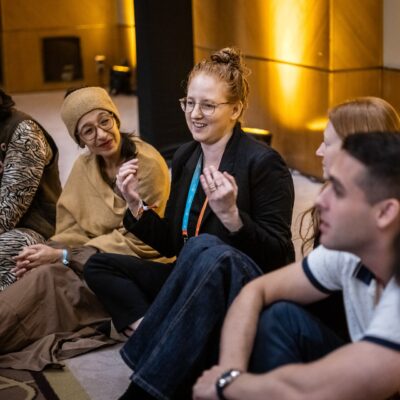
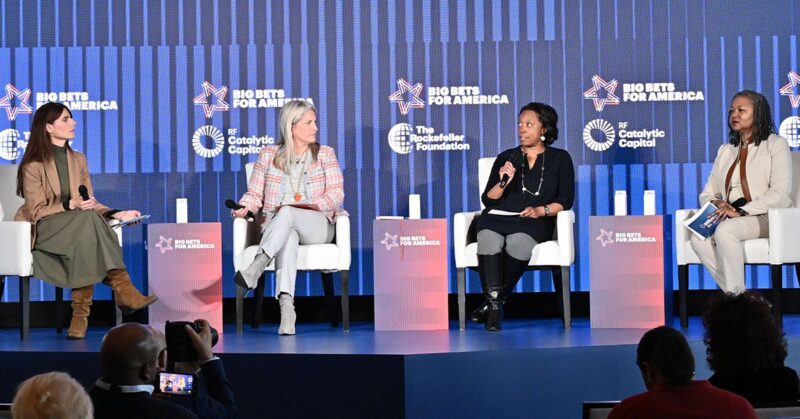
Meg Fosque of the Rockefeller Foundation, Rachel Monroe of the Weinberg Foundation; Shanaysha Sauls, of the Baltimore Community Foundation; and Tonia Wellons, of the Greater Washington Community Foundation speak at the Big Bets for America conference in Baltimore in April 2026.




 Add EJP on Google
The Baltimore-based Harry and Jeanette Weinberg Foundation is one of many large Jewish foundations with local footprints. Last month, the foundation participated in “Big Bets for America: Baltimore,” a conference hosted by the Rockefeller Foundation that rallied 250 changemakers from the city to plan for its future — and celebrate their accomplishments, including the city’s plummeting homicide rate.
“We are really proud of some of the great work that has happened in Baltimore, and that is getting recognition,” Sarah Manekin, the foundation’s managing director for Baltimore grantmaking, told eJewishPhilanthropy. “There’s no reason for us to try to reinvent the wheel,” she said about learning from partners in the field.
During Harry Weinberg’s 82 years on earth, he journeyed from the Austro-Hungarian empire to Baltimore, made stops in Israel and Northeastern Pennsylvania and eventually settled in Hawaii, where he lived for the final 22 years of his life.
A blunt businessman who went from slinging newspapers to making millions in transportation and real estate, Weinberg, who died in 1990, left his entire estate — minus $3 million for his grandchildren — to a $1 billion family trust investing in the people and places that shaped him.
Baltimore particularly shaped Weinberg, who moved to the city in 1911 after his family immigrated to America from Galicia, in what is now Ukraine. Today, Baltimore is home to the foundation’s headquarters, with a second office in Honolulu. Twenty-five percent of the foundation’s $140 million annual giving is invested in combating poverty in Baltimore by supporting housing, health, jobs, education and community services.
Manekin spoke with eJP about the foundation keeping its ears to the ground locally, changes in Baltimore’s philanthropic world after the 2015 Freddie Gray riots, combating generational poverty and TEN: Together Ending Need’s impact in the city.
The interview has been edited for length and clarity.
Jay Deitcher: In Judaism, there’s a theory that people should give tzedakah based on concentric circles where individuals support one’s immediate family, then one’s extended, then one’s community, other communities, one’s country and then the world. In the diaspora, Jews exist within so many communities. How does the Weinberg Foundation weigh the communities it exists within and where to focus its giving?
Sarah Manekin: I love that Torah. We’ve been around for a while, and we’ve funded in Baltimore since the beginning and also in Israel, [Hawaii, New York City and Northeastern Pennsylvania,] but as the foundation has grown over time, we’ve engaged other priority communities, and we’ve funded some work nationally.
At our core, we also understand that we have the opportunity, the responsibility, to be as deep and as connected to the communities where we live and where we serve as possible. Baltimore is my home. It’s been my family’s home, and I think that the opportunity to really listen closely and be part of and be connected to that community is really important to how we think about our opportunity for impact and supporting people in our community.
JD: How do you, as a large foundation, keep your ears close to the ground to find local partnerships in the communities you serve?
SM: We’ve been here for a long time. We have a lot of longstanding, deep relationships with organizations and organizational leaders. The Associated Jewish Federation of Baltimore, for example, we’ve been in partnership for a very long time. Some of it is staff-to-staff — that’s one way that we kind of keep abreast of what challenges their clients are seeing, what the community is facing.
As we develop our refresh of a Baltimore strategy, we are doing two community listening campaigns, where we work with consultants around trying to make sure that we are proactively connecting with neighborhood leaders and community activists around things that matter to them.
There are a couple of organizations that we partner with [such as GreenLight Fund and The Baltimore Children and Youth Fund] that do really community-led grant making, and they have in-depth processes of how they [hold listening campaigns] and how they develop strategy. So we partner with them, and they share some of what they hear so that we are able to support them and their work, but also not overburden, overtax [community leaders who are speaking out].
We talk with our grantees a lot, whether it’s through the reports that they submit or the applications they submit. We go to celebrations and graduations of programs that we’ve supported. We hear from young people about their experiences in the program. There’s a lot of ways that we try to show up and be a part of the community.
JD: In 2022, Baltimore had the second-highest murder rate in the country, and since then, that murder rate has plummeted at a faster rate than the rest of the country. What interventions do you see that are making an impact?
SM: There’s been a tremendous effort on the part of countless people in Baltimore from the active community activists on the streets to the violence interrupters who are going out in neighborhoods to the folks who are visiting the [The R Adams Cowley Shock Trauma Center at the University of Maryland] and doing interventions there to organizations that are providing wraparound supports to the state’s attorney’s office to the mayor’s office to the gun violence reduction strategy to the change in how the police are policing.
All of these things have made a profound impact. I’m not a criminologist to know which one of those things is causal the most, but we are deeply grateful and thankful that they’ve succeeded in saving lives to the extent they have.
JD: It’s also been a decade since the killing of Freddie Gray and the riots after. How have you seen the Baltimore philanthropic world change in that time?.
SM: It had a profound impact on all of us in Baltimore and other places. George Floyd, five years later, also had an impact on how folks thought about opportunity and who had access to opportunity and who didn’t and some of the structural and systemic barriers to opportunity.
In Baltimore, what we’ve seen in the past decade [is] more public funding [for] out-of-school-time programs [including] summer programs. But I also know from the dates of that support that most of the public funding actually came through [Elementary and Secondary School Emergency Relief] as a COVID response measure more than a response to Freddie Gray.
You have a lot of more attention [on] trying to create opportunities and on-ramps for young people, and some of the ways in which some neighborhoods have experienced such deep generational disinvestment, wealth extraction, and thinking about how communities can help lead some of the efforts around development of their communities and how public and private dollars can come alongside to accelerate some of those efforts without displacing existing residents.
JD: I know you’ve worked in Baltimore nonprofits for that entire time. Do you think it changed how the Weinberg Foundation works with the community?
SM: One of the things that the Weinberg Foundation did right before Freddie Gray, but then it really accelerated that summer after, was the summer funding collaborative. The Weinberg Foundation was really at the core, working with the Casey Foundation and the Family League of Baltimore at the time, to really try to create a mechanism that many different kinds of funders could use to put money into summer programming.
This summer, we’re going to have the most private dollars supporting summer opportunities that we’ve had, around $5 million.
JD: If you could give other nonprofits one lesson from what you learned from supporting Baltimore, what would it be?
SM: We still have a lot to learn. We’ve made great strides. It’s really powerful when you can listen to what communities need, what they want to see, and then there is this alignment in public, private funders that they can help accelerate some of that.
There’[re] still generations of poverty and disinvestment and trauma and, yes, there’s tremendous resilience and there’s tremendous grit, and there are tremendous leaders who have stuck it out. It’s generational work and our hope is to support the people doing the hard work on the ground and try to accelerate good solutions, where we can try to catalyze other investment and just be in partnership with our community.
JD: Talk about how TEN: Together Ending Need, which was founded by the Jewish Funders Network and the Weinberg Foundation and supports financially vulnerable Jews, impacts Baltimore.
SM: It created awareness that there were economically vulnerable Jews, which isn’t always something people know. By creating that awareness, it also helped shine a light on opportunities and ways to support them. That’s some of what we’re seeing play out in Baltimore in how agencies within the Associated [Jewish Federation of Baltimore], for example, are paying more attention to how they’re supporting economically vulnerable Jews and also thinking about cultural competence across different elements of the social services infrastructure.
One of the things that I think about in particular are older Jewish adults who are economically vulnerable, who are living on fixed income and who are worried about their apartment communities or they own their homes, and they’re worried about their ability to sustain changes in taxes, changes in heating bills. [I think] about how we can support a safety net for them, just as we think about supporting a safety net for people across Baltimore who have different religious and racial backgrounds.
JD: What do you think other nonprofits could learn from your experiences dealing with generational poverty?
SM: We’ve learned over the years that workforce training programs can be wonderful, and they can have the right curriculum, the right teachers, the aligned skills to industry, but the two biggest barriers in Baltimore to successful workforce completion programs are childcare and transportation costs.
We[’ve] learn[ed] that from people who’ve gone through the programs and say, ‘I want to do this, but I don’t have a place to take my kid.’ As foundations and public systems listen to those experiences and can help solve those barriers, we will all be more successful.
Related News
ADVANCING A VISION
N.Y. federation donates $1M toward building shared-society center named for peace activist killed on 10/7

MAGICAL EXPERIENCE
Shefa launches psychedelics retreat for Jewish professionals suffering burnout

MAJOR GIFTS
Center for Jewish History celebrates 25 years with a $25M matching grant
EXIT INTERVIEW
Elizabeth Sokolsky, longtime EVP of Birthright Israel, to retire next year
PRESIDENTIAL REBUKE
Israel’s Herzog: Mamdani ‘makes no effort’ to hide disdain for Israel, Jews must fight back