INSIDE STORY
Why a real estate developer donated a $100 million high-rise to Chabad of California
The building will become Los Angeles’ Chabad Campus for Jewish Life, a 300,000-square-foot campus housing spaces for community needs ranging from life cycle events to youth and senior programming
courtesy/Chabad
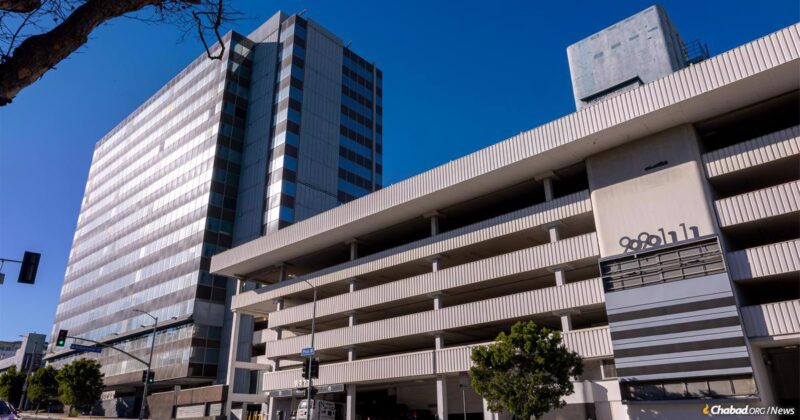
A complex, located at 9911 W Pico Blvd. in Lost Angeles, which was gifted to Chabad of California for a new Jewish life center in January 2026.




 Add EJP on Google
For nearly two years, Chabad of California had been looking for a building to purchase to significantly expand its operations in the Los Angeles area. In July, the organization thought it had found a place that fit the bill, and last week, an hour before Shabbat, they hung a mezuzah by the front door of the 16-floor corporate tower on a 1.3- acres lot in the heart of Los Angeles’ Pico-Robertson neighborhood.
Although the timeline was not dissimilar from that of a typical real estate deal, the circumstances were. The property was donated by prominent Los Angeles real estate investor Alon Abady, a managing partner of Waterfall Bridge Capital, who is perhaps best known for brokering luxury properties for celebrities, including Simon Cowell and Justin and Hailey Bieber. According to Chabad officials, the property was appraised last year at $103 million.
Abady had purchased the then-vacant Pico-Robertson property for $35 million in 2023, in a deal that included an additional property swap, Rabbi Chaim Cunin, CEO of Chabad of California, told eJewishPhilanthropy. (The previous purchaser paid $94 million for the building in 2007.) In honor of his mother, Abady and his wife, Monique, transferred all of their equity in the building to Chabad, which will be required to pay for only the remaining debt — $16 million for a property worth several times more than that.
The donation — notable for both its size and the unusual circumstance of a philanthropist gifting an entire high-rise — came as a surprise to Chabad, Cunin said. The 300,000-square-foot building, which will be dubbed the Chabad Campus for Jewish Life, will be among the largest Jewish centers in the world.
“This is a lifelong dream that also allows me to honor my parents and my children,” Abady said in a statement. “When my family immigrated to Los Angeles in the 1970s [from Syria], Chabad was there for us. That was never forgotten.”
The real estate investor added that the donation “reflects our deep commitment to the Los Angeles community of all faiths and backgrounds, and our desire to leave a lasting impact that will endure for future generations. The Abady Family Center, owned and operated by the Chabad Campus for Jewish Life, is intended not only as a physical home for the Los Angeles community, but also as a platform for growth, adaptability and long-term community benefit.”
Portions of the building will be put to use immediately, while others will require renovation in order to put them into service.
The center will also serve as a catch-all for Jewish life in Los Angeles, housing “a synagogue; Jewish life-cycle venues; youth and senior programming; educational facilities; support for thousands of Jewish students on college campuses; and infrastructure for large communal gatherings and international events,” according to a statement, as well as specialized programming for children with special needs, services for California’s growing aging population and a museum of “Jewish history, heritage and the story of the Land of Israel.”
According to Cunin, Chabad of California began searching for a space several years ago to expand access to Jewish day schools in Los Angeles. After Oct. 7, 2023, amid a surge of interest in Jewish life, that search became a more pressing priority, he said. Chabad explored a number of options, among them the American Jewish University campus in Los Angeles, which was ultimately sold to the Milken Community School in 2024.
When Chabad heard about a property in Pico-Robertson that could house what they were envisioning, they tried to find someone to connect them with Abady, the owner. “We didn’t know that we knew anyone that knew him,” said Cunin. “We were looking for someone that might be able to make an introduction, and we finally found someone that would.”
The connection contacted Abady to see if he would be open to even discussing the campus. The conversation quickly shifted. “A couple of hours later, the one who made the meeting called myself and my brother, and he said, “I hope you both are sitting for this one, because this was the most remarkable meeting of my life,”’ Cunin told eJP.
It turns out that while Cunin did not know Abady, Abady knew Cunin — or at least Rabbi Chaim Cunin’s father, Rabbi Baruch Shlomo Cunin.
In the 1970s, when Abady and his family immigrated to Los Angeles, they struggled, said Cunin. At the time, Chabad offered them housing, and employed Abady’s mother, Liora, as an assistant chef at Chabad’s newly established treatment center for recovering alcoholics. “[Abady] said, the blessings that they have benefited from over all these years can be attributed back to that kindness,” said Cunin. “That allowed them to rebuild their lives with dignity.”
After crossing paths in the 1970s, Abady and the elder Cunin did not stay in contact. “He keeps a very low profile, and I never knew him or met him prior to this,” Cunin said.
To what extent the campus will host other Jewish organizations is also an ongoing conversation, Cunin told eJP.
“That’s also very much a part of the conversation and part of our internal discussions. There are wonderful opportunities [for] putting this campus to use for the entire community and for many other related organizations that could greatly benefit, and the community could greatly benefit from having their home in our center,” he said.
While some floors are immediately being pressed into service, readying the rest of the building for use will be a lengthy undertaking, said Cunin. One step Chabad has already taken is affixing mezuzahs to the doorframes of the spaces that will be in immediate use. By the time the full building is operational, they will need many more, which Cunin said presents its own logistical challenges.
“We already talked to our local mezuzah supplier, because it’s quite a few,” he said. “We put [a mezuzah] on one of the floors where we have a makeshift setup. But there are hundreds, maybe thousands…Actually, I don’t know. But definitely hundreds of doors throughout the campus.”
Related News

MAGICAL EXPERIENCE
Shefa launches psychedelics retreat for Jewish professionals suffering burnout
EXIT INTERVIEW
Elizabeth Sokolsky, longtime EVP of Birthright Israel, to retire next year

MAJOR GIFTS
Center for Jewish History celebrates 25 years with a $25M matching grant
HIGHER EDUCATION
As Jewish donors reconsider academia, Jan Koum doubles down, endowing Israel studies at Stanford
CLOSING WORDS
In AZM address, Cosgrove links communal ‘orthodoxy’ on Israel to rising anti-Zionism among young Jews