NATIONAL FUNDING
KKL-JNF approves $598 million budget for 2026, along with millions in wartime allocations
New annual budget includes increases for land management and education, a highly unusual allocation for the Druze community of southern Syria and — in a rare move for the organization — a decrease in overhead costs
Noa Azar/KKL-JNF
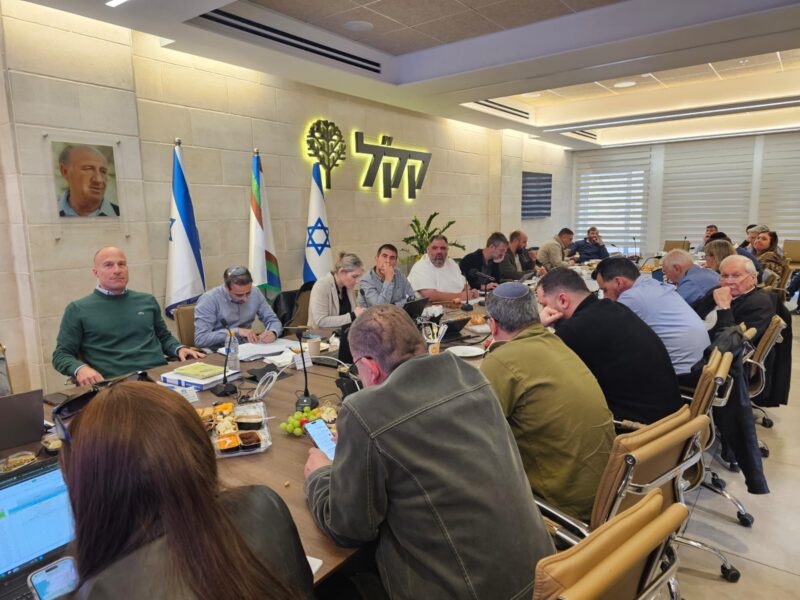
The KKL-JNF Board of directors meets to approve aid for Beit Shemesh and Beersheva in March 2026.




 Add EJP on Google
As Eyal Ostrinsky, chair of Keren Kayemet LeIsrael-Jewish National Fund, discussed the organization’s allocations in recent weeks, in a conversation with eJewishPhilanthropy this week, he repeatedly realized that there was something else he wanted to share, peppering the conversation with “oh, and one more thing,” “I nearly forgot” and “I also have to mention” — a sign of both the recent flurry of activity by the KKL-JNF board and the growing needs of the country, as the war with Iran and Hezbollah drags on, exacting a heavy toll.
Most significantly, last week, the KKL-JNF board unanimously approved the organization’s NIS 1.87 billion ($598 million) budget for 2026, which includes increases for land management and education, a highly unusual allocation for the Druze community of southern Syria and — in a rare move for the organization — a decrease in overhead costs.
The passage itself was a point of pride for Ostrinsky, who said he hoped to get the budget approved within two months after he was appointed to the role in early January. “We are doing things through dialogue. We are working with everyone, even with [the religious Zionists], the Likud, the Haredim,” he said.
But in addition to the overall budget, the KKL-JNF board has also approved a number of emergency allocations in recent weeks, directly connected to the ongoing war with Iran and Hezbollah, the latter of which is again pummeling Israel’s hard-hit northernmost communities.
In light of major missile strikes in the central Israeli city of Beit Shemesh and southern city of Beersheva, KKL-JNF allocated NIS 2.5 million ($800,000) last week in emergency aid to each municipality. A portion of that will go to funding emergency support on the ground, while another NIS 1.5 million ($480,000) will go to fortification-related initiatives, based on the needs of the city. In Beersheva, Ostrinsky said, the funds will go toward improving public bomb shelters, where residents who do not have fortified rooms in their homes or buildings have been taking cover from Iranian attacks. In Beit Shemesh, the city found that there was a need to install small portable bomb shelters in parts of the city that did not have sufficient fortifications.
Earlier this week, KKL-JNF allocated NIS 7 million ($2.3 million) for northern communities. Unlike in Israel’s fall 2024 war against Hezbollah, in this conflict, the northern kibbutzim, moshavim and villages along the border with Lebanon have not been evacuated. Many Israeli leaders — including Ostrinsky and most northern mayors — believe that this was the right choice, particularly in light of the lingering challenge of getting evacuated residents to return to those communities. But this means that Israelis living in these communities, which are regularly being targeted by drone and missile fire from Lebanon, are forced to spend long stretches holed up in bomb shelters. “We spoke with local mayors to understand their needs,” Ostrinsky said. “There’s no evacuation this time, so they need respite.”
The bulk of the funding — NIS 5.5 million ($1.8 million) — will therefore go toward funding vacations for roughly 5,000 of northern residents, providing them with a few days of relaxation in hotels in less-targeted parts of the country over the Passover holiday. The remaining NIS 1.5 million ($480,000) is allocated for “humanitarian cases,” those who need to temporarily leave because of the Hezbollah attacks, Ostrinsky said. He noted that, for now, this will cover relocations for “days at a time — we can’t afford weeks at this point — but if needed, we’ll consider expanding.”
In addition, the organization, in partnership with the Jewish Agency, is providing NIS 2.5 million ($800,000) to Masa Israel as some 900 participants of its programs are unable to leave the country due to airspace closures in light of ongoing Iranian attacks. The amount is being matched by the Israeli government in order to cover the unexpected costs of having those participants stay in the country at least through the Passover holiday.
“As soon as we appreciated the extent of the crisis where hundreds of students will remain in Israel during a time when they would typically be on vacation and not in a supervised structure, we knew we needed to find a solution,” Roi Abecassis, deputy chair of KKL-JNF and the top representative of the religious Zionist World Mizrachi movement in the so-called National Institutions. “We are deeply grateful that KKL, together with our partners, recognized the nature of the challenge and are providing this critical funding to continue to operate during these difficult times.”
In the regular 2026 budget, nearly half — NIS 870 million ($280 million) — will go toward funding the organization’s own activities, an increase of roughly NIS 100 million from last year. These funds will go toward greater land management operations — part of Ostrinsky’s return to the traditional KKL-JNF focus on Israeli forests, as well as war-related reconstruction efforts — and an expansion of KKL-JNF’s educational programs, both in Israel and in the Diaspora.
This includes NIS 30 million ($9.63 million) for recovery efforts in Kibbutz Manara, on the Lebanese border, including the development of a new neighborhood in the community, as well as another roughly NIS 60 million ($19.3 million) to develop new communities around the southern town of Arad and to bolster Arad itself.
This budget increase includes additional funds for youth movements, pre-army programs, garinei Nahal (which combine military service with community-building), kehilot messimatiot (mission-driven communities) and other informal education initiatives.
In the wake of last week’s Temple Israel attack in suburban Detroit, KKL-JNF doubled its funding for security initiatives in Diaspora communities from NIS 3 million ($960,000) to NIS 6 million ($1.93 million) and approved an additional NIS 20 million ($6.42 million) for campus security programs and community emergency readiness programs worldwide.
The organization is also growing its fundraising and external relations budget by 10%, from NIS 80 ($25.7 million) to NIS 88 million ($28.3 million), and is increasing funding for its IT systems by nearly NIS 10 million ($3.2 million).
Ostrinsky was also particularly proud of the decrease — albeit an admittedly modest one — in the overhead costs for the organization, which is notoriously bloated and regularly alleged to be rife with corruption and cronyism. “It was very important to me to make [overhead costs] smaller,” Ostrinsky said, noting that in the preceding five years, those overhead costs — for salaries and job perks, like cars — increased from NIS 400 million ($128 million) to NIS 645 million ($207 million).
“There was an explosion,” he said. “I am stopping it. For the first time, we are lowering our overhead from NIS 645 million to NIS 640 million ($205 million).” While he acknowledged that the decrease was modest, he said that it was more important that the organization “stopped the growth” in overhead costs.
Another roughly NIS 370 million ($119 million) will go to funding for the World Zionist Organization and Jewish Agency for Israel — another increase from last year.
With the new budget, KKL-JNF is also shifting how it funds informal education programs from focusing on the socioeconomic level of the city, as it currently does, to the socioeconomic level of the population. So instead of funding programs only in “weak cities,” KKL-JNF will also fund programs in weaker neighborhoods of overall better-off cities, such as Rehovot and Netanya, Ostrinsky said.
KKL-JNF will also begin funding the religious pluralism organization Panim, which was initially backed by the Diaspora Affairs Ministry, under former Minister Nachman Shai, and provides financial support to non-Orthodox religious initiatives in Israel, but had its funding cut by the current government. “It was important for us to support it,” Ostrinsky said.
A comparatively modest but nevertheless significant line item in the budget is a NIS 2 million ($640,000) allocation to support the Druze community in southern Syria — representing one of the only times that KKL-JNF is supporting a non-Jewish community abroad. Ostrinsky said he was driven to provide funding for the community in light of both the longstanding ties between Israel and its Druze community and the attacks on the Druze by Islamist groups last year.
“I see the connection between [the Druze] and Zionism as something that is not just strategic but moral,” Ostrinsky said. “If they are our partners, we need to support them.”
Ostrinsky said that he visited the Syrian Druze community recently, hearing accounts of the atrocities committed against them by Syrian government-aligned forces and outside militias. “It’s crazy,” he said. “They cut off their beards. [People] did that to Jews in the past.”
The NIS 2 million allocation will go to three areas: NIS 500,000 ($160,000) for emergency supplies; NIS 750,000 ($241,000) for public advocacy; and NIS 750,000 to facilitate more delegations from Israel to southern Syria, with the goal of raising awareness and additional funds for the community. “That is money so that they can bring in more money,” Ostrinsky said.
“I am very, very proud of [the allocation]. It goes beyond the muvan me’elav,” he said, using a Hebrew term meaning “what is expected from itself.”
Separately, he said, KKL-JNF is also allocating NIS 700,000 ($225,000) to support national service programs for Druze residents of the Golan Heights, a community that traditionally kept its distance from Israel and maintained loyalty to Syria, but which is now reconsidering those affiliations with the fall of the Assad regime. “There’s a one-time opportunity to strengthen their connection to Israel,” Ostrinsky said.
Related News
HIGHER EDUCATION
As Jewish donors reconsider academia, Jan Koum doubles down, endowing Israel studies at Stanford
EXCLUSIVE
Detroit-based philanthropists Nancy, James Grosfeld donate $8M to renovate JDC’s Israel campus

PRESIDENTIAL REBUKE
Israel’s Herzog: Mamdani ‘makes no effort’ to hide disdain for Israel, Jews must fight back
ADVANCING A VISION
N.Y. federation donates $1M toward building shared-society center named for peace activist killed on 10/7

MAGICAL EXPERIENCE
Shefa launches psychedelics retreat for Jewish professionals suffering burnout