NEXT GENERATION
In 1st interview, Toronto’s Kaelen Sherman discusses honoring parents’ legacy, inspiring her kids
With landmark donation for tuition assistance to local day school, the Canadian philanthropist looks to highlight her slain parents' generosity, commitment to Jewish education
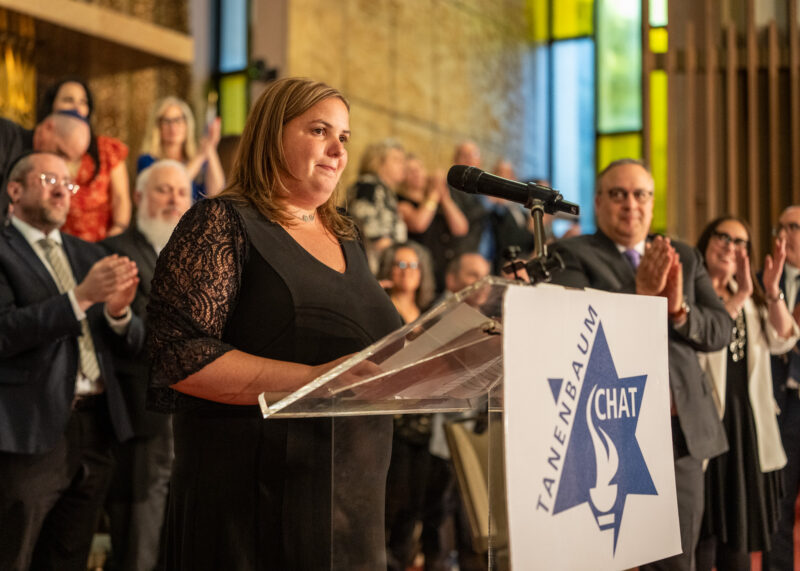
Courtesy/UJA-Federation of Toronto
Kaelen Sherman announces a CAD 25 million donation to Toronto's TananbaumCHAT community day school on June 17, 2026.




 Add EJP on Google
Years after graduating high school, Kaelen Sherman received an email from an old friend. Sherman grew up well-off — her father founded Canada’s largest pharmaceutical firm, Apotex Inc. — but her friend struggled financially. They fell off each other’s radars after high school, but after graduating from medical school, her friend reached out to thank her for her father’s generosity. Sherman’s dad had financially supported her friend’s education.
Sherman had no clue what her friend was talking about. Her father was famously frugal to the point that he flew economy and drove a hoopty. He had never mentioned the donations to her.
“People become very super successful, and then they’re in this stardom and can become so greedy. Totally opposite of what my dad was,” Sherman told eJewishPhilanthropy in her first media interview since her parents were murdered in 2017 (the crime remains unsolved).
On June 17, Sherman announced a CAD 25 million ($17.6 million) donation to establish a fund in memory of her parents, Honey and Barry Sherman. The endowment will provide tuition assistance to students of the Tanenbaum Community Hebrew Academy of Toronto in perpetuity. Sherman’s parents did not attend day schools themselves because their families couldn’t afford it, but after Barry founded his generic drug empire in 1974, the Shermans became two of Canada’s biggest donors, especially to the UJA-Federation of Toronto. Sherman hopes her donation models altruism to her children the same way her parents’ largesse did for her.
The donation, made through the UJA-Federation and housed in the Jewish Foundation of Greater Toronto, is the largest-ever donation to TanenbaumCHAT.
Although Sherman doesn’t hold an official leadership position at the federation, she is part of the “family” and is regularly in conversation with federation leaders about the greater Toronto community’s needs, Daniel Held, the federation’s chief program officer, told eJP.
The idea for the Honey and Barry Sherman Jewish Education Fund emerged from a meeting last year, after Sherman made a smaller — but still significant — donation of CAD 5.4 million ($3.8 million) to cap off a fundraising appeal for the federation’s Generations Trust Scholarship, which provides tuition subsidies for elementary day school families.
“What about the high schoolers?” Adam Minsky, the federation’s president and CEO, recalled Sherman asking at the meeting.
“It was really a pretty incredible moment for us to be sitting with a then-34-year-old who was prepared to take responsibility for this really important issue in our community, and that moment was seared in my memory and was very powerful to see her stepping into the shoes of her parents in a very special way,” Minsky told eJP.
Sherman’s parents both came from humble beginnings. Honey was born in a Displaced Persons camp in Austria to Polish Holocaust survivors before the family moved to Canada, and Barry was born in Canada to a zipper manufacturer and occupational therapist, but his father died of a heart attack when he was 10.
“Jewish education used to be a privilege,” Kaelen Sherman said, one that not everyone could afford. But today, as incidents of antisemitism in Canada soar, “Jewish day school is no longer a choice, but a necessity and almost a requirement. Children who can’t afford [to go] to Jewish day school end up in the public school system, and are now being bullied or whatnot for being Jewish. No kid should have to be put into that situation, regardless of financial status.”
Jews make up roughly 1% of Canada’s population, but according to police data are victims of 82% of religiously motivated hate crimes. Post-Oct. 7, antisemitism is at a record high in the country, and Jewish businesses and synagogues have been regularly shot at, vandalized and firebombed.
At the same time, Greater Toronto day schools have seen a surge of students. The 2025-26 school year had TanenbaumCHAT’s largest enrollment in over 15 years. UJA estimates that nearly 40% of Jewish students in greater Toronto attend day schools — but there still aren’t enough seats to satisfy demand.
Schools have lengthy wait-lists, especially TanenbaumCHAT, the largest Jewish high school in North America, according to UJA. This is in stark contrast to a decade ago, when the school was struggling.
In 2017, 873 students were enrolled in TanenbaumCHAT. That year, the UJA launched a five-year experiment to see how much lower tuition would affect enrollment. Supported by $14 million in gifts, UJA lowered the school’s tuition by a third, and today, there are nearly 1,500 students, with demand rising.
“We in Toronto have seen the power of work in affordability to dramatically grow our system,” Daniel Held, the federation’s chief program officer, told eJP.
The Honey and Barry Sherman Jewish Education Fund will make the school accessible to more students, especially those who haven’t viewed day school as an option in the past.
“It’s going to ensure continued growth and all of that is going to lead to further elevating academic excellence and hopefully more kids who want to go,” Jonathan Levy, TanenbaumCHAT’s head of school, told eJP. “It’s a virtuous cycle.”
After working at TanenbaumCHAT for 17 years, Levy is ending his tenure this year. The donation is “an amazing way to wrap up my work at the school and wish the school continued strength,” he said. “I hope that [TanenbaumCHAT] continues to welcome families in. I hope it makes it the standard that middle-income families can afford and apply for tuition assistance and get a little bit of help doing it.”
Education was important to her parents, Sherman said. They sent her and her three siblings to Jewish day school, and she plans to do the same with her children, once they are of school age.
“My parents believed deeply in the power of education,” Sherman said in a speech at last Wednesday’s TanenbaumCHAT graduation ceremony, where she announced the donation. “They believed that education creates opportunity, builds confidence, strengthens communities and changes lives. They also believed that when we are fortunate enough to succeed, we have a responsibility to help others succeed as well. They cared deeply about the Jewish community and understood that one of the greatest investments we can make is in the next generation. They knew that a strong Jewish future begins with a strong Jewish education.”
Her parents also believed that “no kid should be turned away from an education that they should have a right to because they can’t afford it,” she told eJP.
According to Forbes, Barry Sherman had a net worth of $3.2 billion when he died. At the Shermans’ funeral, Jack Kay, Apotex CEO and a close friend of Barry, described Barry as having “a mind like a steel trap and the stubbornness of a bull.” But both Barry and Honey were known in Canada for their altruism, giving tens of millions to universities and hospitals and tens of millions to Jewish causes, including the UJA, to which the couple gave CAD 50 million ($35 million).
“Her parents were among our most generous supporters, no doubt, but what really made them exceptional was their leadership,” Minsky said. “They were always leading from the front with their personal example, both in terms of generosity, but also in terms of leadership.”
The headquarters for the UJA-Federation sits alongside the Prosserman JCC, Jewish Family and Child Service and the Toronto Holocaust Museum on the Sherman campus, which now includes a two-acre Honey and Barry Memorial Park. Kaelen Sherman’s donation, Minsky said, “is the most beautiful embodiment of what her parents meant to me personally and to the whole organization and its volunteer and professional leadership.”
While her father “was a workaholic, as everyone knew,” she said, her parents taught her that even if you don’t have money, “you can volunteer your time.” Her mom chaired UJA fundraising campaigns, traveled the world on missions and assembled care packages for newborn babies.
“Giving money is the easy part,” Sherman said. What really matters is “becoming involved in the money that you’re giving and following up and seeing how that money is being used and impacted.”
When chatting with women in Moroccan villages, Sherman’s mother would look at the struggling local population and see reflections of herself during her youth in the Displaced Persons camp, Sherman said. “At the end of the day, we’re all people. Some people need more help than others.”
As a next-generation donor, Sherman envisions herself as a link in the chain her parents forged to strengthen the Jewish community. “Sure, I can honor my parents, but I think the biggest thing is that I’m also setting an example for my own generation and for my children.”
Related News
HIGHER EDUCATION
As Jewish donors reconsider academia, Jan Koum doubles down, endowing Israel studies at Stanford
ADVANCING A VISION
N.Y. federation donates $1M toward building shared-society center named for peace activist killed on 10/7

MAGICAL EXPERIENCE
Shefa launches psychedelics retreat for Jewish professionals suffering burnout

MAJOR GIFTS
Center for Jewish History celebrates 25 years with a $25M matching grant
CLOSING WORDS
In AZM address, Cosgrove links communal ‘orthodoxy’ on Israel to rising anti-Zionism among young Jews