Opinion
SPEAK UP
This is not politics as usual




 Add EJP on Google
In Short
Today’s candidates for political office are finding their Jewish identity and support for Israel at the center of the conversation in an unprecedented way.
This week, multiple campaign signs for Alma Hernandez, a Jewish Latina woman representing Tucson in the Arizona Statehouse and currently running for a seat in the state Senate, were vandalized. Splashed across the signs in large red letters were the words: “Zionist B*tch.” Both antisemitic and misogynistic, one word targets her as a Jew, while the other demeans her as a woman.
This is not politics as usual.
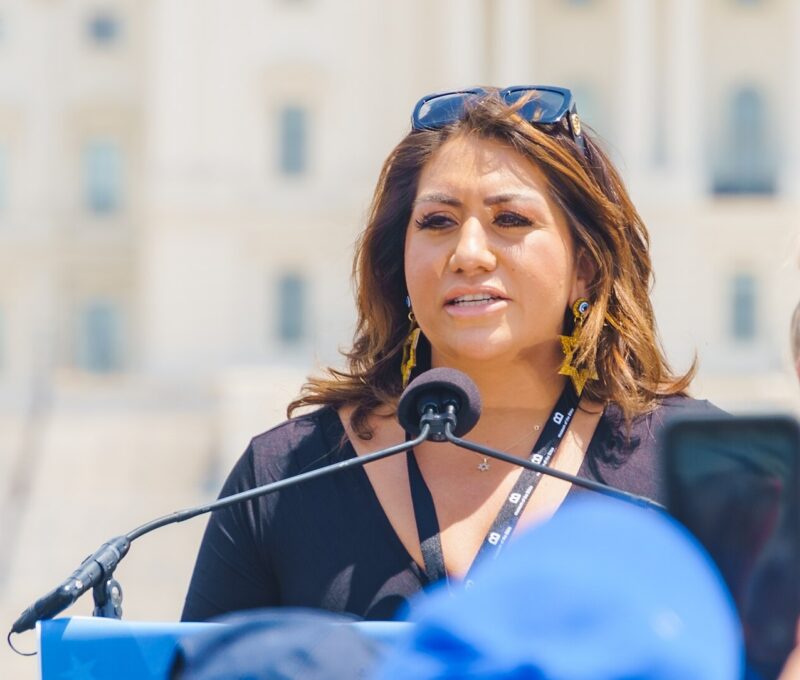
Ted Eytan/Wkiimedia Commons
Alma Hernandez speaks at No Fear: A Rally in Solidarity with the Jewish People, July 11, 2021, in Washington, DC. Featuring Elisha Wiesel, Arizona House Representative Alma Hernandez, Noa Tishby, Ysabella Hazan, Joshua Washington, Rabbi Shlomo Noginski, Blake Flayton, Meghan McCain Complete speaker list and additional information - https://nofear.combatantisemitism.org
I have spent much of my life participating in political campaigns, both as a volunteer and as a candidate, since I was a teenager, including my own run for Congress. Negative campaigning is nothing new. Candidates exaggerate accomplishments, misrepresent opponents, make unrealistic promises, benefit from opaque funding sources and sometimes lack the very qualities we hope to see in public servants. We may wish politics were different, but none of this surprises us. It is part of the imperfect reality of democratic life.
What is not normal is when candidates are singled out because they are Jewish.
What is not normal is when Jewish identity itself becomes the subject of political attack.
Post-Oct. 7, many of us in Jewish life have come to understand that allyship cannot be assumed; it must be cultivated with intention. At Jewish Philanthropies of Southern Arizona, we have embraced this responsibility through the Center for Jewish Resilience, which works to strengthen relationships, deepen understanding and advocate for the security and dignity of Jewish life. We champion safe schools, secure institutions, stronger Holocaust education, equal treatment for Jewish students, patients and employees and policies that protect the Jewish community. We also invest in relationships across political, religious and cultural divides because trust is built long before it is tested. We seek partners, not partisans, guided by the Jewish imperative of tikkun olam — repairing the world by strengthening the communities we share.
At the same time, we cannot become such good partners to others that we fail to stand up for our own community when it is under attack.
Most of this advocacy and ally-building work happens quietly, in conversations, meetings and relationships developed over years. Community relations is a marathon, not a sprint, and there is no finish line.
Occasionally, however, remaining behind the scenes is no longer sufficient.
Over the past several months, members of Tucson’s Jewish community have raised concerns about rhetoric in a local primary campaign that has placed Hernandez’s Jewish identity — particularly her Zionism — at the center of the political conversation. If the campaign rhetoric were about differences over taxes, education, healthcare or any other policy issue, the Center for Jewish Resilience would remain on the sidelines.
But when political rhetoric reduces a candidate to their Jewish identity — when it implies that being Jewish, including believing in the Jewish people’s right to self-determination, makes someone inherently suspect or less deserving of full participation in civic life — it ceases to be an ordinary political disagreement and becomes a challenge to the equal standing of Jews in the public square, one the Jewish community has a responsibility to confront.
History teaches us why this matters.
When public figures encourage suspicion toward people because of their identity, whether Jewish or otherwise, the consequences rarely remain confined to a single issue. Once identity itself becomes grounds for exclusion, prejudice becomes easier to normalize and discrimination easier to justify. The attack may begin with one aspect of a person’s identity, but it seldom ends there.
This makes it all the more important that institutions like CJR and individuals like you and me speak when silence would allow harmful patterns to become accepted. Advocacy is not about telling people how to vote. It is about drawing principled lines when members of our Jewish community are targeted because of who they are.
Regardless of one’s political views, no public discourse should imply that being Jewish — or embracing a belief widely held across the Jewish community — makes someone less worthy of participating in civic life. No one should ever have to disown one part of their identity to be accepted in another.
Years ago, I taught a college course on civil rights law. One of the most revealing aspects of that course was studying the legal reasoning that once justified discrimination. Students encountered court decisions arguing that women belonged in the home because that was supposedly God’s intended role for them. Those arguments were once considered persuasive. Today, they stand as reminders of how deeply flawed societies can become when prejudice disguises itself as reason.
The Jewish People have experienced versions of this throughout history. Again and again, false narratives have portrayed Jews as uniquely suspect, uniquely dangerous or uniquely undeserving of equal participation in society. Those ideas have led to discrimination, exclusion, violence, displacement and attempted annihilation.
We are witnessing another version of that pattern today. Increasingly, “Zionism” is being used not simply as a political position to debate but as a label that serves as permission to marginalize Jews. It has become an excuse to target Jewish students on campus, Jewish professionals in workplaces, Jewish leaders in civic life — and now Jewish candidates on the campaign trail.
For the overwhelming majority of Jews, Zionism is not an abstract political slogan. It is intertwined with Jewish peoplehood, history and identity. Treating that identity as inherently disqualifying does not simply affect one election or one candidate. It affects an entire community.
History has repeatedly shown that when good people remain silent, prejudice grows stronger.
Speaking up is not partisan. It is not a political strategy. It is our responsibility.
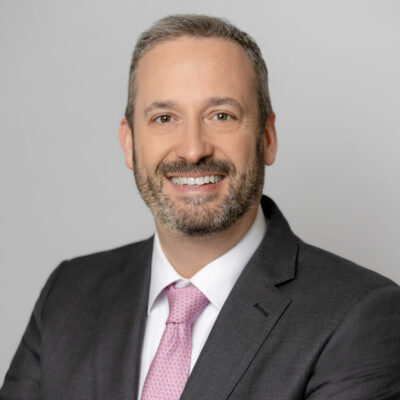
Hava Leipzig Holzhauer is the president and CEO of Jewish Philanthropies of Southern Arizona, founder of the Center for Jewish Resilience and a former leader of the Anti-Defamation League in Florida.