Opinion
MARKING A MILESTONE
Beyond the numbers: 1,000 days of trauma and mutual responsibility




 Add EJP on Google
In Short
A thousand days are only the beginning of a journey of recovery.
A thousand days. In a thousand days you can begin a bachelor’s degree, finish it and hold the diploma in your hand. You can meet someone, fall in love, marry and have a child, and that child will be already walking, talking, calling out for Mom and Dad. Seasons turn three times and then some. Governments fall and rise. People move cities, change careers and build a house from the foundation to the roof.
Nearly three years of life.
Felipe Wolokita
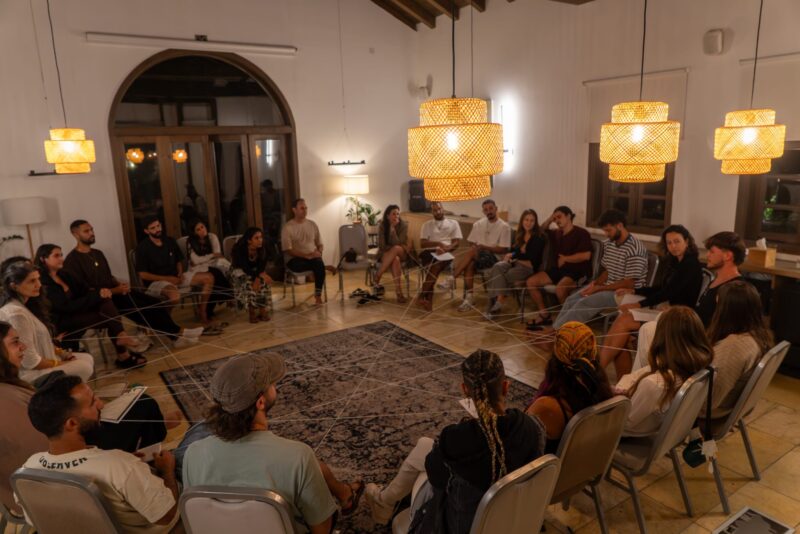
Retreat for survivors and their families.
But there is another way to look at those same thousand days. Seen through the eyes of a journey of emotional healing, the picture changes: A thousand days is almost nothing. It is far too short a time, especially when the war grants no respite.
The psyche knows no timetables. There is no moment when you cross a line and declare, “I am healed,” no finish line to cross to the sound of cheers. There are good days, and there are days when everything you have achieved collapses again in an instant. One trigger: a headline, a smell, a sound, a date. And for the survivors of Oct. 7, 2023, the journey is many times harder, because it does not unfold in a calm, peaceful space. It unfolds in a country that, for nearly three years now, is still at war, with hostages who came home after far too long, with many security fronts, with sirens, reserve duty and hard news breaking every day. How do you begin to recover when everything around you is still traumatic, and there is no stability?
A thousand days are only the beginning of a journey of recovery. Not its end. Not even its middle. Only the opening of a chapter that will accompany the survivors for years to come.
That morning, at 6:29 a.m., the massacre that changed everything began. Thousands of young people who had come to celebrate life found themselves fleeing under a hail of fire, seized by a terror without bounds. A total of 411 precious souls did not survive. To them were joined survivors whose souls were murdered on Oct. 7, Shirel Golan and Roi Shalev, of blessed memory, who could not bear what they had endured and chose to end their lives. For the thousands who survived the festivals, the massacre did not end when they came home; it became an ongoing journey of coping, of recovery and treatment.
Roughly 70% of the survivors experienced the massacre under the influence of psychedelic substances, a condition that gave the trauma a distinct character, one that demands specific professional expertise to answer correctly. On the afternoon of that very day, the Lev Batuach (“SafeHeart”) association was born, founded as an emergency initiative by therapists, clinicians and scientists from within the safe space and festival community, to support survivors through mental health care informed by psychedelics, delivered by therapists who come from that community themselves. Recognizing the uniqueness of the survivors’ situation, what began as an emergency initiative quickly became a long-term national treatment network, working closely with the authorities, the National Insurance Institute, the Ministry of Health and the Ministry of Welfare.
Today, after 1,000 days, our network accompanies more than 1,000 survivors through 400 professionals: experts in trauma and in care informed by psychedelics, psychologists, psychiatrists, social workers and arts therapists, working across the country. Because healing the psyche is never only psychological, we built a complete circle of support around the individual care: a team for complex cases and emergencies, body and mind therapies, therapy groups, retreats and support for families. The association is also leading groundbreaking research, in partnership with the University of Haifa and headed by professor Roy Salomon, into how trauma forms with and without altered states of consciousness and how survivors heal along the way.
This is not a project. It is a long-term commitment, because true healing is not measured in months, nor even in a thousand days. The journey of treatment and recovery is long, and it demands the time and space that only continuous, professional work can provide. The data gathered over these 1,000 days paints a painful portrait of a generation halted in full bloom: 76% of the survivors are young people at the very start of their path, aged 18 to 24, a generation that had not yet shaped the course of its life before this extreme trauma knocked it off course. The depth of the fracture is clear in the findings from the research with the University of Haifa: Over 60% of survivors developed acute symptoms of PTSD, expressed in an uncontrollable flooding of memories, extreme hypervigilance, avoidance of simple daily activities and deep emotional difficulty that disrupts any routine. National Insurance Institute data reflects that same depth: 79% of survivors have been recognized as having a psychiatric disability tied to Oct. 7; only about 60% have managed to return to work, and even then only in partial positions since the daily struggle takes the greater part of their strength.
This is only the beginning of the journey to recovery. Not the end.
This journey does not belong only to the festival survivors, or to the survivors of Oct. 7. It belongs to all of us, to all of Israeli society and to Jews around the world. These thousand days are our thousand days too, as an entire society that was wounded. A thousand days in which reservists went out for a third round, a fourth, a fifth, without anyone able to say when it would end. A thousand days in which the words “cleared for publication” became a phrase that stops the heart again and again. A thousand days of funerals, of empty homes and of chairs left vacant around the Shabbat table. A thousand days in which the reality of Jews everywhere changed: a Star of David tucked beneath a shirt, synagogues under heavy security, universities that became unsafe for Jewish students and attacks against Jews in Australia, in London and elsewhere. This pain, too, did not end on Oct. 7. It continues, in new forms, every single day.
These 1,000 days were not only days of pain. They revealed the strength of Israeli society in crisis. We saw a broad civic mobilization and initiatives born overnight out of an understanding that mutual responsibility is our engine: community efforts that helped displaced families, volunteers in the hospitals and the houses of mourning and organizations that arose to meet every need. Within this continuum, the 400 therapists of SafeHeart stand at the deep front line of healing, holding survivors in the treatment rooms and walking with them down the long road to recovery. This work is an inseparable part of the social safety net that proves that even in the most fragile moments, no one is left behind. We saw a true human goodness rise from the darkest place.
This commitment does not stop at the country’s borders; it echoes wherever a Jewish heart beats. Within these 1,000 days, an inconceivable force of mobilization was revealed among Jews all over the world, who chose to turn shared pain into concrete action. From every corner of the earth, people did all they could. They gave, they raised funds, they threw themselves in, they opened their homes and their hearts, out of a deep and uncompromising sense of belonging. The knowledge that there is a wider family choosing to carry the burden with us, even from thousands of miles away, is a source of immense strength with no substitute. It is living testimony that our shared fate is not a theoretical idea, but the strongest human fabric there is, the fabric that lets us keep standing firm together, never alone.
There is healing in this, too. Not of one person. Of an entire people.
The road to recovery is still long. It is long for the festival survivors who cope every day with the symptoms of trauma; it is long for an Israeli society called upon to mend its fractures and bridge its rifts; and it is long, too, for the Jews of the Diaspora, who stand on a challenging front line against waves of antisemitism around the world.
Yet precisely in these spaces, where it seems the hardships will never end, something else is happening. We see healing take place, not as a single event, but as a slow, stubborn accumulation of moments. In every conversation in the treatment room, in every social initiative that grows and in every act of solidarity across the sea, we turn shared pain into a source of strength.
The road is still long, for the survivors and for all of us as one people. But it is a road we walk together. Not alone. The thousand days that have passed are only the starting point of a journey of healing. And the rest of that journey depends on us and on the shared commitment of us all.
In blessed memory of the 413 people murdered at the festivals on Oct. 7.
Efrat Aton is the CEO of SafeHeart, which has provided mental health care to the Nova festival survivors since Oct. 7, 2023.