EMERGENCY RESPONSE
As search-and-rescue efforts end, the Joint readies for long-term relief in quake-struck Venezuela
'It's death, it's destruction, it's trauma — a complete disaster layered on top of a country that already had very weak infrastructure,' JDC's Latin America office director says
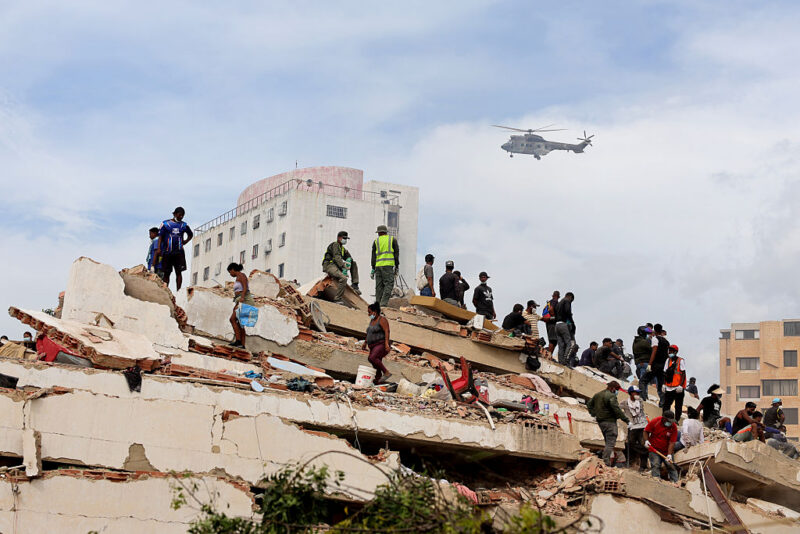
Jesus Vargas/Getty Images
Rescuers search for victims at a collapsed building as a helicopter flies by in the background following a magnitude 7.2 earthquake that struck Venezuela and other regions in the Caribbean, on June 28, 2026 in Caraballeda, La Guaira, Venezuela.




 Add EJP on Google
A week after two powerful and prolonged earthquakes struck in quick succession outside of Venezuela’s capital city Caracas, the country’s small but tight-knit Jewish community is still counting its losses, Sergio Widder, American Jewish Joint Distribution Committee’s director for Latin America, told eJewishPhilanthropy.
According to Widder, at least nine members of the Jewish community are believed to be dead, “between those who were actually found dead and [those still] missing.” The twin earthquakes, both above magnitude 7, were the most severe to hit the country in a century. In addition to killing at least 2,000 people, a number authorities expect to rise, the tremors have also caused rampant property damage throughout a country already grappling with economic and political instability.
Within the Jewish community, roughly 80 people remain displaced and unable to return home, out of more than 400 who fled to community facilities in the earthquake’s immediate aftermath. Fifteen homes were destroyed outright, said Widder, and JDC reports that 36 have been determined too damaged for habitation and are 43 unsafe to occupy pending inspection.
“It’s death, it’s destruction, it’s trauma — a complete disaster layered on top of a country that already had very weak infrastructure,” said Widder.
According to JDC officials, the earthquake compounded pre-existing vulnerabilities within the country’s Jewish community. Venezuela’s economic crisis has significantly shrunk the Jewish community, which once had tens of thousands of members, leaving behind a population skewed toward older residents and those with fewer resources to rebuild. Many of the displaced in San Bernardino were already among the community’s poorest and most isolated members, including elderly residents whose children have emigrated, Michael Geller, the organization’s chief spokesperson, told eJP.
“Among Venezuela’s Jews, before the earthquake, there were many who were already vulnerable, people who were poor or elderly,” said Geller. “As we often find in disaster zones, if you’re already vulnerable before a disaster, you’re going to become even more vulnerable after the disaster, particularly if your home was destroyed or you lost your possessions or a business.”
In addition to providing and coordinating the distribution of food supplies alongside community organizations, as he spoke with eJP, the Argentina-based Widder was also preparing to visit the country himself to help provide support and conduct an on-the-ground assessment of the community’s needs. JDC deliberately waited before sending its own disaster-response team, he said, because in the immediate aftermath of the crisis, best practice is for only search and rescue teams to arrive on the ground, to avoid drawing on already in-demand resources.
A four-person team — including Widder and other staff from JDC’s Latin America office and its disaster response unit — is set to arrive in Caracas on Wednesday, the first from the organization to reach the country since the earthquake.
“We are going there to have an onsite assessment, but what we know so far is that there are close to 40 families who have been displaced and will need temporary housing, so we will have to go and find resources to help with this temporary housing,” Widder told eJP. “Many apartments lost their windows, for instance, or need some structural repairs in the walls.”
Venezuela’s Ashkenazi and Sephardic Jewish communities — which have historically operated somewhat separately but have grown closer in recent years, said Widder — mobilized within minutes of the quake. Most evacuees converged on Venezuela’s Hebraica Jewish community center campus, which under normal circumstances, functions as a hub for the country’s roughly 3,000 remaining Jews. Many members of the Jewish community, who were relocated from the “Beit Avot,” a home for the elderly, were also evacuated to the Union Israelita de Caracas, the Ashkenazi community headquarters.
According to Widder, the JCC has since been operating as a major makeshift refugee camp largely because of its access to generators that keep the electricity and water running. In the earthquake’s first days, evacuees converted the campus’s soccer field into a parking lot, with many choosing to sleep in their cars rather than inside buildings, out of fear of aftershocks and structural collapse. Now, around 80 people remain at the JCC, and the rest have returned home or relocated to family or friends in the area, he said.
Related News

MAGICAL EXPERIENCE
Shefa launches psychedelics retreat for Jewish professionals suffering burnout
EXCLUSIVE
Detroit-based philanthropists Nancy, James Grosfeld donate $8M to renovate JDC’s Israel campus
CLOSING WORDS
In AZM address, Cosgrove links communal ‘orthodoxy’ on Israel to rising anti-Zionism among young Jews
HIGHER EDUCATION
As Jewish donors reconsider academia, Jan Koum doubles down, endowing Israel studies at Stanford

EXIT INTERVIEW
Elizabeth Sokolsky, longtime EVP of Birthright Israel, to retire next year