BUILDING BRIDGES
Asian Jewish students celebrate intersecting identities, gather for landmark Shabbaton at Yale
‘It was wonderful being in a community this weekend where that didn’t make me special,’ one participant told eJP of the event, which saw more than 450 student attendees
COURTESY/SoNo Brand Lab
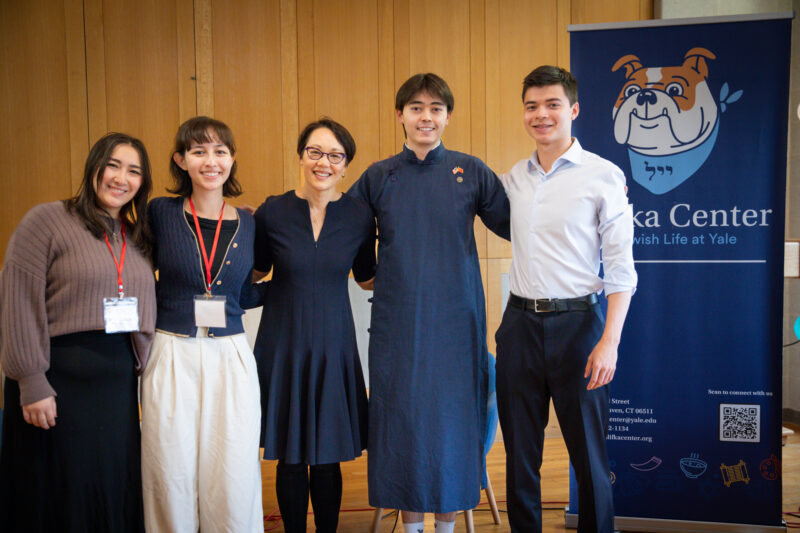
Central Synagogue Rabbi Angela Buchdahl, center, stands with attendees at the first-ever Asian Jewish Shabbaton at Yale University in October 2025: Aasia Gabbour, of NYU, left; Brooke Cohen, of Brown University; Benjamin Nuland, of Yale; and Zach Pan, of Yale.




 Add EJP on Google
The table setting at the inaugural Asian Jewish Shabbaton at Yale University Hillel last Friday night — challah and chopsticks — straddled more than just culinary worlds. It also served as a tangible bridge linking the intersecting identities of the 450 students from 15 universities in attendance.
The two-day inaugural Asian Jewish Shabbaton, organized by Yale’s Asian Jewish Union, provided students a place to connect over the challenges around balancing both Asian and Jewish identities — and the associated stereotypes. It also gave participants a chance to explore the natural allyship the two groups share, with an emphasis on their mutual values — such as community and education.
“Before this weekend I had met a handful of Asian Jews my entire life,” Aasia Gabbour, a senior at New York University studying global public health and nutrition and food studies, told eJewishPhilanthropy. “This feels special because it’s something I never got to experience. I’ve always been able to find my community within the Jewish community, but [Asian Jews] are such a niche group that getting the chance to learn there are a lot of us is a unique experience.”
“The groups are natural allies and I especially saw that this weekend,” continued Gabbour. “We all naturally gravitate towards each other. We got to know each other on a deeper level with semi-facilitated discussions.”
Those discussions addressed issues relevant to both communities, including a surge in antisemitism and anti-Asian hate seen in recent years. Students asked each other questions, including, “How do you balance your Asian identity with your Jewish identity? What was your experience like growing up? Did you deal with stereotypes?”
Even amid some heavy conversations, the weekend’s mood was overwhelmingly one of Asian and Jewish joy, according to those in attendance, with a buffet that included crispy tofu, spring rolls and biryani. Shabbat dinner — the largest student Shabbat in Yale Hillel’s history — was followed by a performance from Magevet, Yale’s Jewish a cappella group and services led by Rabbi Angela Buchdahl, senior rabbi of Central Synagogue in New York City and the first Asian American rabbi ordained in North America.
Participants included Asian Jewish students from Yale, MIT, Bowdin, Brandeis, University of Illinois, Georgetown, NYU, Princeton, Cornell, Columbia, Stanford, Rutgers, Brown, Harvard and Ithaca College.
“I was surprised at how deeply we connected over just 48 hours,” Brooke Cohen, a Brown University senior studying economics, who grew up in Singapore, told eJP. “While we all came from different Asian backgrounds, we connected not only through our Judaism but also by sharing a distinctive Jewish Asian identity,” said Cohen, whose father is Ashkenazi Jewish and mother, who is Chinese, converted to Judaism. Cohen recalled being told by her parents, as a child, that “Chinese and Jewish values are very similar, from respecting your parents to caring about great food.”
“It was moving to realize that experiences that I previously felt were unique to me were shared with this bigger group,” she continued. “I’m usually the only Asian Jew in a space and it was wonderful being in a community this weekend where that didn’t make me special.”
The retreat’s Jewish learning was headlined by Buchdahl and featured a panel discussion with Florence Pan, an Asian Jewish federal judge in Washington, D.C.
“When I was going to Yale in the 1990s, the only Asian Jew I knew, the idea of a Shabbaton filled with Asian Jews was inconceivable,” Buchdahl told attendees, adding that she was “grateful to be part of this historic weekend.”
Gabbour called Buchdahl’s address the “most impactful part of the weekend.” Buchdahl just published a memoir about her historic life story as the first Asian-American rabbi in North America, titled Heart of a Stranger.
“She spoke about her experience and I could relate to it,” said Gabbour. “[Buchdahl] said how she always felt like she had to prove herself as a Jewish person because she didn’t have those stereotypical traits. That really resonated with me, I’ve been doing that most of my life.”
Yale’s Asian Jewish Union was formed in the fall of 2023 because that sentiment resonated with two other Asian Jewish students as well. Now juniors at the university, Benjamin Nuland and Zachary Pan were raised with different experiences of Asian Jewry that converged on the New Haven, Conn., campus.
Nuland, a history major, grew up in the Shanghai, China, Jewish community as it established a Reform movement amid the country’s limitations around religious practice. After moving to the U.S. as a teenager, he grew increasingly interested in working with Chinese academics and central Asian diplomats. “I remember being completely shocked when I came to the U.S. by the type of institutionalized Judaism that America had,” Nuland told eJP. “I felt a little bit alone.”
Zach Pan, meanwhile, was raised in a vibrant D.C. Jewish community, having never encountered another Asian Jew outside of his family (his mother is Judge Florence Pan of the U.S. Court of Appeals for the District of Columbia Circuit). That’s until freshman year at Yale, when he met Nuland and the two bonded over “Jews of color facing some of the same stigma and discrimination as other Jewish students,” Pan said.
“So it’s a difficult position to be in because you’re not necessarily welcome in any community because you have your feet in between communities,” he said. “You’re straddling two communities.”
“Personally, I was very happy to find a Jewish community at the Slifka Center [Yale’s Hillel],” recalled Pan, who is studying history and political science. “But I know for a lot of Asian Jewish students it was harder to find community. So when we started the union, we created a space for a lot of Jewish students to come more often to Jewish events. That’s been one of the great rewards — to give a space to Jews that may have otherwise felt like they needed to pick a community.”
“The real issue, for me, was that there was no space for us to define what it means to be Asian and Jewish,” said Nuland. “There’s never really been anything for collegiate Asian Jews. That discussion has become even more prevalent since the Oct. 7, [2023, Hamas terrorist attacks], not just because there’s a rise of antisemitism on campus but also: how do Asian Jews think through these issues when, to some extent, they feel uncomfortable walking into spaces whether it be a Hillel or an Asian organization? That’s where we come in.”
In the two years since its launch, Yale’s Asian Jewish Union has grown from four members to 48, and Slifka’s student board has two Asian Jewish members. Recently, Yale students from other minorities have followed suit, forming a Black Jewish Union and Latino Jewish Union, both of which run joint programs with the Asian Jewish union. Nuland and Pan said that the decision to open the Shabbaton to students from other campuses — including to some non-Jewish students — gave an opportunity to “expand relations,” especially for those at universities where the Jewish-Asian alliance is less of a focus.
“It’s a really cool new area of broadening the tent of what it means to be Jewish on campus,” said Pan.
Related News
CLOSING WORDS
In AZM address, Cosgrove links communal ‘orthodoxy’ on Israel to rising anti-Zionism among young Jews

MAGICAL EXPERIENCE
Shefa launches psychedelics retreat for Jewish professionals suffering burnout

MAJOR GIFTS
Center for Jewish History celebrates 25 years with a $25M matching grant
HIGHER EDUCATION
As Jewish donors reconsider academia, Jan Koum doubles down, endowing Israel studies at Stanford
PRESIDENTIAL REBUKE
Israel’s Herzog: Mamdani ‘makes no effort’ to hide disdain for Israel, Jews must fight back