ADVOCACY ARM
After pilot year, Rabbinical Assembly unveils new policy institute: the Tzedek Center
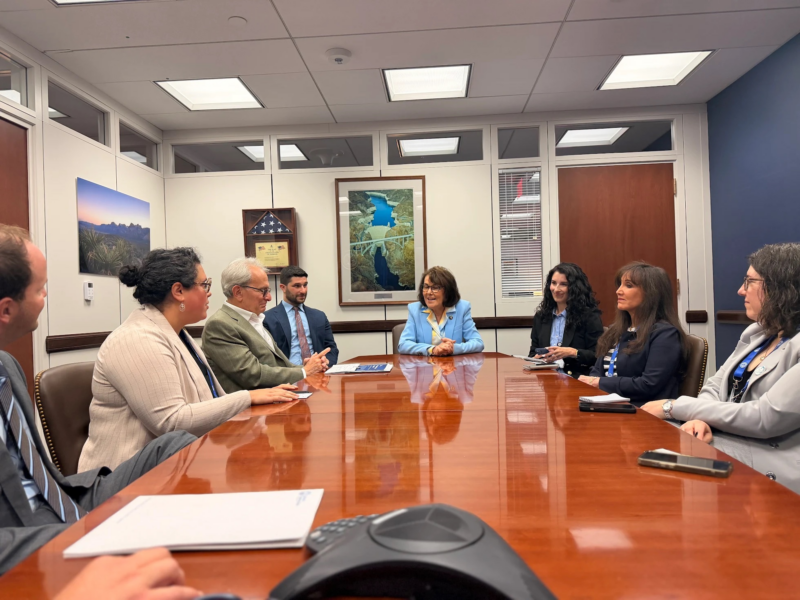
Courtesy: Emily Jaeger
Emily Jaeger (second from left) meeting with Senator Jackie Rosen (center) and her staff in May 2026 in Washington, D.C.




 Add EJP on Google
Founded 125 years ago, the Rabbinical Assembly, the rabbinic arm of the Conservative/Masorti movement, has long been engaged in advocacy through its social justice commission. But last year, the movement piloted a policy institute that focused on grassroots advocacy across the movement; and last week, the RA announced the institute’s name: the Tzedek Center, tzedek meaning justice in Hebrew.
“We have a set of specific needs and concerns as the Conservative movement that has not been fully represented on a national level, and this is our opportunity to do that,” Emily Jaeger, the center’s director, told eJewishPhilanthropy. “Individual congregations are doing amazing work in social action and some are doing amazing work also in advocacy on the local level, but we have this amazing opportunity to work across a state or across multiple states. That’s what the Tzedek Center is really there to build out.”
Tzedek is “a central value of what the Conservative movement’s about and what we’re trying to do,” Jaeger said. “There’s many places that tzedek comes up in the Torah, but of course one of the famous ones is ‘tzedek, tzedek tirdof.’ [Justice, justice, shall you pursue.] The idea there is that you’re not just supposed to work on tzedek when the opportunity arises, but you’re actually supposed to be actively pursuing it.”
The center was born out of a 2023 five-year, $3 million seed grant to the RA from an anonymous donor. The first years were spent mapping out ideas for the center, which launched in August 2025 with Jaeger as its first employee. Over the past year, the center, which runs out of the RA’s Manhattan headquarters, has hired three part-time employees, including a project manager and an advancement professional.
Last year, Jaeger went on a five-month listening campaign, connecting via Zoom and in person with over 150 stakeholders, lay leaders and clergy. Her goal was to identify the issues that united people across the movement.
“One of the strengths of our movement is that we are a big tent,” she said. “In the policy landscape, that gives us a unique advantage, because we’re able to find issues that have a bipartisan focus and then work across differences towards consensus,” she said.
Outside the realm of public policy, there may be multiple topics that divide the movement — such as whether clergy can participate in interfaith marriages — but when it comes to national policy issues, there are many that people agree on, Jaeger said.
The center has set three priorities to focus on: Jewish safety, which includes advocacy for the Nonprofit Security Grant Program and support for the Jewish American Security Act now before Congress; advocacy for federal food security programs; and advocacy for affordable, clean energy.
Last winter, the center moved from listening into action. It gathered cohorts of over 80 congregations and camps to learn about the issues and brought together over 100 Jewish teens for advocacy. Webinars reached over 500 clergy and lay leaders.The center also developed resources including divrei torah, community letters and policy guides.
One topic of concern that the center identified within the Conservative community was whether congregations who accepted NSGP grants could be forced to work with U.S. Immigration and Customs Enforcement and distance themselves from diversity, equity and inclusion efforts, per the grant’s terms and conditions. Doing so would force some leaders to go against their “religious conscience,” Jaeger said.
Alongside a coalition of partners, the center was “able to get clarification that those would not be enforced,” Jaeger said. As a result, congregations could apply for up to $200,000 in Nonprofit Security Grant Program funding without worrying about being called upon to violate their values.
(Other sources connected to the Conservative movement, who spoke to eJP on the condition of anonymity, said that the terms and conditions in the paperwork continue to be a concern for many congregations and leaders, including other advocates who have partnered with RA, because as long as the terms remain in the paperwork, there is the potential for consequences to be enforced.)
Other Jewish advocacy organizations have also shared advice on which advocacy models have worked for them. The center has partnered with the Jewish Federations of North America, the Jewish Council on Public Affairs, the Religious Action Center of Reform Judaism and the Orthodox Union Advocacy Center, among others.
The center is also building a revenue plan and seeking funding beyond the original seed grant. This year, it received a $57,500 grant from Keren Kayemeth LeIsrael-JNF for work focused on environmental sustainability.
As the center prepares for its Rashei Tzedek fellowship, a seven-week virtual training for lay leaders, staff and clergy, its outreach work is continuing. “This year is very focused on continuing building outreach in the different congregations,” Jaeger said, “so we can build that network to work across them.”
“We often talk about [there being] three parts to Jewish life — Torah, avodah and chesed, study, worship and doing good in the world — so for us to be a movement that encompasses all of Jewish life and Jewish expression, we should be working on all three of those areas,” Rabbi Jacob Blumenthal, CEO of the RA, told eJP. “We have lots of ways in which we encourage Torah study, lots of ways in which we worship and pray in our communities, and we want to strengthen our work when it comes to doing good and pursuing justice in the world.”
Related News
EXCLUSIVE
Detroit-based philanthropists Nancy, James Grosfeld donate $8M to renovate JDC’s Israel campus
HIGHER EDUCATION
As Jewish donors reconsider academia, Jan Koum doubles down, endowing Israel studies at Stanford
EXIT INTERVIEW
Elizabeth Sokolsky, longtime EVP of Birthright Israel, to retire next year
CLOSING WORDS
In AZM address, Cosgrove links communal ‘orthodoxy’ on Israel to rising anti-Zionism among young Jews
PRESIDENTIAL REBUKE
Israel’s Herzog: Mamdani ‘makes no effort’ to hide disdain for Israel, Jews must fight back