OVERTON WINDOW OVERHAUL
After mainstream groups express concern over Gaza aid crisis, experts say Jewish world widening tent of acceptable views on Israel
'It needed to happen,' Steven Windmueller, emeritus professor of Jewish communal service, tells eJP 'So many folks are asking questions, and they have been to so few places where people were prepared to offer answers, or at least give space for the right to ask such questions'
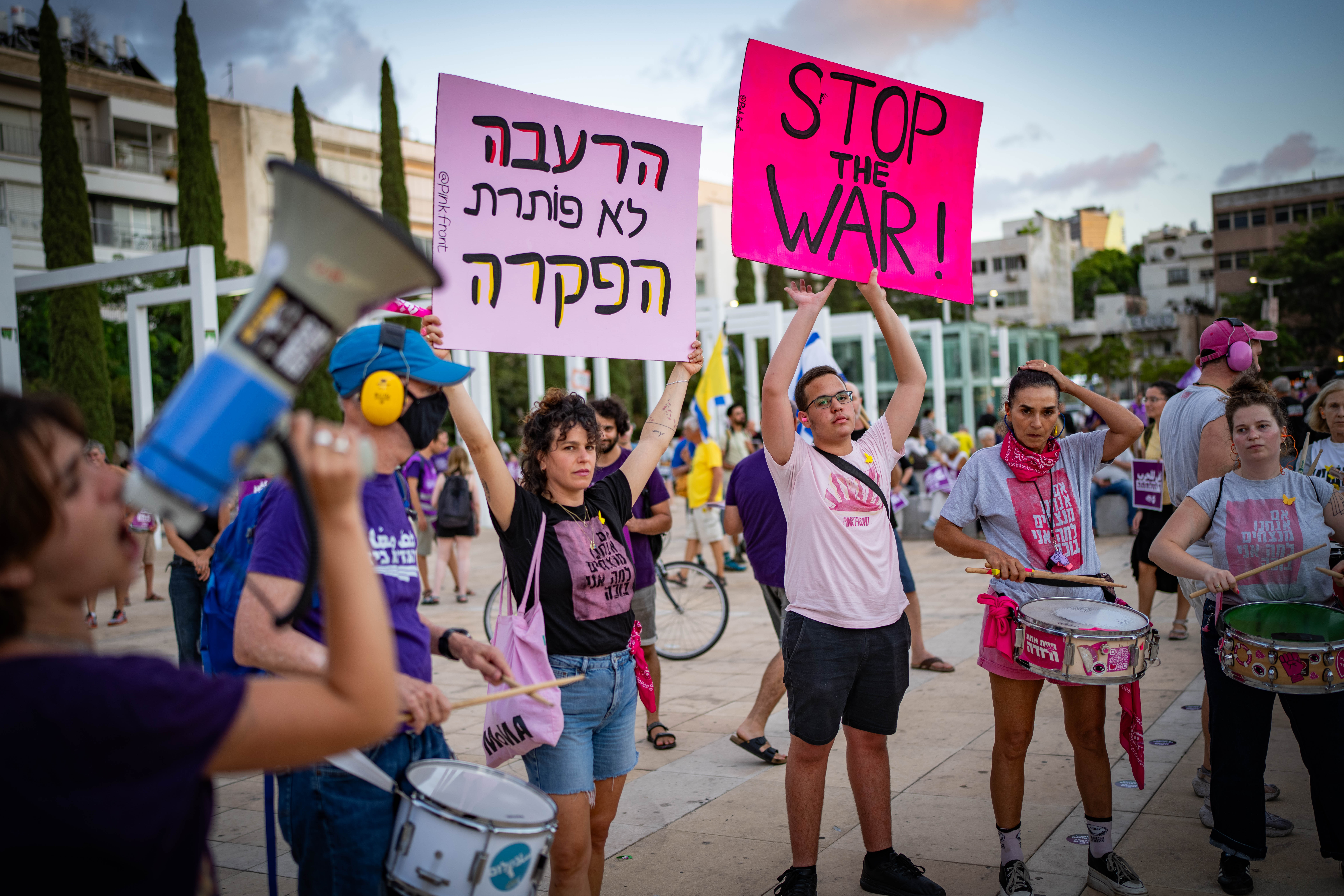
Erik Marmor/Flash90
Demonstrators take part in a rally against the war in Gaza and the government at HaBima Square in Tel Aviv on July 31, 2025.




 Add EJP on Google
In recent weeks, the needle appears to have shifted on what is considered acceptable to talk about in the Jewish philanthropic world related to criticism of Israel. This comes after multiple mainstream organizations and figures with clear Zionist bona fides, such as the American Jewish Committee, British Chief Rabbi Ephraim Mirvis, the Zionist Federation of Australia and others, have released statements expressing deep concern about the humanitarian crisis in Gaza.
Those remarks, all of which primarily blamed the situation on the Hamas terror group, which launched the war with its brutal Oct. 7 attacks and perpetuates it by holding 50 people hostage, seem to have signalled to the wider Jewish community that criticizing aspects of Israel’s conduct in its war against Hamas is not out of bounds.
Just on Wednesday, dozens of prominent Jewish philanthropists from around the world signed a letter, along with thousands of other Jews, calling for an end to the war in Gaza, a crackdown on settler violence in the West Bank and denouncing the extremist rhetoric of some Israeli politicians.
Until now, the majority of Jewish nonprofits, day schools and movements have refrained from criticizing Israeli policies and actions in Gaza and the West Bank. This has made some members of those organizations who have harbored such concerns fearful that they could lose their jobs if they voice their criticisms of Israel. But with institutions now providing a more nuanced example of what it means to support Israel — including criticism and even outright condemnation, in the case of the Reform movement — the lines of what can and can’t be appear to have shifted.
“It needed to happen,” Steven Windmueller, emeritus professor of Jewish communal service at the Jack H. Skirball Campus of Hebrew Union College-Jewish Institute of Religion in Los Angeles, told eJewishPhilanthropy. “Probably because the situation itself has evolved to a point where the donor, the student, the rabbi, you name it… where everyone is struggling to find a way forward in terms of how to understand what is happening, how to question and ask questions about the crisis and the response.”
These changes, where organizations feel the need to widen the conversations around Israel and Zionism are happening “from the bottom-up,” Windmueller said. “So many folks are asking questions, and they have been to so few places where people were prepared to offer answers, or at least give space for the right to ask such questions.”
According to Windmueller, the people pushing for these shifts are not “necessarily coming at this from a point of view of being an anti-Zionist or a non-Zionist, but rather from the point of view of their love of and engagement with Israel and their difficulty and even frustration at times with understanding and managing the events that are unfolding.”
He added: “That’s a very different kind of conversation than one having to do with folks who have walked away from the Israel discourse. This is where the mainstream of the Jewish community is having, finally, that kind of essential conversation.”
Even though leaders and funders may have anxiety over taking this step of opening communal discourse to critical attitudes toward Israel, “there’s also a sense [that] there are internal differences that we can no longer avoid,” Melissa Weintraub, co-CEO of Resetting the Table, a nonprofit that works with organizations to counter polarization in the workplace, told eJP.
These “subterranean tensions” have been “bubbling and just breaking through to the surface,” she said.
Some New York Jews are openly supporting anti-Zionist Democratic mayoral candidate Zohran Mamdani because of his stances on Israel, not despite them. Some progressive Orthodox Jews have also condemned the Israeli government for their actions in Gaza and the West Bank under the banner of Smol Emuni, a group that counts among its members Rabbi Yosef Blau, the former mashgiach ruchani (spiritual supervisor) at Yeshiva University’s rabbinical school and a past president of Religious Zionists of America.
“Differences don’t tend to go away without being addressed,” Weintraub said, adding that this isn’t simply a liberal issue: Jews on the right have also been cast out from social justice organizations for their views. Stifling certain voices causes everyone in a community to trust each other less.
In a communal religion like Judaism, the prospect of being excommunicated is terrifying. For people working for Jewish organizations, it is also a threat to their livelihood.
“One of the ways in which these kinds of statements from major Jewish institutions make a difference is by signaling very explicitly to people, ‘Actually, this thing that you’re feeling is not going to push you outside the boundaries of the ‘we,’” Joanna Ware, executive director of the progressive Jewish Liberation Fund, told eJP.
Although the conversation is opening, there still need to be boundaries, Windmueller believes. “There are some sort of core principles that we stand for as a community. We’re not going to move outside of the comfort zone that Zionism and Israel’s right to exist are core to the Jewish story and essential to modern Jewish history… If we’re going to call ourselves a community, reaffirming those key positions will be essential.”
There are some Jewish nonprofits that will never take a stance on what is occurring in Israel and Gaza. For Ilana Kaufman, the CEO of Jews of Color Initiative, taking a stance simply does not align with its mission. “By way of policy, we do not dabble with international affairs,” she said. It’s not that the organization is apolitical, but its leaders made a decision to be “politically, nonpolitical, [which] has created an environment where the diversity of the Jewish People can thrive.”
There have been staff, funders and grantees who have wanted the organization to take a firmer stance on what is occurring in the Middle East, but “it’s not something we do,” Kaufman said. “If you want to talk about the most innovative way to make a grant, this is a place for you.”
Still, Jews of color run the gamut politically, a reality Kaufman understands. “People need to be human and in their own space outside of work,” she said.
If an employee’s actions off the clock interfere with the organization’s mission to support Jews of color in America, especially if it causes a schism with partners legitimately invested in improving racial inclusion, Kaufman will have a conversation with them.
“I have been really clear with the staff that their social media posts will have legs, and I can’t control those, and I will only defend them to the point that it’s appropriate in my role in service to the work,” she said. “They have choices to make. I’ve asked them if they feel like they cannot be in service to the mission to let me know, and we will try to make that an easy transition.”
But things are changing in JOCI, too. If an employee accused Israel of causing the humanitarian crisis in Gaza, “six months ago, [we] probably would have had a conversation about it,” Kaufman said. Today, that would be less likely as others with influence and authority have spoken out on the topic. “It’s signaling that it’s more acceptable,” she said.
The fact that many Jewish organizations are opening up direct and honest dialogue among their constituents is a huge step to cultivating a safe space for differing views, Weintraub said, and the Jewish community is actually doing better than the larger American community, which is completely polarized.
Broadening the conversation can serve as an opportunity to educate, address concerns and correct falsehoods, Windmueller said, because people simply want to better understand what is actually happening in Gaza. “If people are able to unpack and go deeper in understanding why somebody is employing a term and and whether or not that’s a correct or even appropriate definition, that can only happen when you have discourse, when you have dialog, and it doesn’t happen when people are shut down or shut out from having their questions answered,” he said.
Related News
CLOSING WORDS
In AZM address, Cosgrove links communal ‘orthodoxy’ on Israel to rising anti-Zionism among young Jews
PRESIDENTIAL REBUKE
Israel’s Herzog: Mamdani ‘makes no effort’ to hide disdain for Israel, Jews must fight back
EXIT INTERVIEW
Elizabeth Sokolsky, longtime EVP of Birthright Israel, to retire next year

MAJOR GIFTS
Center for Jewish History celebrates 25 years with a $25M matching grant

MAGICAL EXPERIENCE
Shefa launches psychedelics retreat for Jewish professionals suffering burnout