LISTEN UP
After years of growth, Project Shema officially becomes an independent nonprofit
The antisemitism education group is focused on the progressive community, where "lack of context, a lack of shared language and sometimes just the ability to slow down enough for people to hear or be heard” are the biggest challenges, says its founder
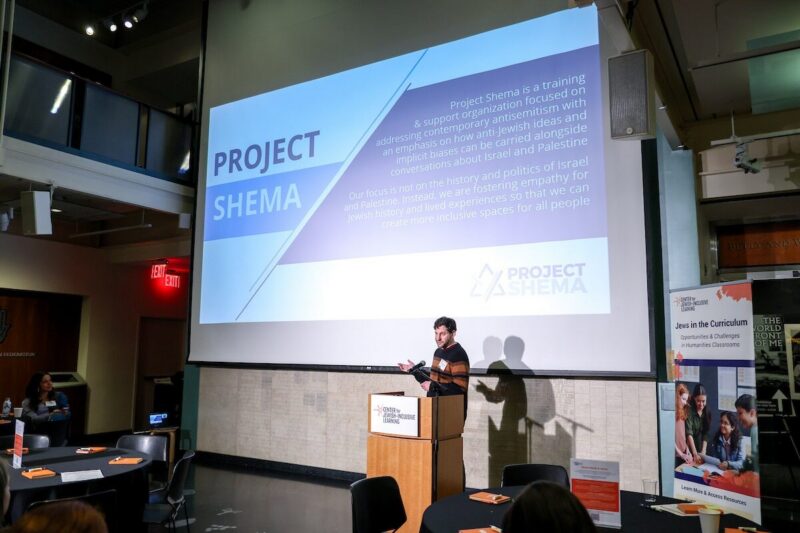
Courtesy/Project Shema
Eli Cohn-Postell, Project Shema's vice president of research and innovation, in an undated photo.




 Add EJP on Google
After Oct. 7, the surge in antisemitism and anti-Zionism in progressive circles upended relationships between traditional liberal Jewish groups and those further to the left.
Now that Project Shema — an antisemitism education group that deals specifically with that progressive community — has become an independent nonprofit, it stands poised to play a larger role in today’s fraught conversation.
The organization’s name comes from the Hebrew word for “hear,” in reference to its mission to teach skills that will help others hold productive dialogue about difficult topics like the Israeli-Palestinian conflict. Project Shema specifically works within liberal communities to better live up to the values of diversity and equality they claim to champion, partnering with schools and organizations to create educational programming for staff and students.
As early as 2015, progressive organizer Oren Jacobson realized that the conversation around the Israeli-Palestinian conflict and antisemitism in progressive spaces was breaking down. “The biggest challenges were lack of context, a lack of shared language and sometimes just the ability to slow down enough for people to hear or be heard,” Jacobson, Project Shema’s co-founder and CEO, told eJewishPhilanthropy.
The idea for Project Shema arose in 2018 but became a reality in 2022 after disputes around the actions of Israel in Gaza the previous year again brought the issue to the fore. Originally, it was primarily diversity, equity and inclusion officers at colleges and organizations who would contact Jacobson for speaking engagements; but then the Oct. 7 massacres in Israel led to a surge of interest from non-Jewish organizations seeking to learn to better navigate the complex and polarizing subjects of the Israeli-Palestinian conflict and antisemitism.
Project Shema partners with organizations to create programming based on each organization and school’s needs, Kara Wilson, the group’s chief strategy officer, told eJP. Project Shema organizers ask partners what they have tried so far, and then they help them get back to their missions of cultivating belonging and safety. Wilson has witnessed light bulbs flash above participants’ heads: “I never thought of it that way,” she recalls them saying, or “Maybe I have been a little closed off.”
Project Shema attracts employees who “are looking for a home,” said Wilson, especially progressive multiracial Jews. As a Black Jewish woman raising two Black Jewish kids, Wilson has never felt that being progressive was a choice. “I have to try to push this country to be something different for my kids,” she said. Her work at the organization “helps me feel good about the little piece that I can do in this moment of bringing about a better world for my kids.”
Since launching, Project Shema has worked in 22 states and with major universities, including Harvard, Columbia and Tufts. At the beginning of 2025, the organization had 11 full-time staff. A year-and-a-half later, it has 24.
Originally funded by grants and workshop revenue, Project Shema was approved for 501(c)(3) status in January, only announcing it publicly last month because of a focus on onboarding new staff, including a vice president of communications and vice president of development. The organization held its first in-person board meeting in May in Chicago, following months of board meetings online. The organization has received past funding from the SRE Network, Steven Spielberg’s Righteous Persons Foundation and others. Its 2026 budget is expected to be $6 million.
Coming with the new status are more workshops and new initiatives, including a podcast, “Translations,” which launched in March and features interviews with experts with lived experience on deepening inclusion and working through tension.
While criticizing the left for antisemitism was once shunned, today, many Jewish nonprofits have come under fire, especially the Anti-Defamation League, for downplaying antisemitism on the right while zeroing in on antisemitism on the left.
Wilson and Jacobson said that Project Shema’s focus on antisemitism in progressive circles comes naturally, because those are the communities that they exist within and care for.
“It’s not attacking,” Wilson said, adding that the mission is to “hold this progressive movement to a standard that’s like: We can do this. We can hold complexity. We can honor inclusion.”
The board lives by the values at the core of Project Shema’s mission, Rachel Sussman, the organization’s board chair, told eJP. These include valuing dialogue, inclusivity, engagement, empathy and “working across conflict or disagreement.”
The nonprofit hasn’t adopted a formal definition for antisemitism, Jacobson said, a move that runs counter to much of the organized Jewish world, which uses the International Holocaust Remembrance Alliance working definition of antisemitism. “What we do help people understand is that antisemitism typically doesn’t present as anti-Judaism and instead presents as anti-Jew, usually through conspiracy theories and tropes.”
The goal is not to shame workshop participants, but to “help people understand why certain rhetoric and actions are undermining Jewish safety and inclusion in real time,” he said.
While public and online discourse on the Israeli-Palestinian conflict can be extremely “polarized, toxic and binary,” Jacobson said, it is “not necessarily representative of the way most people actually think and feel.”
Jews on the left have been challenged recently by “the Trump administration choosing to use antisemitism as the sort of tool, if you will, to go after, for example, institutions of higher learning,” he said. “[It] has made it more difficult and made people [in progressive circles] less trusting or receptive about the legitimacy of the concern around antisemitism in discourse around Israel and Palestine.”
Using a standardized pre- and post-workshop survey, Project Shema found that participants had doubled their commitment, from 40% to 80%, to challenge anti-Jewish ideas, including in their own networks.
Even before receiving its nonprofit status, Project Shema has faced criticism on the left for conflating antisemitism and anti-Zionism.
“I read and know the criticisms that are put out there against us,” Jacobson said. “We’ve been pretty consistent about saying that we don’t think anti-Zionism is always antisemitism, and we don’t educate that way inside of any of our actual programs or workshops… We state over and over, it’s not antisemitic to criticize the actions or policies of the Israeli government. It’s not antisemitic to advocate for the end of a war. It’s not antisemitic to advocate for a different future for the Palestinian people or to support Palestinian rights or freedom, or even for people to say things that are really harsh… What we do talk about is the way in which certain rhetoric and narratives demonize and dehumanize Jews.”
Related News

EXIT INTERVIEW
Elizabeth Sokolsky, longtime EVP of Birthright Israel, to retire next year
Israel’s Herzog: Mamdani ‘makes no effort’ to hide disdain for Israel, Jews must fight back
HIGHER EDUCATION
As Jewish donors reconsider academia, Jan Koum doubles down, endowing Israel studies at Stanford

MAJOR GIFTS
Center for Jewish History celebrates 25 years with a $25M matching grant
CLOSING WORDS
In AZM address, Cosgrove links communal ‘orthodoxy’ on Israel to rising anti-Zionism among young Jews