Opinion
OUT OF THE SILO
Beyond Israel programming: The case for institutional redesign




 Add EJP on Google
In Short
Israel cannot remain the responsibility of one department or one educator. It must be woven into Jewish institutions as a whole.
For decades, the North American Jewish community has invested enormous resources into what became known as “Israel education.” Younger Jews were growing more distant from Israel, so institutions, educators and funders responded with seriousness and creativity. Immersive trips, campus initiatives, shlichim (Israeli emissaries), Israel days, speaker series, educational programs and conferences all became central tools in the effort to strengthen belonging and proficiency.
This investment created a jargon and built generations of educators deeply committed to helping North American Jews form meaningful relationships with Israel. I am part of that story myself. What began for me as a temporary shlichut experience became a career devoted to understanding how Jews build lasting connections to Israel.
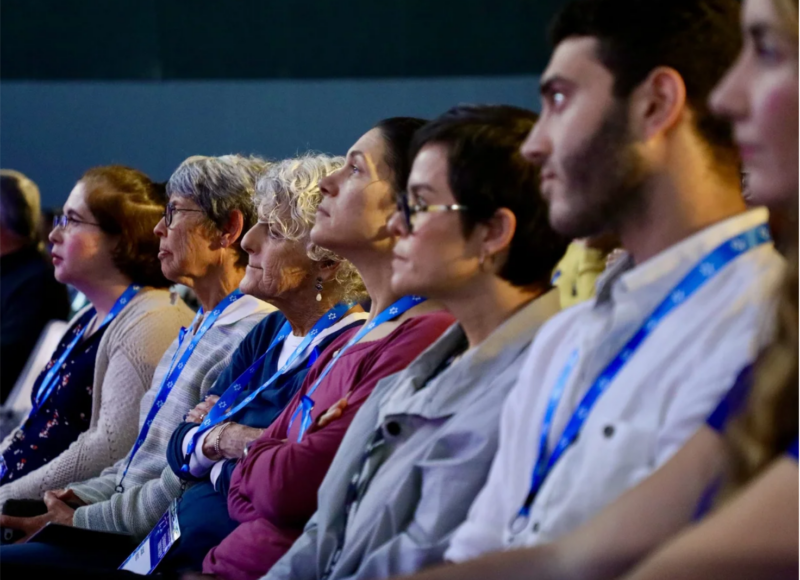
Screenshot/Z3 Project
Illustrative.
But alongside its achievements, Israel education also created an unintended problem: it developed into an independent, specialized field.
As it became a distinct field, institutions came to see Israel as a discrete domain rather than intrinsic to Jewish identity. Over time, “Israel” became a program on the calendar, or a designated staff member — in well-resourced institutions, even a department. And when Israel became siloed rather than integral to an institution’s mission, institutions responsible for building thick, layered Jewish identities inadvertently created fragmented ones instead.
If Israel is part of Jewish identity, then it’s not enough to exist as a standalone program; it must appear in the institution’s structure itself — its values, mission, staff training, leadership, physical space, budget decisions, programming and community engagement. Every staff member should be able to articulate the organization’s values and understand that they are agents in shaping Jewish identity, regardless of their formal role. Israel cannot remain the responsibility of one department or one educator. It must be woven into the institution as a whole.
A child in preschool does not learn what matters only from a formal lesson. They learn from the prayer before snack, the smell of challah on Friday morning, the staff they observe, the songs they hear, the language spoken around them, the images on the walls and the assumptions the adults around them treat as natural. Campers do not build a relationship with Israel only during “Israel Day.” They build it through music, food, Hebrew, Israeli staff, informal conversations and the way Israel quietly becomes part of the atmosphere of camp itself.
This is why the focus can no longer remain on program development. We need to talk about institutional design.
One useful case study is the evolution of the Z3 leadership lab over the years. Originally, the labs consisted of meaningful learning experiences for cohorts drawn from different parts of the Jewish organizational world, based on the belief that one or two professionals from each organization could help shift its culture. Over time, we realized that if the goal is to influence how institutions shape identity, then it was not enough to train one or two professionals from each organization; we needed to go deeper within individual institutions.
Different communities have interpreted this idea in ways that reflect their own culture and priorities. One JCC, for example, revisited its mission statement to better reflect the varied ways community members relate to Israel. Another redesigned its welcome hall to include an interactive screen where visitors can explore places across Israel. A third launched a Hebrew-speaking class in its preschool. Beyond those examples, six additional communities have hosted their own Z3 conferences and leadership labs, a number we expect to grow in the coming years, creating local spaces for conversations about Peoplehood and Israel.
What these efforts share is not a program model but a mindset. The institutions that seem to make progress are often those that stop asking what Israel initiative to add next and begin asking how Israel and Jewish Peoplehood might already live within the work they are doing every day. Today, more than 350 professionals have participated in this learning journey, adapting these ideas to the realities of their own community.
Israel education successfully built the infrastructure that makes Israel and Jewish Peoplehood a priority in these institutions. The next stage is to see Israel education as integral to Jewish identity and a way to influence the entirety of Jewish institutional life.
As long as Israel remains a program, the rest of the institution remains exempt. The next stage is not another Israel program, but reconceiving Jewish institutions in a way that understands Israel as part of the identity they seek to shape.
Dror Stein is the director of content and leadership at the Z3 Project, an initiative of the Oshman Family JCC in Palo Alto, Calif.