FEELING THE LOVE
Progressive ‘36 Awards’ aims to fete those who combat antisemitism, not shame those who spread it
The Nathan Cummings Foundation, in partnership with Jewish Social Justice Roundtable, is launching the award, which comes with a cash prize, to honor individuals combating antisemitism through a broader civil rights lens
Jewish Federation of Greater Harrisburg/Facebook
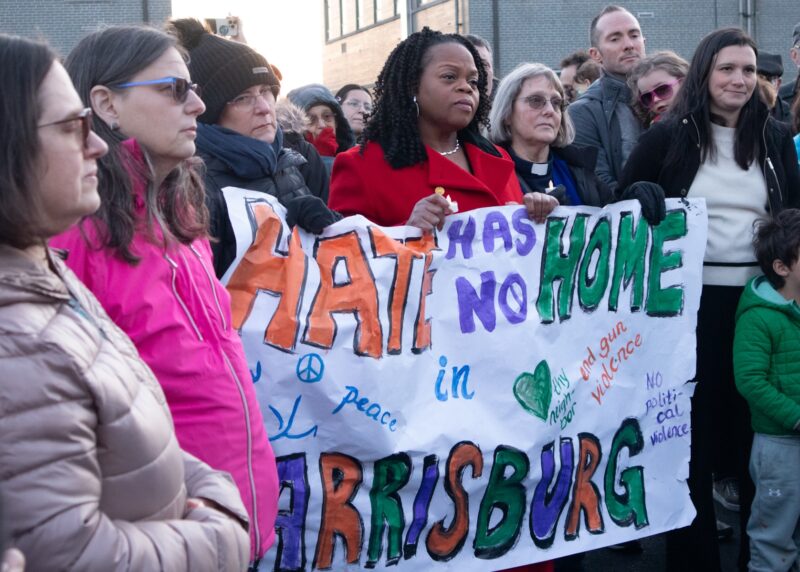
Leaders from Jewish congregations and partners from across faiths in the Harrisburg, Pa., community gather for a vigil near the Governor's Residence a few days after an antisemitic attack against Governor Josh Shapiro on the first night of Passover on April 12, 2025.




 Add EJP on Google
After the Oct. 7 massacres in Israel, hundreds of millions of dollars flooded into initiatives claiming to combat antisemitism, yet antisemitic incidents continued to skyrocket. The surge of anti-Jewish sentiment spurred calls from Jewish leaders as well as observers like New York Times columnist Bret Stephens and World Jewish Congress President Ronald Lauder to halt the efforts to combat antisemitism so resources could be redirected toward nourishing Jewish identity.
Partnering with Jewish Social Justice Roundtable, which is made of 67 progressive Jewish organizations — from mainstream groups like the Conservative movement’s Rabbinical Assembly to more radical ones like Jews For Racial and Economic Justice — the Nathan Cummings Foundation took a different tack, shifting the discussion from shaming those guilty of bigotry to focusing on celebrating those combating antisemitism by building bridges, even during fraught times.
Last Wednesday, the two organizations christened the initiative the 36 Award, a reference to the Jewish concept that in every generation there are 36 righteous people, hidden in their communities, whose goodness sustains the world.
“We felt like that concept from Jewish tradition really was the North Star for what we’re looking for with giving this award to individuals,” Abby Levine, CEO of JSJR, told eJewishPhilanthropy. “We don’t want the famous or the credentialed, but the people who are doing what’s right, even when it’s unpopular or unnoticed or far from the spotlight. This is our attempt to go find some of them and to say, ‘We see you and we support you, even if you haven’t been recognized up to now.’”
Three awardees will each receive $15,000 to $25,000 in recognition for their work combating antisemitism through a civil rights lens, with the view that antisemitism intersects with other forms of hatred.
“Social change doesn’t only happen within the contours of nonprofits,” Isaac Luria, senior director of strategic initiatives at NCF, told eJP. “Individuals are making change in their communities, and some of them are not funded at all, they’re just out there doing the work.”
The initiative will be pragmatic, with the goal of injecting “more innovation into the space” of combatting antisemitism, Luria said. “I confess to being quite angry about the persistence and growth of antisemitism, but my anger is insufficient when it comes to strategy. I can be angry about what my daughter experienced at school, but what I need to be able to do is [have a] strategy.”
Every five years, Nathan Cummings comes up with a strategic plan, mapping its work for the years ahead. The last plan was created in 2022, but last year, the board voted to augment its work due to the rising antisemitism, using what it calls an “all of assets approach” to combat the oldest hatred, Luria said. “It’s kind of the NCF flavor of philanthropy, where we try to bring our voice, our resources and grant making, our relationships and reputation to bear on issues that are of serious concern, and antisemitism is obviously one of those.”
Both NCF and JSJR believe that the best way to combat antisemitism is to cultivate relationships across differences, not to further isolate.
At the same time, recently, many in the Jewish community have advocated for Jewish organizations to pull away from progressive circles, which they see as having turned on the Jewish community, especially with their opposition to Israel and support for figures whose criticism of Zionism can cross into antisemitism.
Levine pushed back against moving away from progressive alliances, especially when antisemitism is surging, saying, “Building our democracy, building social justice, are the most effective and durable protection for our people.”
Shaming people for antisemitism is not a productive method of combating it, Levine said. “It’s not effective to call someone a racist if you want to change their views; it’s not effective to tell someone they’re antisemitic… We’re trying to impact the way that our partners understand Jews, understand the way that antisemitism operates as a conspiracy theory, but to do that in partnership with folks who see the world in similar ways and may have real honest questions about the complex nature of Jews as a religion, as an ethnicity, about the ways that Israel plays into all of it.”
NCF sees antisemitism as “inseparable” from other forms of hatred. “We know that there is a raging debate on defining antisemitism out there,” Luria said, “and what we’re trying to do is to think about this in a broad lens. Working on antisemitism through a solidarity civil rights framework has the potential to be extremely catalytic. This is work that is under-resourced and it doesn’t have enough attention on it.”
Additional partner organizations include the Henry Luce Foundation and The Jewish Community Foundation of Greater Washington, and sponsors include Bend the Arc, Horizon Philanthropy, Nexus, the Rabbinical Assembly, Reconstructing Judaism, the Workers Circle and T’ruah.
The prize is open to both Jews and non-Jews, and the initiative involves both non-Jewish partners and judges, including Eric Ward, the executive vice president of Race Forward. Another topic of heated debate post-Oct. 7 is who gets to define antisemitism or decide how to combat it, with many in the Jewish community feeling non-Jews should not play a part in the discussion.
“If we measured our success on antisemitism based on what Jews thought about it, that would be a mistake,” Luria said.
Including non-Jews in the fight against antisemitism comes from the broader “playbook” of combating other forms of bigotry by bringing in outside allies. By bringing others in and having them invested in combatting antisemitism, it sends the message that “this is a problem across difference, and one that serves the interests of communities facing other oppressions,” Luria said.
Jonathan VanAntwerpen, program director of religion and theology at the Henry Luce Foundation, told eJP that his foundation is “grateful” to be involved in the project. “We especially appreciate the way the award emphasizes the extent to which some of the most effective responses to antisemitism are happening in unexpected places, and the way it leans into and seeks to uplift the power of both creativity and moral courage, in an effort to build solidarity across communities.”
Working across differences is nothing new for The Jewish Community Foundation of Greater Washington, which partners with the Community Foundation of Greater Washington, a secular organization, to fight hate and extremism in Washington.
Post-Oct. 7, many Jews watched a schism develop in cross-cultural and solidity alliances, feeling legitimate hurt over past allies turning hostile towards Israel or overly critical of the country’s actions, but “there’s a narrative to be told that solidarity work is still happening in this time,” Sara Brenner, the executive director of JCFGW, told eJP. “That’s been a big focus of our work here locally, and I think this award can help amplify that and support solidarity work.”
Henry Luce’s inclusion in the initiative is essential, Brenner said. “It’s critically important for the Jewish community to know that there are non-Jewish organizations that will make this a priority, not just with their voices, but with their actions, whether that be money or doing other things.”
Recipients can use the prize money to support initiatives they care for, launch a new one or pay off debt. “It’ll be up to them,” Luria said. “This is really about spotlighting their work and recognizing that what they have to contribute will be only enhanced by the award.”
There are so many stories of people doing work combating antisemitism that can inspire others, Luria said. “The young organizer in New Jersey… who is doing immigration organizing, and she thinks of that work as fighting antisemitism when Jews show up to support immigrant communities. I’m thinking about the small Jewish nonprofit in Minnesota that became a key fiscal backbone for racial justice organizing at a very, very dangerous time. I’m thinking about the mutual-aid organized in the Southwest amongst communities and inclusive of Jewish organizations. I’m thinking about the individuals who are pulling together multifaith coalitions under extreme duress in small towns all over the country. I’m thinking about the high school students organizing an antisemitism training for their teachers in the small town I live in in Massachusetts.”
Related News
HIGHER EDUCATION
As Jewish donors reconsider academia, Jan Koum doubles down, endowing Israel studies at Stanford
ADVANCING A VISION
N.Y. federation donates $1M toward building shared-society center named for peace activist killed on 10/7
CLOSING WORDS
In AZM address, Cosgrove links communal ‘orthodoxy’ on Israel to rising anti-Zionism among young Jews

MAGICAL EXPERIENCE
Shefa launches psychedelics retreat for Jewish professionals suffering burnout

MAJOR GIFTS
Center for Jewish History celebrates 25 years with a $25M matching grant