WHAT YOU SHOULD KNOW
Global antisemitism envoys issue joint call for action amid rising attacks
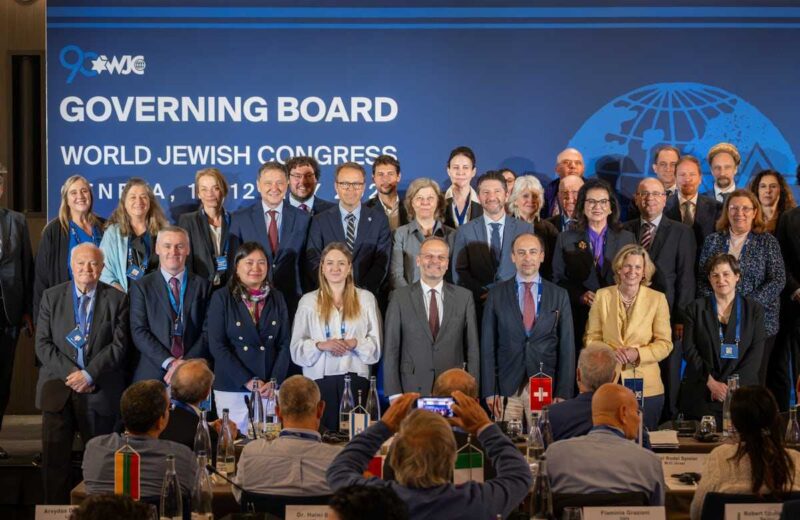
Shahar Aran/World Jewish Congress
Special envoys and coordinators for combating antisemitism from around the world issue joint statement at the World Jewish Congress' meeting in Geneva on May 12, 2026.




 Add EJP on Google
In a show of solidarity, 32 government officials tasked with combating antisemitism and other forms of bigotry around the world released a joint statement today in Geneva, decrying the rise in attacks on Jews and Jewish institutions around the world in recent years and highlighting three core areas for governments to take action: increased security, prosecution of perpetrators and curbing hate speech on social media.
The document, which was shared first with eJewishPhilanthropy, was finalized and released at a convening of the World Jewish Congress’ Special Envoys and Coordinators Combating Antisemitism (SECCA) Network, a group of dozens of officials tasked with fighting Jew hatred in their respective countries. The SECCA meeting was held alongside the World Jewish Congress Governing Board meeting, which kicked off on Sunday.
“Synagogues, schools and Jewish gatherings in many countries have become the target of horrific antisemitic attacks. These attacks are intended to intimidate Jewish communities and disrupt and threaten Jewish life,” wrote the signatories, which included representatives from individual countries, including the U.S., Australia and Canada, and multinational groups, such as the European Commission, Organization of American States and the Organization for Security and Cooperation in Europe.
“Antisemitism is a threat to Jews — and that alone would be reason enough to fight it. But it also erodes the very foundations of our democratic and free societies: human rights and dignity, equality, and the rule of law. A society in which Jews cannot live openly and safely is one in which fundamental rights are under threat for everyone,” the statement reads.
The document paralleled remarks made yesterday by Mathias Döpfner, CEO of the international publishing firm Axel Springer, who stressed the broader threats to Western societies posed by antisemitism and called on non-Jews like himself to do more to address it, if only for self-preservation purposes.
But alongside this concerted push to coordinate and support these special envoys and coordinators, there was a tension at play in Geneva this week around their work and the broader effort to address rising antisemitism.
In an address yesterday, WJC President Ronald Lauder stressed the failures of the Jewish communal world to combat antisemitism.
“Since Oct. 7, [2023,] all Jewish organizations in the United States together have spent upwards of $600 million fighting this avalanche of antisemitism. I have one question. Has it helped? Has all this money stopped? Even slowed down the hatred against us? The answer is no. All the efforts of TV commercials, the full-page ads in newspapers and conferences — all the attempts to tell the world the facts have accomplished very little,” he said.
In Döpfner’s speech, he also highlighted the inefficacy of these officials, noting that in his native Germany, there are 17 such figures — one federal commissioner and 16 state-level officials — whom he described as “an entire bureaucracy [that] is dedicated full-time to soothing consciences,” which “works splendidly” in theory, but “falls short” in practice. (Felix Klein, the federal government commissioner for Jewish life in Germany and the fight against antisemitism, who was in attendance, later pushed back on this description.)
Lauder, who called the address “one of the most crucial” that he’s ever given, called on the dozens of Jewish leaders from around the world to effectively abandon the current fight against antisemitism.
“So how do we fight this? We fight this with a complete change in course. We stop concentrating on antisemites, and we start concentrating and focusing on our children,” said Lauder.
“Take all the money that’s been spent on this media circus and spend it on Jewish education. Concentrate on our own communities, the next generation. This must be our focus. I have seen with my own eyes what Jewish education could accomplish,” he said, noting his background in creating Jewish schools throughout Eastern Europe, where he said there has not been a major rise in antisemitism.
In his speech, Lauder, 82, said that he would not seek reelection as WJC president when his term ends in three years.
While Lauder called for Jewish communities to refocus their energies on educating the next generation, he offered himself as an emissary on their behalf, noting his close ties with President Donald Trump and willingness to speak bluntly to world leaders.
“You have to tell me what you need and how I can help. And I’ll convey that to the leaders of your country. Let me tell you, I have one added strength: I’m not afraid to tell the heads of state that they’re cowards. What do I have to lose?” he said.
“When I say the World Jewish Congress, they know I’m talking for all Jews. And let me say something else. The fact that I’m American and I’m talking on behalf of America and our president gives me power, gives me tremendous strength,” Lauder said. “I know these people well, but I know how weak they are, how scared they are.”