Opinion
SHARED INVESTMENT
Beyond politics, a well still needs water




 Add EJP on Google
In Short
Joint projects between Jews and Muslims may ultimately do more to advance understanding than a hundred conferences about understanding.
Few passengers boarded the plane on my recent flight from Doha, Qatar, to Kinshasa in the Democratic Republic of Congo. Many wore masks, echoing the uncertain early days of COVID-19; reports of a new Ebola outbreak in the DRC had already altered behavior even before touchdown.
I was not traveling as a doctor or aid worker, but to meet the rabbinic leadership of Central Africa. There are not many Jews in Africa, yet the Jewish story on the continent is older and more diverse than many realize: the Ethiopian Jewish communities whose descendants returned to Israel; Igbo communities in Nigeria preserving traditions linked to ancient Israel; the rich history of North African Jewry intertwined with the Muslim world; and South Africa’s established Jewish institutions that continue to support communities across the region.
Alliance of Rabbis in Islamic States
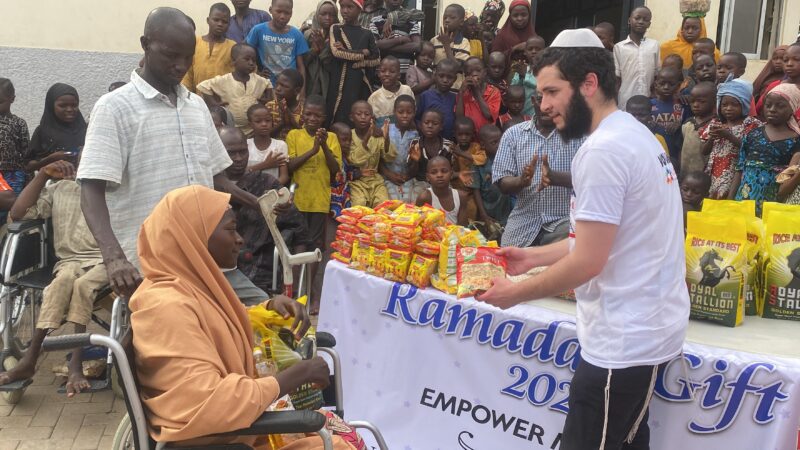
A ChabadAid rabbinical intern distributes Ramadan food packages to families in Nigeria. Through education, food relief and community partnerships, ChabadAid serves vulnerable populations in Africa regardless of religious background.
In sub-Saharan Africa today, with the notable exception of South Africa, most Jewish presence consists of small, scattered groups — businesspeople, teachers, diplomats, investors, aid workers and families quietly sustaining Jewish life far from major centers. Some communities number only 50 families, others a few hundred. Unlike wealthier Jewish centers where institutions are taken for granted — schools, kosher food, security, functioning synagogues — maintaining Jewish life in Africa demands constant improvisation, deep relationships and sacrifice.
In such settings, rabbis are rarely just clergy. They serve as organizers, counselors, teachers, fundraisers, social workers and emergency responders all in one.
This is precisely the kind of work ChabadAid was created to support. With communities small enough that every absence is felt, religious life is intensely personal. The synagogue is not merely a house of prayer; it is often the fragile hub sustaining an entire communal ecosystem.
Yet the work of these communities reaches far beyond their own members. Rabbis and Jewish organizations invest as much energy in food distribution, school support, medical aid and humanitarian relief as in holiday services or Torah study. The line between “religious” and “humanitarian” work blurs. In these places, faith is not abstract — it is responsibility in action.
This reality has reshaped my thinking about Jewish-Muslim relations.
Much contemporary “interfaith dialogue” implies that religions must dilute their distinctiveness to coexist. I disagree. Judaism and Islam are distinct faiths with different theologies, historical memories and perspectives on regional conflicts. Serious engagement requires acknowledging these differences, not pretending they do not exist. Authentic traditions endure by preserving their unique obligations and worldviews.
At the same time, human suffering cuts through political and ideological barriers. A village without clean water cannot wait for geopolitical agreement. A sick child does not demand theological agreement before accepting help. Hunger does not consult a diplomatic calendar.
The masks on the flight were a reminder that vulnerability does not respect borders, religions or political alliances. Disease, like hunger, does not wait for diplomatic consensus.
In many parts of Africa, Muslims and Jews understand this instinctively. They pray and see the world differently, yet they live side by side, trade together, support one another and raise families amid shared challenges. Practical responsibility often outweighs ideological distance.
I have witnessed this repeatedly in Muslim-majority countries where small Jewish communities endure: relationships built not on grand statements, but on everyday trust. A local official securing a synagogue. A Muslim neighbor checking on a Jewish family in crisis. Jewish organizations providing aid to local populations without regard to religion.
The future of Jewish-Muslim relations may depend less on what we say to one another in conference halls and more on what we build together in places of need — schools, hospitals, wells and quiet acts of charity.
I was reminded of this recently while visiting a ChabadAid-supported school in Nigeria. Nearly 4,000 children study there — approximately 2,000 Muslim students and 2,000 Christian students. I was attending the dedication of a new building funded by a Jewish philanthropist from France.
Standing in the courtyard, I found myself looking at a scene that no political analyst could easily explain. Muslim children, Christian children, African educators and a Jewish donor from Europe had all become part of the same story. The children were not being taught to abandon their faith. The Muslim students remained Muslim. The Christian students remained Christian. The Jewish benefactor remained Jewish. Yet together they had built something many adults struggle to achieve: a shared investment in the future.
Watching those students stream between classrooms, I could not help but think that this may be what genuine coexistence looks like. Not agreement on every issue, not the erasure of differences, but people remaining true to their own traditions while working together to educate children, strengthen communities and create opportunity where little existed before.
A school built together may ultimately do more to advance understanding than 100 conferences about understanding.
In another community, a newly drilled well now provides clean water where families once walked long distances each day to collect it. Such projects rarely make headlines. Yet they change lives in ways that political statements rarely can.
The Jewish concept of tikkun olam (repairing the world) and Islam’s emphasis on zakat and care for the vulnerable both frame charity as religious duty, not optional kindness. These traditions need not merge to cooperate effectively. Partnership gains meaning precisely when people remain rooted in their own convictions while upholding the dignity of every human being.
This spirit increasingly guides the cooperation between ChabadAid and the Alliance of Rabbis in Islamic States: not theological fusion, not political alignment, but practical moral responsibility. In Nigeria, ChabadAid runs schools for children who would otherwise have none. In villages across the region, it drills water wells. And each year during Ramadan, it distributes holiday packages to hundreds of thousands of needy families — Muslim families — because a Jewish organization understands that hunger does not ask for a passport or a prayer book.
There is enormous room for this kind of partnership to grow. Across Africa and beyond, religious communities often possess something governments and international institutions lack: trust at the local level, long-term presence and a moral obligation deeply rooted in communal life. If Jewish and Muslim organizations can work together to provide food, medicine, education and dignity, all while remaining fully faithful to their own traditions, they may help model a different kind of coexistence — one built less on slogans and more on responsibility.
Traveling through Central Africa, I thought less about geopolitics and more about these simple obligations. The modern world pushes us into ideological camps where every issue tests loyalty. Yet beyond social media arguments and governmental calculations, people need electricity, medicine, education and stability. Charity often succeeds where politics fails — because it begins with a simple recognition: another human being cannot be ignored.
The Sages taught: “It is not upon you to complete the work, but neither are you free to desist from it” (Pirkei Avot 2:16). Few of us can solve the conflicts that dominate headlines. Few of us can transform entire nations. But all of us can help build a school, support a clinic, feed a hungry family or bring water to a village.
The work is larger than any one of us. Yet none of us is exempt from doing our part.
The Lubavitcher Rebbe taught that the purpose of religious life is not withdrawal from the world, but transforming it into a more Godly place, one act at a time. A better world is built slowly, often beginning with something as basic as bringing water to a village that needs it.
Religious organizations, foundations and governments looking to invest in practical coexistence would do well to look at what is already working quietly on the ground. The model exists. It only needs partners willing to recognize that a well dug together holds more water than any resolution passed alone.
And the work cannot wait. It begins not tomorrow, but today.
Rabbi Mendy Chitrik is the chairman of the Alliance of Rabbis in Islamic States and Ashkenazi Rabbi of Turkey.