SHARING THE STAGE
At JPPI’s annual conference, some heckling and some ‘cautious’ hope
Dana Bar Siman Tov
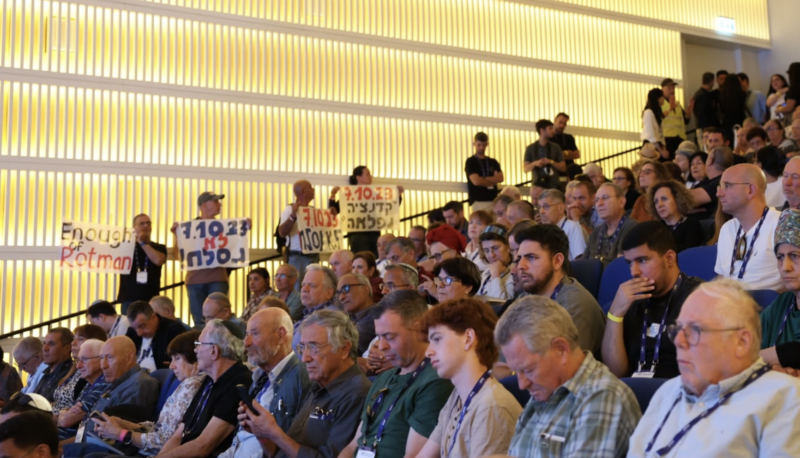
Protestors hold up placards as audience members listen to the speakers at the Jewish People Policy Institute's annual conference on Sunday, June 14, 2026 in Jerusalem.




 Add EJP on Google
Israeli Prime Minister Benjamin Netanyahu has for years cited, almost as an article of faith, that Iran poses an existential threat to Israel. But Shuki Friedman, who runs the Jewish People Policy Institute, contends based on JPPI’s research that Israelis believe the gravest danger facing the country is internal divisions.
“The majority of Israelis think the most threatening challenge is not the Iranian missiles coming tonight, but the lack of cohesion and the rifts within Israeli society,” Friedman told eJewishPhilanthropy, reflecting on the institute’s annual conference, which was held Sunday in Jerusalem.
And as if to highlight those divisions and make Friedman’s point for him, demonstrators heckled from the audience during speeches by former Prime Minister Naftali Bennett, former IDF Deputy Chief of Staff Maj. Gen. (res.) Yair Golan, now running as head of the Democrats Party, and Knesset member Simcha Rothman of the Religious Zionist Party, who is one of the key architects behind the government’s contentious judicial overhaul.
JPPI’s own research buttresses the claim of an Israeli house divided. The institute’s 2026 Israeli Society Index, released at the conference, paints a complex picture (the English edition is expected to be released in the coming days, but the Hebrew version is available here). The “Hope Index” rose compared to last year, meaning optimism is up, but polarization is up as well; and the “Proximity Index” — how warmly Israelis feel toward other groups in their society across political, national and religious lines — fell, suggesting that Israelis feel more distant from those unlike them than they did a year ago. Contrary to what many might assume, the report also found that the war in Gaza and the bitter debate over its execution and the hostage deals did not create these divisions; rather, Israel’s deep internal fractures were already well entrenched before Oct. 7.
The conference, titled “The State of Israeli Society,” brought together politicians on both ends of the ideological spectrum — from Rothman to Golan. It was a deliberate choice that reflects JPPI’s core mission, Friedman said: “We are not affiliated with one side. That enables us to be considered an objective venue and mediator for Israeli society — and this is crucial these days.”
The daylong program covered identity, social cohesion and resilience, with sessions anchored by keynote addresses from Bennett, MK Benny Gantz and Golan. Other speakers included former IDF Air Force Commander Amir Eshel, who served as director-general of the Defense Ministry when Gantz led it, former Minister of Economy Orna Barbivai of the Yesh Atid Party, MK Yaakov Asher of United Torah Judaism and Gila Gamliel, minister of innovation, science and technology. It was a lineup spanning most of Israeli political and religious life — not including the country’s Arab parties.
JPPI has spent the past 2 1/2 years working on what Friedman calls the “Thin Constitution,” an effort to draft the constitutional core of Israeli law, led by a group of experts from across the political spectrum, including Justice Emeritus Elyakim Rubinstein, former deputy chief justice of the Supreme Court.
“In American terms, it’s writing the constitution without the amendments,” Friedman said. “It’s really hard to bring people to agree on values and identity, but that’s exactly what we’re trying to do.”
The Israeli Society Index reflects just how hard that task is. Israelis show higher agreement on universal values — democracy and equality — and far less on particularistic ones, such as the Jewish character of the state and policy toward Palestinians.
Yet Friedman found something meaningful even in yesterday’s heckling: that figures with such divergent views could share a stage at all. “Having serious conversations between people who disagree with each other is very rare in Israel today,” he said.
Friedman said that the conference was defined by what he calls “cautious hope,” with speakers from both the right and left acknowledging the cost of years of division and expressing a willingness to reach across the aisle.
“Both sides recognize that the stakes for this election are incredibly high,” he said. Although this tension risks deepening the political divide, “the fact that they at least express a desire for something different is, in itself, a reason for hope.”
Related News

MAGICAL EXPERIENCE
Shefa launches psychedelics retreat for Jewish professionals suffering burnout

MAJOR GIFTS
Center for Jewish History celebrates 25 years with a $25M matching grant
EXIT INTERVIEW
Elizabeth Sokolsky, longtime EVP of Birthright Israel, to retire next year
PRESIDENTIAL REBUKE
Israel’s Herzog: Mamdani ‘makes no effort’ to hide disdain for Israel, Jews must fight back

EXCLUSIVE
Detroit-based philanthropists Nancy, James Grosfeld donate $8M to renovate JDC’s Israel campus