GROWING TOGETHER
Birthright Israel volunteers construct rooftop gardens for the children of Majdal Shams
The volunteer program has taken a creative approach to building green spaces
Courtesy/Birthright Israel
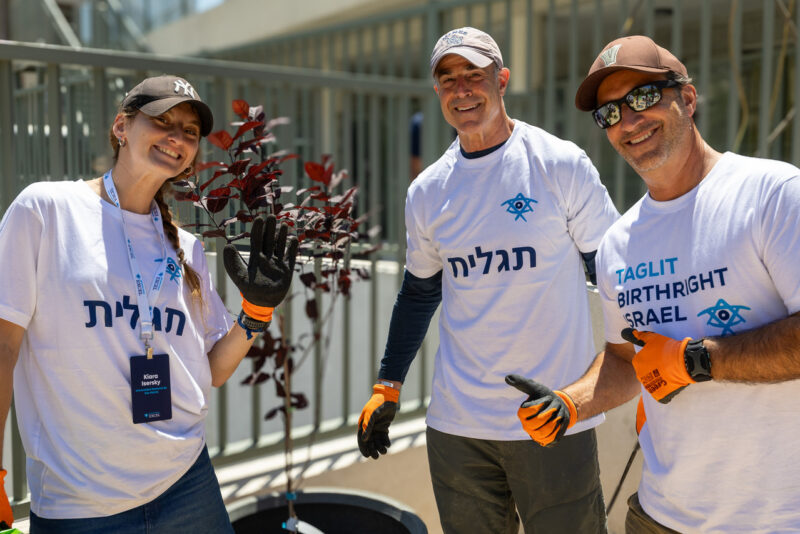
Birthright Israel volunteers in Majdal Shams.




 Add EJP on Google
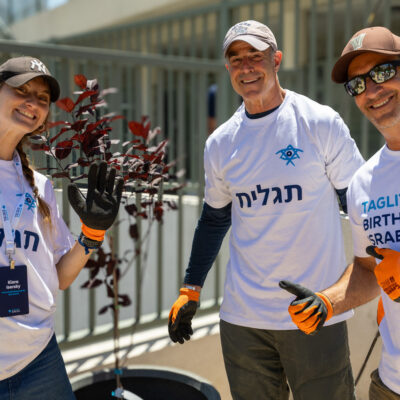
It’s not easy being green, it turns out, in a rugged place like Majdal Shams, located on the slopes of Mount Hermon on the Golan Heights near the border with Syria. Birthright Israel volunteers are learning that the hard way this summer: Since the beginning of July, they have been hauling soil, wood and irrigation lines onto school rooftops to build a network of therapeutic and educational gardens for the children of this Druze village.
The project — part of Birthright’s broader Volunteer In Israel Program funded by the David and Meredith Kaplan Foundation — grew from a seed planted two years ago, Elias Saratovsky, president and CEO of the Birthright Israel Foundation, told eJewishPhilanthropy.
In July 2024, during the war with Iran and Hezbollah, a Hezbollah rocket struck a soccer field in Majdal Shams where children were playing. It was the deadliest single missile attack of the war, killing 12 and injuring dozens. Shortly after, said Saratovsky, the foundation asked if Birthright had any projects there. Birthright staff met with local leadership in the Golan, who welcomed the idea, he said, and the Kaplan Foundation provided “a meaningful investment” to fund the construction of eight gardens across four educational institutions.
Since Oct. 7, 2023, and particularly after the strike in Majdal Shams, the bond between Druze and Jewish citizens of Israel — and Jews in the Diaspora — has grown more pronounced.
In the Golan Heights specifically, communities like Majdal Shams have historically maintained more distance from Israel than Druze in the Galilee because of lingering ties to Syria and its Druze minority. But the Hezbollah attack, as well as the Israeli government’s support of Syrian Druze in Sweida after the fall of the Assad regime, have deepened the bond of the region’s Druze with the state. Applications for Israeli citizenship from Golan Druze are now sharply increasing, a reversal for a community that had largely declined Israeli citizenship when Israel annexed the Golan Heights in 1981.
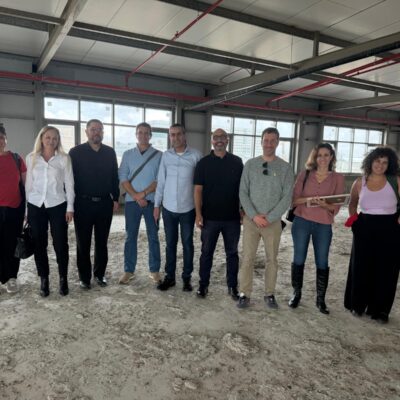
At the start of the project, during a meeting with a group of volunteers, Dolan Abu Saleh, the head of Majdal Shams municipality, talked about when Golan Druze realized that their security was intertwined with Israel’s.
“The turning point for the Golan Druze began on Oct. 8, 2023,” Abu Saleh said. “On Oct. 8, we accepted the Jews and Israelis as our home. Now, the Jews finally accepted us. We arrived first; you met us there.”
Saratovsky described Majdal Shams as a community “that has also contributed so much to Israel, despite the fact that they’re not Jewish.”
The idea for the gardens actually predates the war, Ohad Yaron, Birthright’s director of volunteers and sustainability, told eJP. Shortly before Oct. 7 attacks, the organization started to develop an environmental responsibility strategy: because Birthright flies some 40,000 people to Israel annually, he said, the program was exploring ways to offset its carbon footprint. Cutting it outright was going to be unrealistic, so instead the organization set out to mitigate it by having volunteers physically rebuild and or bring new green spaces to damaged or underserved areas. It is an approach that lets participants “take responsibility over the carbon footprint,” he said, acting as the land’s stewards, and impact local communities in a concrete way.
The result: Birthright participants have built more than 100 projects over the past three years, ranging from small gardens at institutions serving people with disabilities to large community green spaces. When Kibbutz Be’eri’s residents were displaced after Oct. 7 to temporary housing in Hatzerim, a kibbutz in the Negev, said Yaron, volunteers built 300 individual backyard plots, one for each family. Many of the communities affected by war were agricultural communities in Israel’s periphery, making garden-building both a literal and symbolic act of regrowth, said Yaron.
But Majdal Shams presented an unusual predicament: While the town is agrarian by tradition it has “not even one square foot” of open land within it, he said. While the residents’ homes sit on the mountainside, their fields and orchards are located in a valley a 20-minute drive away. The town itself has been built up with concrete, often several stories high, to make use of all available space.
The solution was to put the gardens on rooftops. Working with the municipality’s education department and school principals, Birthright and its architects designed gardens for the town’s school complexes. One site is a four-story kindergarten and “resilience center” that borders where the rocket strike took place, built entirely on top of a parking structure. Another is a five-story school with a garden on its roof; a third is a larger campus with usable land but no resources of its own to develop it. As of early this month, crews were working on what Yaron described as the fourth facility and sixth garden overall. If they find more funding, they’ll expand to the high schools as well, he added.
Building on a roof, Yaron told eJP, is considerably more complex than planting in open ground. Engineers had to be brought in to account for the weight of soil and raised wooden beds, and to make sure irrigation systems don’t damage the concrete below. Volunteers have to carry soil up to the rooftops by hand.
Each garden combines trees, vegetable beds and medicinal herb plots with quiet seating areas where teachers or therapists can work with a full class or one-on-one with a student, along with wooden furniture and play elements for younger children, said Yaron.
In Majdal Shams, community members requested gardens tied to their schools, but other communities in Israel have asked for large communal gardens in the center of town, or climate forests planted around a village’s perimeter, said Yaron.
“Think about areas that are either very arid, or, in the context of Majdal Shams, just concrete, and you build a garden that people can use over time to plant crops, or just to add more color to the community,” Saratovsky told eJP. “They have a therapeutic purpose, and they also have the symbolism of bringing life to a community that needs it.”
Related News

PRESIDENTIAL REBUKE
Israel’s Herzog: Mamdani ‘makes no effort’ to hide disdain for Israel, Jews must fight back
CLOSING WORDS
In AZM address, Cosgrove links communal ‘orthodoxy’ on Israel to rising anti-Zionism among young Jews
EXCLUSIVE
Detroit-based philanthropists Nancy, James Grosfeld donate $8M to renovate JDC’s Israel campus
HIGHER EDUCATION
As Jewish donors reconsider academia, Jan Koum doubles down, endowing Israel studies at Stanford

EXIT INTERVIEW
Elizabeth Sokolsky, longtime EVP of Birthright Israel, to retire next year