Opinion
CAMPUS SCENE
When academic inquiry requires a police escort




 Add EJP on Google
In April, the University of Cincinnati hosted a multi-day conference, proudly supported by the Academic Engagement Network, exploring the Abraham Accords and the possibilities for regional collaboration and cooperation that may emerge from those agreements. Diplomats, policymakers, academics and researchers gathered to discuss topics as wide-ranging as interfaith Zionism, developing an Abraham Accords curriculum and the Accords’ impact on faith, culture and technology.
Of course, as with most events today featuring Israeli or Jewish topics, on campus or beyond, the conference featured a heavy police presence — the “Jewish tax” that organizations are forced to pay to ensure safety in an increasingly antisemitic society.
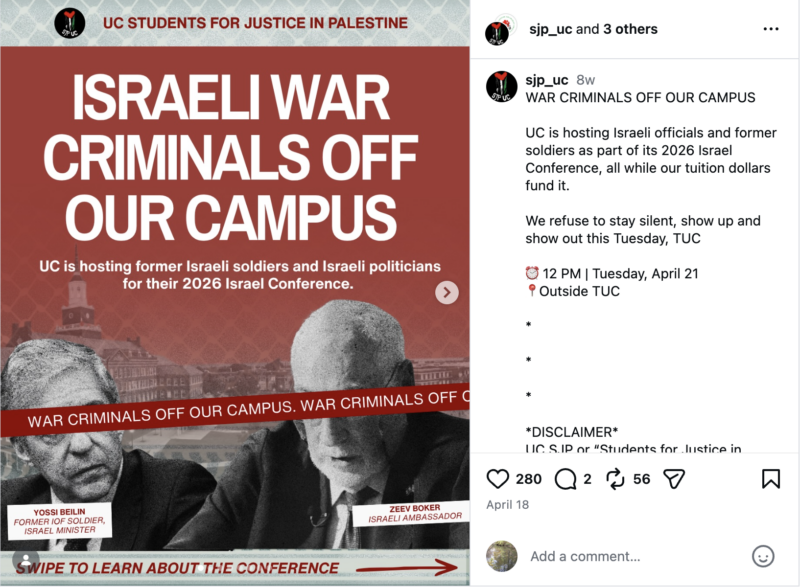
UC Students for Justice in Palestine/Instagram
A call to protest put out by UC Students for Justice in Palestine in advance of the conference.
The importance of such a presence, and the investment needed to maintain it, was made clear on the last day of the conference. A campaign launched by the university’s Students for Justice in Palestine chapter urged community members to disrupt the conference due to the presence of Israeli guests. A group of demonstrators gathered outside, their shouts amplified by loudspeakers. Then, several students who had registered for the final session entered the building and proceeded to disrupt the last speaker, former U.S. Ambassador to Israel Daniel Shapiro, as he made his remarks — one after another, the students read prepared statements mouthing the usual falsehoods about “genocide” and “apartheid,” yelling obscenities and stomping away before the police could escort them out.
Most unsettling was the scene as we left the building, when a small group of demonstrators started shouting at us — and then following us. Additional police arrived; it was obvious it wasn’t safe for us to walk alone. Ultimately, we had to be driven in police cars to our respective hotels and offices.
It was clear that these protesters, at all stages, had been well-trained to get close enough and loud enough to disrupt (and later intimidate), but far enough away to avoid running afoul of the law. This is distinct from peaceful protests, which of course should be protected as a form of free expression.
While I was never under a real physical threat, thanks to the presence and professionalism of the police, it is a jarring experience to have a program of learning, connection and intellectual engagement marred by propaganda, or to be a small person surrounded by people shouting angry, hateful slogans.
But I was more struck by the contrast between the goals of the conference and the rhetoric and actions of the protesters. Despite the current geopolitical situation, and often-differing views among the speakers, the atmosphere at the conference was one of collegiality, dialogue and hope for a future where nations work together to solve common challenges. The protesters did not care about any of that, preferring to repeat talking points given to them by radical organizations whose presence on college campuses have made life increasingly difficult for Jewish faculty and students.
Imagine if they had actually sat in — respectfully — on the panels and sessions, learning about how “normalization” with Israel could bring about more peace and prosperity, one that could benefit all in the region, including the Palestinians whom they claim to support!
But the irony is actually the point, because radical anti-Israel groups, on both the faculty and student levels, are not actually seeking peace and justice. They seek to erase Israel from the Middle East, and understanding that as militarily impossible, to remove “Zionists” — and thus the vast majority of the world’s Jews — from campus spaces.
To a degree, they are succeeding, with their intimidation tactics leading to an erasure of Jewish, Zionist and Israeli perspectives in many academic arenas. Many institutions and organizations are unwilling or unable to pay the “Jewish tax,” and there have been too many instances of deadly violence against Jewish targets in recent years to take risks with security. The result? Israeli speakers are disinvited from conferences and keynote talks. Celebrations of Israel are muted or do not take place at all. Events focused on Israel, antisemitism or the Jewish experience are not widely advertised, with addresses sent to vetted registrants the day before. Just recently, a Jewish Zionist academic and former university president withdrew his name as a commencement speaker at Georgetown Law, under threat of disruptive protests. And this year’s Israel Day on Fifth parade in New York City required an unprecedented police presence to keep marchers and spectators safe. These all have the cumulative effect of implying that there is something controversial, or debatable, about proud, mainstream expressions of Jewish identity.
But Jews and Zionists are not the only victims of this coarsened climate. The whole campus community suffers from the loss of their voices, and from allowing radical faculty and student organizations to violate campus policy and the basic principles of the academy. Places that are supposed to be for critical thinking, social connection, dialogue and debate instead become sites of hostility, exclusion and one-sided narratives. These patterns undermine the very role of the academy in shaping future leaders able to meet the immense challenges of the world.
At the Academic Engagement Network, we work to counter these trends. The faculty members in our network craft innovative programs on Jewish identity, Israel, Zionism and antisemitism, insist on Jewish visibility and bravely discuss their experiences with antisemitism and anti-Zionism in the academy; and the administrators we work with are eager to learn about how to make their campuses more inclusive by incorporating Jewish perspectives.
But we cannot do it alone. It is up to campus leaders — faculty, administrators, trustees and other stakeholders with authority — to reclaim the core values of the academy.
Raeefa Shams is the director of communications and programming at the Academic Engagement Network.