WHAT YOU SHOULD KNOW
With election results unclear, most U.S. Jewish groups stay mum, hail Israeli democracy
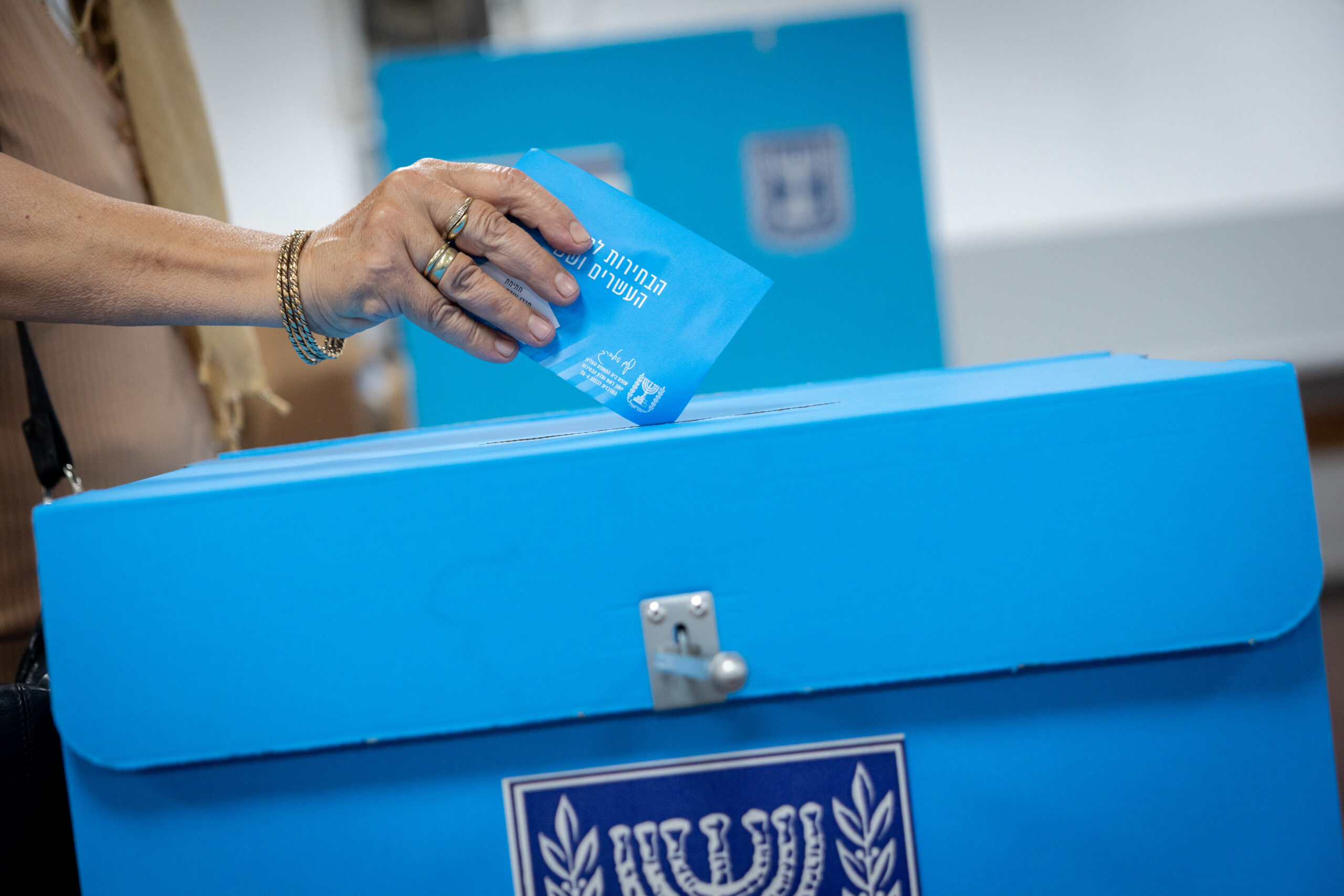
Chaim Goldberg/FLASH90
Israelis cast their ballots at a voting station in Bnei Brak, in central Israel, during Election Day, on Oct. 27, 2026.


 Add EJP on Google
For the first time since the Oct. 7 terror attacks, Israelis headed to the polls in droves yesterday, with the highest turnout rate so far this century. While these elections are perceived by many to be of enormous consequence not only to the country but to Jewry writ large, the initial indications — showing no bloc with a clear path to a majority without breaking a campaign promise or two — have left much of the Jewish world, well, speechless, or at least reduced to banal statements.
Even as workers continue to hand-count the millions of paper ballots cast yesterday — 4,875,751, as of the most recent count at 2:32 p.m. local time, with 84% of the votes counted — two results are already clear: barring truly unforeseen developments, the next Israeli government will not look like its current one; and Arab Israelis, who turned out in unprecedented numbers, have become a more potent political force in the country than ever.
The final results are expected to be announced tomorrow, following a full tally of the normal ballot boxes, as well as the votes of soldiers and diplomats stationed abroad, and after any recounts or appeal proceedings.
Israeli Prime Minister Benjamin Netanyahu is on track to have the largest party in the Knesset, but would not reach the necessary 61 seats with only his current coalition partners — the Haredi parties and far-right Religious Zionist and Otzma Yehudit parties. This marks a significant defeat for the current government, which at its peak controlled a solid 68-seat majority, and is on track to see a roughly 25% loss.
Yet, Maj. Gen. (res.) Gadi Eisenkot, the head of the second-largest Yashar party, can also not put together a majority coalition, without breaking his campaign promise to not include the country’s Arab-majority parties — due to their ambivalence or opposition to Zionism in general and particular concerns about the longevity of such a coalition. Eisenkot has also vowed to not enter into a government with Netanyahu, saying on record that he would resign before doing so.
The exclusion of Arab parties makes the formation of a government far more difficult in this election, in light of Arab Israeli citizens’ historic turnout, garnering the two main parties — the Joint List and Ra’am — 19 seats, according to the latest tally. (This may change slightly as additional ballots are counted.)
Describing the complexity of Israel’s coalition-building, Rabbi David Wolpe quipped: “You have two IKEA furniture kits, no instructions, and you can swap parts between them to try to build one complete dresser. You don’t know what it looks like until you’re done. I.e. Israeli elections.”
Next week, President Isaac Herzog will meet with the parties and hear their recommendations for prime minister before determining who has the best chance of forming a government. If no one is able to do so, the country would go back for another round of elections — and potentially another and another, if no stable coalition emerges, as was the case from 2018 to 2022.
Without a clear vision for what the next government will look like, most Diaspora Jewish groups are primarily hailing the country for its impassioned electorate.
“Israel’s vibrant democracy is on full display in today’s election. Israeli elections are always consequential, but this one carries particular significance for the country and its relationships with the United States, American Jewry, and the broader Middle East,” Betsy Berns Korn and William Daroff, the chair and CEO of the Conference of Presidents of Major American Jewish Organizations, respectively, said in a statement. “We wish Israel well as its leaders work to form a new government and unite the country around a shared path forward.”
In its statement, Jewish Federations of North America also remained neutral on the outcome of the election, saying that it looks “forward to continuing our work with leaders across the political spectrum to strengthen the bonds between Israel and Jewish communities in North America and advance our shared future.”
Some more ideological, progressive organizations are hailing the defeat of the current coalition and calling for the opposition bloc to form a government.
“The message is unmistakable: Israelis want a change in direction. The leaders of the opposition must now move quickly to form a government that breaks with the failed policies of the past and works to ensure equality, security and democracy for all of Israel’s citizens, and everyone living in the occupied West Bank and Gaza,” Jeremy Ben-Ami, president of J Street, said in a statement.
“The voters have spoken. They have rejected the politicians who have ruled Israel so disastrously over the past four years,” the progressive New Jewish Narrative said. “We call on Israel’s political leaders to respect that outcome and put together a new government as soon as possible. Israel cannot afford a long stretch of caretaker rule or another round of deadlock.”
Nira Dayanim and Jay Deitcher contributed to this report.