WHAT’S IN A NAME?
The Dorot Foundation is shuttering; the anti-loneliness Dorot nonprofit is emphatically not
Despite operating in different fields and performing different functions, sharing a name with a shuttering organization has caused this N.Y.-based nonprofit a major headache

courtesy/Dorot
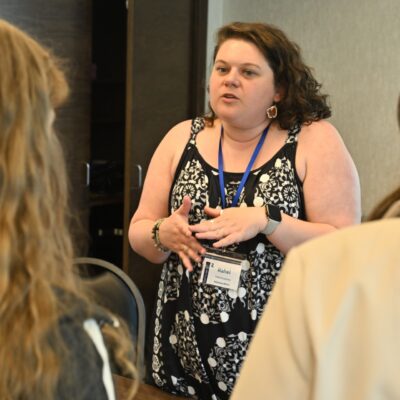
Participants in a Dorot programin New York City, in an undated photograph.




 Add EJP on Google
There’s Jeffrey R. Solomon, the former president of the Andrea and Charles Bronfman Philanthropies, who’s not to be confused with Jeffrey M. Solomon, board chair of the Foundation for Jewish Camp. There’s David A. Harris, the former CEO of the American Jewish Committee, who’s not to be confused with the other David A. Harris, the former CEO of the National Jewish Democratic Council.
There’s also Daniel Septimus, the outgoing CEO of Sefaria, who’s not to be confused with Rabbi Daniel Septimus, the inaugural director of the Center for Jewish Peoplehood of the JCC Association of North America. And for that matter, there’s also the JCC Association, which is not to be confused with the other JCCA, the nonprofit formerly known as the Jewish Child Care Association.
This reporter is even aware of an insurance outfit based out of New Jersey run by brothers Judah and Ari Gross.
Ordinarily, these kinds of duplicate names and abbreviations are good for a chuckle or an easily rectified miscommunication, but for Dorot, a New York-based nonprofit focused on combating loneliness through cross-generational programs (hence the name, which means “generations” in Hebrew), sharing a name with another North American Jewish organization has been something of a nightmare over the past few weeks.
Last month, the Rhode Island-based Dorot Foundation — a grantmaker focused on social justice — announced that it was shuttering, spending down its endowment by 2034.
Soon after eJewishPhilanthropy reported on the Dorot Foundation’s plans to “sunset,” people began to reach out to the New York nonprofit Dorot, believing that it was the one closing down (never mind that it is not a foundation and operates in a different sector entirely). To clarify the matter, eJP added a note explicitly saying that the shuttering foundation had “no connection to the New York-based social service agency of the same name.”
But alas, even with this note, the calls kept coming, Mark Meridy, Dorot’s executive director, told eJP.
“We are still getting a disconcerting number of phone calls,” Meridy said last week. “So we’re just looking to try to alleviate some of the concerns, particularly with our vulnerable older adults, that we’re not going anywhere. We’re financially strong, we’ve got great programming, and we’re not phasing out.”
According to Meridy, it started with calls from clients and participants, concerned that they would soon no longer be able to access the organization’s programs.
“So that was the first alarm bell that went off, of people who were really concerned that the rug is being pulled out from under them,” he said.
“And then I literally had a number of foundations who said, ‘Well, I’m not sure we want to fund you because you’re spending down.’ And we’re not spending down because we’re not a foundation. We’re not giving grants. We are the recipient of grants,” Meridy said.
Finally, he said, other organizations in the field started reaching out to poach Dorot’s employees. “Staff members started to get calls from other organizations. ‘I heard you’re going out of business, do you want to come work for us?’” Meridy said. “And it was just like, no, no, no, no, no, you can’t steal any of my staff. We have an outstanding staff, highly dedicated. Obviously, the staff internally knows that we’re not [shutting] down.”
According to Meridy, there have been mix-ups with the Dorot Foundation in the past, but never at this level.
In addition to sharing a name, the two Dorots also started around the same time — the foundation in 1972 and the social service agency in 1976.
“We were started by recent graduates of Columbia University who literally saw older adults sitting on the park benches on Broadway and on the campus, and it was around the [High Holy Days], so they started by delivering food packages to older adults in the community,” Meridy said. “From there, they developed the ‘friendly visit’ program where volunteers would go out into the community and visit with older adults in their homes. And over the years, we have grown exponentially.”
Dorot now works with close to 7,000 older adults, and deploys more than 8,000 volunteers, who make home visits, phone calls, provide technology assistance or make and send birthday cards, according to Meridy. “For many older adults, that’s the only person who’s acknowledged their birthday, so we’re providing really important work. We have social work services. We have a kosher home meals delivery program. We have programming that’s on-site [at the group’s Upper West Side headquarters,] and we have an office in Westchester [N.Y.]. We also do programming on Zoom,” he said.
In line with its name, Dorot also has programs for younger generations, including a teen program that Meridy said recently received a “major endowment” and is now “called the Anita K. Hersh Jewish Summer Teen Internship,” as well as programs for pre-bar and bat mitzvah children.
“We’re celebrating our 50th year. Our mission of addressing social isolation and loneliness is more important than ever — we know that for people who are isolated, who are lonely, there are increased health risks,” Meridy said. “As a result of that, we’re providing meaningful ways for people to stay engaged and connected. … So we’re alive, we’re strong, and we’re looking ahead to the next 50 years.”
Correction: An earlier version of this article incorrectly identified the donor who provided the endowment for the summer teen fellowship; the correct name is Anita Hersh, not Anita Hirsch, who is — appropriately enough — a homophonous donor to Jewish causes.
Related News

CLOSING WORDS
In AZM address, Cosgrove links communal ‘orthodoxy’ on Israel to rising anti-Zionism among young Jews
HIGHER EDUCATION
As Jewish donors reconsider academia, Jan Koum doubles down, endowing Israel studies at Stanford

EXIT INTERVIEW
Elizabeth Sokolsky, longtime EVP of Birthright Israel, to retire next year
ADVANCING A VISION
N.Y. federation donates $1M toward building shared-society center named for peace activist killed on 10/7

MAGICAL EXPERIENCE
Shefa launches psychedelics retreat for Jewish professionals suffering burnout