RIPPLE EFFECT
Sunsetting Russell Berrie Foundation looks to the future with final Making a Difference Awards
The foundation named after the founder of a plush toy and troll empire is set to close its doors in 2033
COURTESY/Russell Berrie Foundation
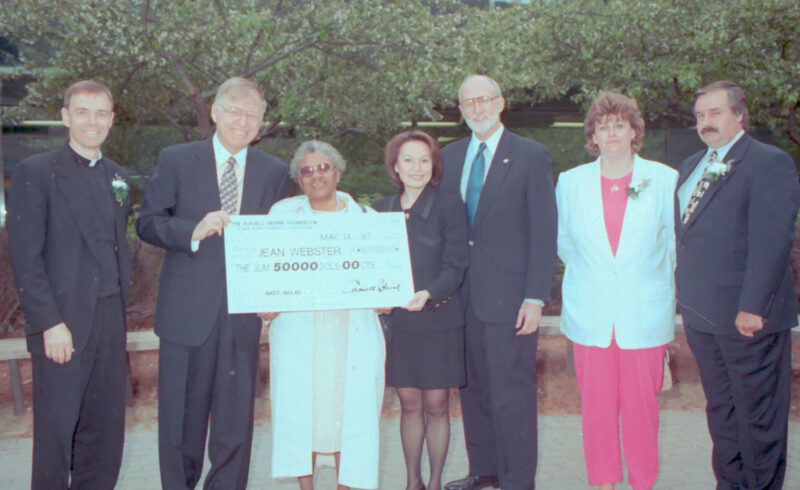
Russell (second from left) and Angelica (center) Berrie present the first Making a Difference Awards in 1997.




 Add EJP on Google
With the Russell Berrie Foundation preparing to sunset after 40 years of supporting initiatives in Israel and — especially — New Jersey, the foundation looked to the future recently, honoring a new generation of changemakers across the Garden State.
At a May awards ceremony at Ramapo College of New Jersey in Mahwah, the foundation honored the 30th and final class of recipients of the Russ Berrie Making a Difference Awards, recognizing the state’s unsung heroes who are transforming their communities. This year’s awards recognized Gen Z leaders creating positive impact.
Over the past three decades, the awards have invested over $4.7 million into 485 changemakers, many whose impact has been felt far beyond New Jersey’s borders. “Each one of those numbers is a story, and for us, each of those stories reveals more than just the awardee, it’s the impact that the award has on the person, on their neighborhood, on their community and others,” Idana Goldberg, CEO of the Russell Berrie Foundation, told eJewishPhilanthropy. “That ripple effect that that award makes possible.”
The foundation awards honorees with a monetary prize — $50,000 for the top winner, $25,000 for the second- and third-place winners and $7,500 for runners-up — as well as professional development opportunities and entry into a community of peers and mentors. While many awardees use the funds to pay off debt or invest in their organizations, one of this year’s winners, Rashanna James-Frison, who was recognized for her volunteerism, used the money to start a college scholarship for women from Newark, N.J., where she was raised.
Awardees often overcome poverty and trauma, but they “realize that they have the ability to do something different, and they just do it,” Goldberg said. “In a given year, you could have somebody who literally jumped into the water to save a person’s life and someone who founded an organization that’s working in 50 states. You could have an 89-year-old who had a lifetime of service, and you could have a 21-year-old who realized that they needed to write a story book when they didn’t see disabled people in the stories.”
This year’s awards highlighted the “ripple effect” that Goldberg spoke of by not only honoring Gen Z changemakers, but by including a separate category that allowed past honorees to nominate new problem solvers.
Russell Berrie, the foundation’s namesake, “loved people, and he bet on people,” Goldberg said. For a period spanning from the 1970s to the early aughts, America’s favorite cute and cuddly stuffed animals came with a red Russ tag. Named by Forbes as one of 2001’s Best Small Companies, Russ Berrie & Co., now known as Kid Brands, Inc., became ubiquitous with mom-and-pop stores, with Russ stuffies adorning shelves at boutiques, card shops, florists and hospital gift shops. Many of the store owners Berrie knew personally and believed in.
It was in 1963 that Berrie founded Russ Berrie & Com. with only $500 in a Palisades Park, N.J., garage. The company would become a $300 million business, and at its peak, Russ Berrie & Co. employed thousands, importing gifts from abroad and introducing the world to classic critters including Fuzzy Wuzzies, Alf finger huggers and a rush of wild-haired trolls. “He built his business and his wealth on this gift company, and the idea of making people happy,” Goldberg said.
Berrie, who was named by Forbes in 1998 as one of the 40 most generous Americans, launched the foundation in 1985. After his death on Christmas Day 2002, at 69, the foundation continued with his widow, Angelica Berrie, at the helm, but last year Goldberg announced it would sunset in 2033.
“The goal isn’t closure but creating sunrises for the organizations and causes that we care about, ensuring that our impact continues long after our foundation closes,” Goldberg said in a statement.
The Making a Difference Awards “honor Jewish values in action: justice, compassion, responsibility and care for the vulnerable,” Berrie’s son, Scott, an Emmy Award-winning producer, told eJP. “Some honorees come directly from the Jewish community while others reflect the diversity of New Jersey’s demographics, yet the values they embody are both universal and deeply reflective of those Jewish values that my father instilled in me and which animate our foundation.”
The awards relay the message to young leaders that “you do not have to wait for permission to do good,” the younger Berrie said. “These young leaders are not just volunteering around the edges. They are building things. They are starting programs, organizing peers, addressing food insecurity, advocating for literacy and opportunity and even stepping into public service… They are not waiting for institutions to solve every problem; they are creating the first response themselves.”
When Gary Oppenheimer won the award in 2011, he said it was like joining a family,
“I had not known anything about Russ Berrie before this happened,” Oppenheimer, the founder and executive director of AmpleHarvest[dot]org, a nonprofit that invites farmers to share their surplus harvest with local pantries, told eJP. “It was a huge honor to be recognized at the time. AmpleHarvest[dot]org was a much younger and much smaller organization than it is today, and even when I got to the event, I discovered, ‘Wow, I’m in the same room with some of these other really serious heroes.’”
The award provided Oppenheimer with much-needed funding, but the foundation also offered consulting from a nonprofit expert. Today, he is inspired by the passion and impact of new winners and is honored to serve as a mentor to them, as others were to him.
“In a world where there’s so much negativity, to highlight the positivity and the good that’s going on is so important,” said Rabbi Zalman Grossbaum, a 2018 honoree and the co-founder and CEO of Friendship Circle and Lifetown, organizations that support children with special needs — or “unique abilities,” as they call it.
Every year, his organizations serve tens of thousands of participants of all backgrounds, including ones with “head coverings that are not necessarily yarmulkes,” Grossbaum told eJP. Like the awards, Friendship Circle and Lifetown have Jewish roots, but create connections across differences. “The real magic of [the awards is that] you come to realize the number of people who are not… billionaires, who are not Elon Musks, who still come along and say, ‘I can make a difference. I can change my community or my country.’”
For young people especially, receiving the award is a reminder that their voice matters, Ezra Fineman,17, a 2026 Gen Z honoree, told eJP. Too often, members of Gen Z feel like no one will listen to them, he said. “Then they end up just not doing anything or just not sharing their ideas.”
Fineman won the award after creating the “Hyper IgM Podcast,” which supports patients and families of individuals with Hyper IgM, a rare primary immunodeficiency disorder. He had been diagnosed with the disorder as an infant and received the first of two stem cell transplants when he was 3. Receiving the awards drew attention to his podcast and the Hyper IgM community, “a one-in-a-million rare disease,” he said, as well as similarly rare disorders that he and his guests discuss on the podcast.
“The award just really reaffirmed my commitment to advocacy,” Fineman, who is about to enter his senior year of high school, said. “I hope as the podcast grows, I can continue to reach out to more organizations, maybe even start partnering with some organizations to help get my message out, but I plan to not let up the gas on my efforts.”
Even though the awards are ending, “what’s coming next is what our 485 winners choose to continue to do,” Goldberg said. “We see the legacy of the program in the organizations they’ve developed, the food they’ve harvested, the mothers that they’ve helped care for their children, the children that have learned how to play an instrument, the people with disabilities that are continuing to be included. Or,” she said, “just all of these organizations and people who are continuing to do this work.”
Related News

PRESIDENTIAL REBUKE
Israel’s Herzog: Mamdani ‘makes no effort’ to hide disdain for Israel, Jews must fight back
CLOSING WORDS
In AZM address, Cosgrove links communal ‘orthodoxy’ on Israel to rising anti-Zionism among young Jews

MAJOR GIFTS
Center for Jewish History celebrates 25 years with a $25M matching grant
HIGHER EDUCATION
As Jewish donors reconsider academia, Jan Koum doubles down, endowing Israel studies at Stanford

EXCLUSIVE
Detroit-based philanthropists Nancy, James Grosfeld donate $8M to renovate JDC’s Israel campus