SIDELINE CONVERSATION
Shira Ruderman: ‘At a time of crisis, who can change this situation? Only philanthropists.’
In an interview at the Israeli-American Council summit, the executive director of the Ruderman Foundation says it's time for critical reassessment of Jewish communal institutions
Noam Galai/IAC
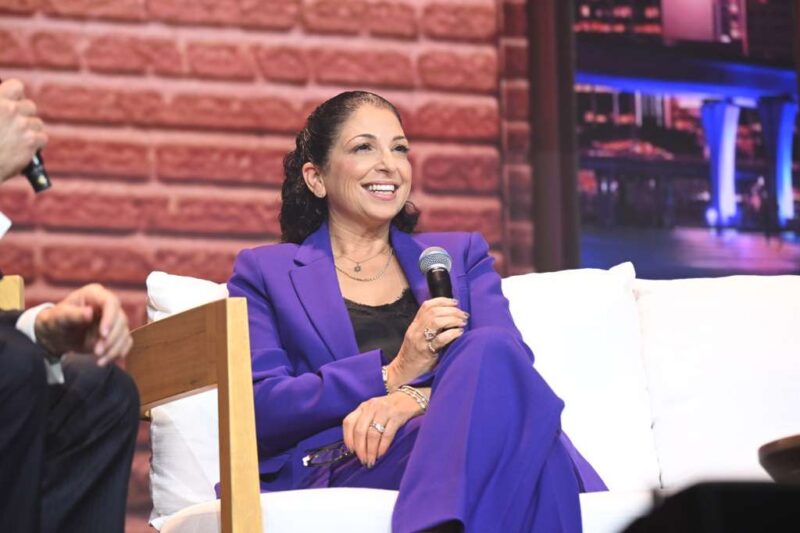
Shira Ruderman at the Israeli-American Council summit in Hollywood, Fla., on Jan. 16, 2026.




 Add EJP on Google
HOLLYWOOD, Fla. — With financial resources and the high-level connections that come with them, Jewish philanthropists are both uniquely qualified and duty-bound to lead the Jewish world as the community grapples with heightened antisemitism, division and other “existential” threats, according to Shira Ruderman, executive director of the Ruderman Family Foundation.
“Our role is to move the Jewish world forward,” Ruderman told eJewishPhilanthropy over the weekend, speaking on the sidelines of the Israeli-American Council’s National Summit in Hollywood, Fla. “At a time of crisis, amid rising antisemitism and an existential reality, who can change this situation? Only philanthropists. We are the ones who can make the change.”
In an interview, Ruderman, who splits her time between Israel and Boston, where she moved 24 years ago after marrying American attorney, activist and philanthropist Jay Ruderman, was unequivocal about the moment the Jewish world is facing, arguing that philanthropy must be understood not merely as financial support.
“The Jewish world today is more dependent than ever on philanthropy — but not only on money,” she said. “This is the moment to call on philanthropists to act not only through financial support, important as it is, but through true leadership.”
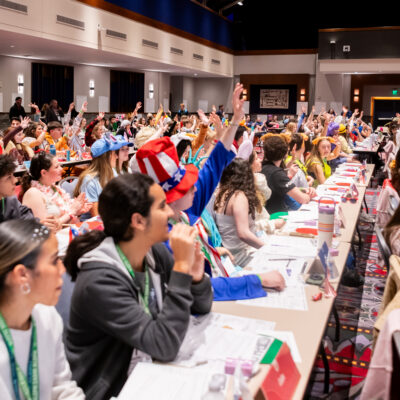
Some 3,500 people from across North America and Israel attended IAC’s summit, which marked both the 10th national gathering and 18 years since its founding in Los Angeles. Over the course of three days, Jewish communal leaders, philanthropists and activists gathered to discuss the challenges and responsibilities facing the Jewish world today.
Among participants were several high-profile figures in the Jewish philanthropy world, including Dr. Miriam Adelson, Adam Milstein and Shawn Evenhaim. Rabbi Doron Peretz, executive chairman of the World Mizrachi movement and president of the World Zionist Organization, actor and podcast host Jonah Platt, and Safra Catz, executive vice chair of Oracle, also attended the gathering.
In the wake of the Oct. 7 terror attacks and the rise in global antisemitism that followed, Ruderman said Jewish philanthropists must reassess how and where they allocate their resources. For instance, many Jewish donors give generously to universities, she said, but they fail to support Jewish students at those schools.
“We’re not talking about millions of Jewish students,” she said. “Even if there are 200,000 Jewish students, that is a number you can count.”
Even for donors who do support Jewish students, this is often being done in a disorganized, redundant way.
“We’re not working efficiently enough and not working together. For the same student, there are 20 organizations, each with 20 different messages, and this poor Jewish student is left asking, ‘Who do I go to?’” Ruderman said. “Instead of us, the Jewish people — with some of the best minds — thinking about how to streamline this, how to reach students faster, with less wasted money and with efficiency that leads to real impact.”
She called for a candid reassessment of the field — not only for university groups, but more broadly in the Jewish world — and a need to address the reluctance and difficulty in shutting down organizations that no longer function effectively. “It’s not a failure to say we’re no longer needed,” she said.
While such conversations happen privately, she noted, they rarely translate into action because the decisions are difficult and emotionally charged. But following Oct. 7, Ruderman believes the moment for such hesitations has passed. The crisis, she said, demands structural change, courage and a willingness to rethink how the Jewish world organizes itself — before inefficiency becomes irreversible.
Ruderman also acknowledged the difficulties of operating in the Jewish philanthropy and nonprofit world, which is closely monitored and scrutinized. The Jewish world, she noted, is intensely engaged, but it can also be intensely critical. “You’re constantly being judged,” she said, adding that the criticism often comes from multiple directions at the same time.
She also addressed the broader tension many Jewish philanthropists grapple with today: how to balance universal engagement with Jewish responsibility.
“There are two philosophies, and there is room for both,” she said. “You can’t place all the solutions only within the Jewish world. In the end, we are a small group in a very large world. If we want to have influence in many places, we need to be part of larger organizations. Therefore, it is legitimate to give to broader causes and not only to Jewish needs. At the same time, when you give to other organizations, the question is whether you bring your identity with you — your Jewish identity — or whether you are absorbed into the larger crowd.”
Disclosure: The Israeli-American Council provided eJewishPhilanthropy’s travel and accommodations.
Related News
HIGHER EDUCATION
As Jewish donors reconsider academia, Jan Koum doubles down, endowing Israel studies at Stanford

EXCLUSIVE
Detroit-based philanthropists Nancy, James Grosfeld donate $8M to renovate JDC’s Israel campus
ADVANCING A VISION
N.Y. federation donates $1M toward building shared-society center named for peace activist killed on 10/7

MAGICAL EXPERIENCE
Shefa launches psychedelics retreat for Jewish professionals suffering burnout

MAJOR GIFTS
Center for Jewish History celebrates 25 years with a $25M matching grant