BARUCH DAYAN EMET
Rabbi Andrea Weiss, the first woman to ordain Reform clergy, dies at 60
'A generation of rabbis, cantors and educators were blessed to study Hebrew Bible with her'
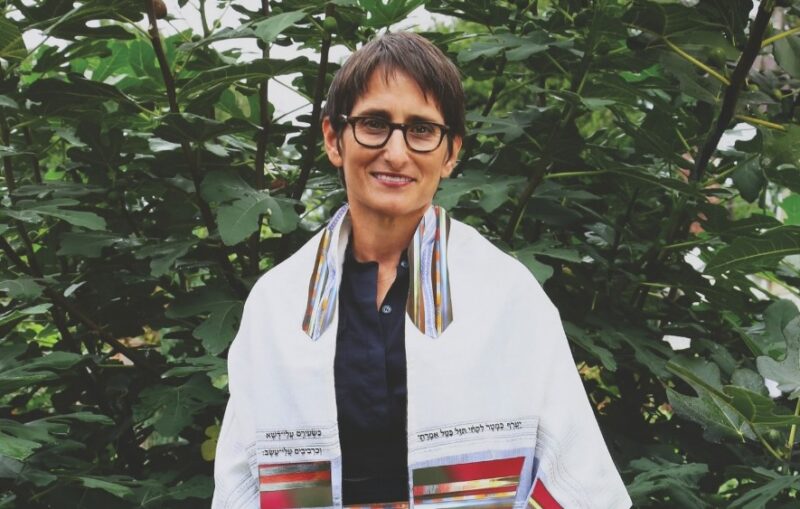
Courtesy
Rabbi Andrea Weiss.




 Add EJP on Google
Rabbi Andrea Weiss, the first woman to ordain Reform rabbis and cantors, died on Tuesday at her home in Lower Merion, Pa., after a battle with lung cancer, a loss described by Reform movement leaders as “enormous.” She was 60.
Weiss, a pioneer in the Reform movement, remains to this day one of the few female rabbis to have ordained Jewish clergy. She served for more than two decades as a professor of Bible, and later provost, of the movement’s flagship seminary, Hebrew Union College-Jewish Institute of Religion in New York, where she was ordained in 1993. During the COVID-19 pandemic, Weiss created the institution’s first remote curriculum.
Lisa Hostein, executive editor of Hadassah Magazine and a longtime friend of Weiss’ told eJewishPhilanthropy that the two “shared personal and professional triumphs and challenges and whatever the subject, she always exhibited the same wisdom and warmth she became known for in the wider Jewish world.”
Among the Jewish leaders Weiss taught is Rabbi Hilly Haber, director of social justice organizing and education at Central Synagogue in New York. In a statement to eJP, Haber reflected on her time as a student, saying, “with the breathless urgency of the prophets, Rabbi Weiss called us to moral leadership and filled us with renewed hope in times of uncertainty and pain. With humility and courage, she modeled for her students a rigorous engagement with and love for Jewish texts and instilled in us a commitment to transforming the world through sacred imagination.”
Weiss was remembered by Andrew Rehfeld, HUC’s president, as a “transformative presence” at the institution. “Her scholarship, vision, and fierce commitment to the formation of Jewish clergy have shaped this institution in ways that will endure for generations,” Rehfeld said in a statement.
The Central Conference of American Rabbis, the Reform movement’s rabbinical arm, called Weiss “a prolific scholar whose life and learning were her students’ greatest texts.”
“Reform rabbis will miss Rabbi Dr. Weiss’s menschlichkeit, brilliance, compassion, wisdom, integrity, eagerness to learn, and so much more,” CCAR said in a statement. “A rabbi’s rabbi, she was a generous teacher, mentor, and friend who truly loved her students and was invested in their successes. The loss to our Reform Movement is enormous. The grief of those who were ordained by her and of her faculty and staff colleagues is tremendous.”
“If you knew Rabbi Dr. Andrea Weiss, z”l, then you loved her,” wrote Rabbi Rick Jacobs, president of the Union for Reform Judaism, the movement’s North American congregational arm. “Brilliant, kind, wise, and open only begin to describe this remarkable human. A generation of rabbis, cantors and educators were blessed to study [the] Hebrew Bible with her.”
Her legacy extends beyond professional Jewish communal work, Weiss’ daughter, Rebecca Tauber, told eJP. “She could do everything,” reflected Tauber. “She would spend all day teaching and then she would cook us a homemade, very good meal for dinner and then she’d go back to her desk and work on a book introduction or a sermon and then she’d sit down with me and edit my high school English paper.”
Tauber, a staff editor at The Athletic, credits her mother for inspiring a career in journalism. “She made me a writer and editor. When I was little she would bring me to New York with her and I’d sit in her classes and then we’d go to Books of Wonder, the children’s bookstore, and she’d buy me whatever books I wanted,” Tauber said. “She was also a model for what it means to pursue passion-driven work.”
Tauber said that growing up, “we were always the house hosting Rosh Hashanah dinner and Passover Seder, which she would lead. She was always the person at synagogue who went up to the new person and asked if they had somewhere to go for Shabbat.”
But her outreach expanded beyond the Jewish community. “She was always the person to cook for someone sick or send unsolicited messages about what someone meant to them,” said Tauber. “I had the perfect model.”
Weiss was raised in San Diego, where her family belonged to Temple Emanu-Ell. She received her bachelor’s degree from the University of California, Berkeley, in 1987. After becoming ordained as a rabbi, she returned to school, receiving her Ph.D. from the University of Pennsylvania in the Department of Near Eastern Languages and Civilizations in 2004.
Weiss went on to author and edit multiple books, including Figurative Language in Biblical Prose Narrative: Metaphor in the Book of Samuel, which she wrote in 2006. Two years later, Weiss won the National Jewish Book Award’s Book of the Year for her role as associate editor of The Torah: A Women’s Commentary.
In 2016 and 2020, Weiss helped establish an interfaith public scholarship project called “American Values, Religious Voices,” which compiled letters written by 100 leaders across religions and denominations to the president and Congress for the first 100 days of the first Trump administration and the Biden administration. The letters were later published in two book volumes.
The project, according to Weiss, was “a national, nonpartisan campaign created from the conviction that scholars who study and teach our diverse religious traditions have something important to say about our shared American values.”
Weiss, who was a member of Congregation Beth Am Israel in Penn Valley, Pa., is survived by her husband, Alan Tauber, an attorney; and their two children, Rebecca Tauber and Ilan Tauber.
Related News
EXCLUSIVE
Detroit-based philanthropists Nancy, James Grosfeld donate $8M to renovate JDC’s Israel campus
CLOSING WORDS
In AZM address, Cosgrove links communal ‘orthodoxy’ on Israel to rising anti-Zionism among young Jews

EXIT INTERVIEW
Elizabeth Sokolsky, longtime EVP of Birthright Israel, to retire next year

MAJOR GIFTS
Center for Jewish History celebrates 25 years with a $25M matching grant

MAGICAL EXPERIENCE
Shefa launches psychedelics retreat for Jewish professionals suffering burnout