Q&A
Post-Oct. 7, Israeli international development and aid groups struggle to raise funds, find partners
New study by SID-Israel finds that while organizations are facing new and growing challenges, they are also displaying resilience and adaptability, CEO tells eJP
courtesy
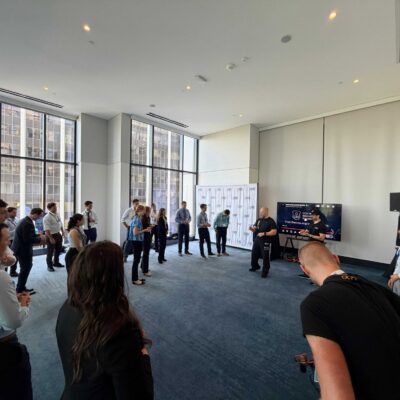
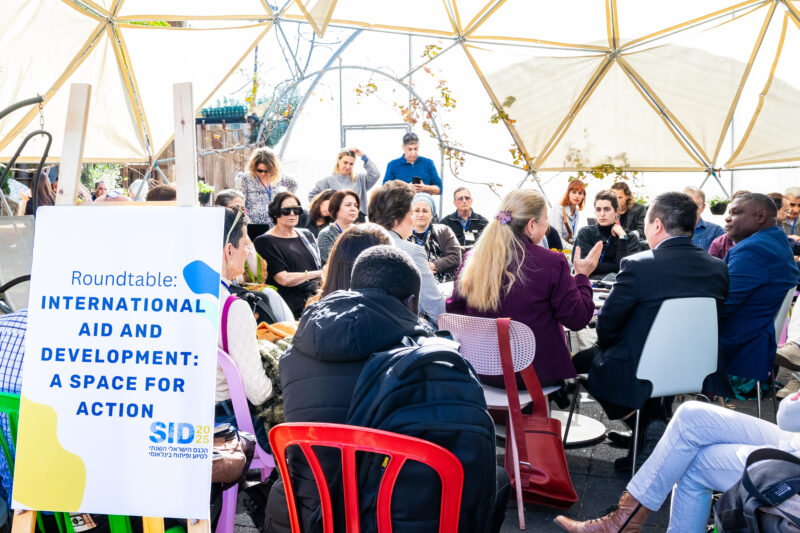
Representatives from Israeli international development and humanitarian aid groups attend the SID-Israel conference in 2025.




 Add EJP on Google
It is a hard time to be an international development or humanitarian aid organization. It is an even harder time to be an Israeli international development or humanitarian aid organization, facing all of the same challenges as other groups — namely, a gutting of American federal support through USAID and a resulting scramble for the remaining resources — while also dealing with overt and subtle boycotts, ideological purity tests and general exclusion from the field.
These are the findings of a recent study of the field following more than two years of war by the Society for International Development-Israel, which is being released this week ahead of the group’s conference later this month. The survey was conducted among 20 Israeli aid and development nonprofits, for-profit companies and representatives of academic programs operating in Israel and abroad. Half of the respondents said that since the Oct. 7 terror attacks, they have seen a drop in donations, in some cases a sharp one. More than one-third reported particular struggles securing multi-year grants, making long-term planning more difficult.
In addition to the fundraising issues, many of the respondents reported antisemitic or anti-Israel experiences. This includes roughly half of the respondents saying that since the war began, they have lost or scaled back partnerships with overseas partners. Sixty percent reported antisemitic or anti-Israeli experiences, as well as a quarter saying that they had felt forced to state their opinions about the war in Gaza as a litmus test. This has resulted in 40% of organizations saying that they have since downplayed their Israeli identity or otherwise changed “how they present their work,” according to the survey.
But the survey was not all bad news, with follow-up interviews indicating a high degree of resilience, with respondents showing a high degree of adaptability and grit, according to Ayelet Levin-Karp, the CEO of SID-Israel.
eJewishPhilanthropy spoke with Levin-Karp today to better understand the results of the survey and the Israeli development and humanitarian aid field.
This interview has been lightly edited for clarity.
Judah Ari Gross: The numbers in your survey are severe and there’s obvious value in having data, but they do not seem particularly surprising to me, considering what we’ve heard and seen anecdotally over the past two years. Just a few weeks ago, for instance, we reported on IsraAid scaling back its headquarters and international missions because of some of the fundraising issues addressed in the survey. Did anything in this stand out to you?
Ayelet Levin-Karp: Yeah, there was nothing there that was very surprising for us. But first of all, it is important to put numbers to our experiences and our feelings. In many ways, I will say that it’s [describing] a phenomenon that anybody in Israel who deals with the external world has experienced. Anyone who’s working in academia or businesses or many different sectors is feeling that pushback, but I feel that in our community, which is very involved with the humanitarian work in Gaza and is generally very liberal, I think we’re feeling even more of that.
I must say that these are not nice figures to see. It’s upsetting and also disappointing that these are the reactions that our community is getting when it’s really going out there to help and do good globally. It’s also really remarkable to keep in mind that with everything going on internally in Israel and with the pushback that we’re getting from the world, most of our organizations and companies did not close [their doors] and are still continuing to do this amazing work that they’re doing throughout the world. [It shows] the resilience of this community and its inner drive. We’re not looking for permission from anybody to do what we want and think is right to do. We’re continuing to do it even when it’s becoming much harder.

JAG: In terms of the loss of donations, did the survey identify how much of that was connected to the cuts to USAID and other forms of government funding versus private donations?
ALK: As you mentioned, the entire funding of our ecosystem went through a big event this year with USAID, but it’s not only USAID. There was a lot of institutional funding drawback. We did have some organizations that were USAID-funded, but that’s definitely not the whole story. I think the full story is that pushback from the international organizations, which I must say, it was quite subtle, but definitely present. If one person’s not answering your email, you’re like, ‘OK, whatever,’ but when you see it so consistently throughout the ecosystem, it’s clear that it’s a trend.
But the other part of it is also the classic “tikkun olam” Jewish philanthropy, which dropped. Some of it, I think, was kind of shying away from [from the field] after being so disappointed by the world in general. But it was more so a shift of priorities because so much was going on and so much support very rightly needed to come to Israel and to support the Jewish communities with their own struggles with a rising antisemitism, etc. I think the “tikkun olam” was perceived as maybe luxurious or “nice to have” and not so pressing in these very stressful two-plus years.
JAG: I don’t want to come across as Pollyanna-ish — these are obviously tough times for the field — but did you find any positives from this period, groups finding more effective ways of doing things, accomplishing more with less or finding new partnerships because existing ones went away? Has this just been a time of scaling back or has this forced innovation in the field?
ALK: First of all, I mentioned the drawbacks that we felt from Jewish philanthropy. I think one trend that we’re starting to see, which is interesting, is Jewish philanthropists who used to give to global international development or humanitarian aid [organizations] and who were not so excited about the way some of these organizations are operating, now looking to support the Jewish or Israeli ecosystem more. So I think that’s an interesting trend. I don’t even know if we can really call it a trend yet, but maybe a beginning of a trend. It’s attracting different kinds of donors.
Besides just helping to close the funding gap, it’s also sometimes providing more professional kind of support because if [philanthropists] are coming from the field or have much more knowledge in international development and humanitarian aid, they can raise the bar of what is expected and how the organizations should be operating — measuring the impact and making sure that they’re working according to the highest standards — which I think is a good thing for our ecosystem.
Another interesting thing. I don’t know if that’s what you meant, but it’s true that the entire international development and humanitarian aid ecosystem is going through a big funding shift, and everything is repositioning. In that sense, our organizations are showing their resilience and adaptability. In a way, that’s the DNA of these organizations. They’re innovative, they’re able to do things differently and rely on technologies. We also have a big private sector effort in Israel that is very relevant for the challenges of the global humanitarian work. It’s not the topic of this interview, but one of the trends that we see is moving towards the private sector and blended finance, with an understanding that these problems will not be solved just by philanthropy or governments and trying to create new models. And I think the Israeli ecosystem is positioned very well for those kinds of trends and shifts. And in that sense, there’s an opportunity there that if we know how to realize what’s going on and show up and not be pushed back by those attitudes that we get as Israeli organizations, we could actually leverage that a lot.
And that’s actually what our upcoming conference is all about: thinking about the future and trying to imagine different kinds of scenarios and see how we, as an Israeli ecosystem, can position ourselves in these scenarios and not dwell so much about what we lost and how the world treated us, but rather think of “What are the main trends and what can we do better to to fit and grow from all these really big shifts that are happening?”
JAG: The survey also mentions growing concerns about security. How does that manifest? I don’t imagine that these groups are suddenly setting up checkpoints outside the emergency clinic that they are operating.
ALK: Generally speaking, all the trends that we mentioned have less to do with the field. I don’t know of any operations that closed because the local communities or the local partners were pushing back or didn’t want to have anything to do with Israel. The issue is seen much more with working with international organizations or in the international space.
I’ll give you an example: In the last [United Nations climate conference] COP, Israel didn’t have a national booth. It went under the radar. There were Israelis around, but there wasn’t a national booth. Israelis definitely went, but even last year and definitely in the years before, Israel had a big booth that was the home for the Israeli organizations and companies and academia to show what they have. And we know that we have so much to give and to learn when it comes to climate change. And this year we chose not to be there.
And I wasn’t in the decision-making room when that happened, but I believe it was because they were afraid of the implications, of the security, of the backlash that they would get in that space. I’m happy I didn’t need to make that decision, but the fact that Israel did not show up to the biggest gathering about climate sends a big message to the world, which, for me, is very upsetting.
This is a big example, but I have also had a lot of conversations with community members, CEOs of different organizations and companies that were going to different conferences and were worried about showing up as Israelis. Sometimes, they did get backlash, sometimes they were pleasantly surprised. But it’s not easy to walk around in these spaces today as Israelis. And to create those partnerships and relationships that we’re used to.
JAG: Post-Oct. 7, there are two trends that have emerged simultaneously. One is the rise of so-called “Oct. 8 Jews,” who became more engaged after the attacks, and the other is people who are moving away out of fear, taking off Star of David necklaces and downplaying their Jewish identity. The survey mentioned that 40% of respondents were downplaying their connections to Israel. But are you seeing the other side, people or groups who are more openly identifying as Israeli?
ALK: Both trends that you mentioned are definitely there, but I think there are more organizations that are showing up as Israelis, and it’s important for them to show that face to the world. They feel it’s part of their goal now, maybe even more than it was before, even with all of the ambivalence that some of them might have to what Israel is doing or not doing in different scenarios. They still feel that they are showing up to the world in a way that they want our country to show up, and that it’s also our responsibility to do so.
Another “Oct. 8” kind of phenomenon that we saw in our community is that we had organizations and companies that never worked in Israel before, who literally on Oct. 8 opened operations in Israel. Some just did it for a month or two or three, until it wasn’t needed. But some actually continue to do very meaningful work in Israel, alongside the work they do internationally.
And we see groups taking what they learned from years of operation in different devastating situations, bringing those capabilities to Israel when Israel needed it. And even more interesting, today we see that the lessons that were in Israel [post-Oct. 7] being translated and moving back the groups’ work internationally.
Related News
EXIT INTERVIEW
Elizabeth Sokolsky, longtime EVP of Birthright Israel, to retire next year
HIGHER EDUCATION
As Jewish donors reconsider academia, Jan Koum doubles down, endowing Israel studies at Stanford

MAGICAL EXPERIENCE
Shefa launches psychedelics retreat for Jewish professionals suffering burnout
CLOSING WORDS
In AZM address, Cosgrove links communal ‘orthodoxy’ on Israel to rising anti-Zionism among young Jews
PRESIDENTIAL REBUKE
Israel’s Herzog: Mamdani ‘makes no effort’ to hide disdain for Israel, Jews must fight back