SURVEY SAYS
In informal JFNA poll, majority at GA say two-state solution ‘unrealistic’
Though nonscientific, the findings indicate widening cracks on what was once a foundational belief among American Jewish institutions
Courtesy/JFNA
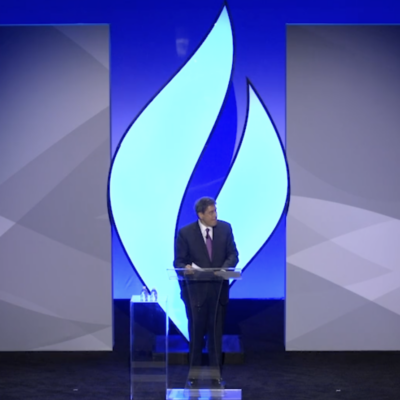
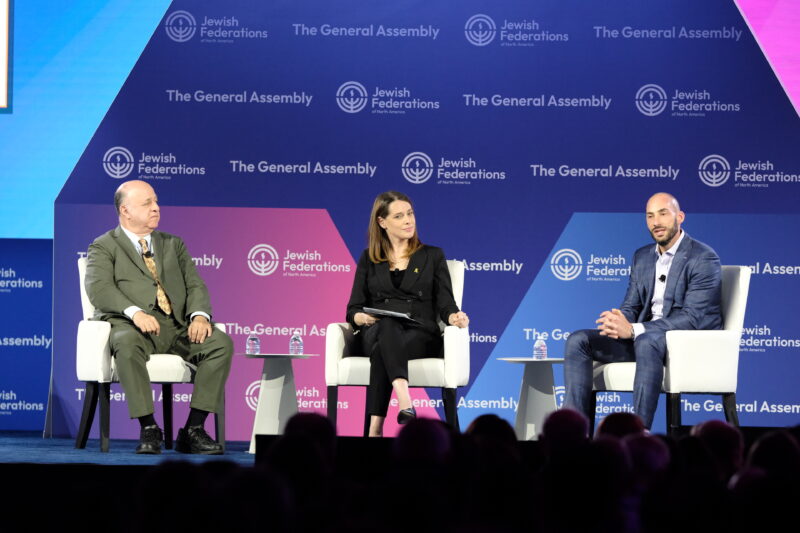
John Podhoretz (left), editor of the conservative Commentary Magazine, debates Michael Koplow, chief policy officer of the Israel Policy Forum, about the viability of the two-state solution as Israeli journalist Tamar Ish-Shalom moderates onstage at the Jewish Federations of North America General Assembly in Washington on Nov. 17, 2025.




 Add EJP on Google
More than two-thirds of attendees at the Jewish Federations of North America’s General Assembly believe that there is no “realistic future” for a two-state solution to the Israeli-Palestinian conflict, according to an informal poll that was conducted at the gathering.
The poll was conducted both preceding and following a Sapir debate between John Podhoretz, editor of the conservative Commentary Magazine, who argued against the two-state solution’s viability, and Michael Koplow, chief policy officer of the Israel Policy Forum, who argued in favor of it. The discussion took place during the Monday afternoon plenary and was moderated by Israeli journalist Tamar Ish-Shalom. In attendance were Jewish federation professionals, lay leaders, philanthropists, students and others.
Opening the debate, Ish-Shalom posited that in recent memory, the two-state solution has been the most popular potential resolution to the conflict among American Jews and American Jewish institutions. “We’re beginning to seek cracks in support for the viability of this ideal, even among some mainstream Jewish organizations,” she said. “So tonight, we asked the essential question: Is there a realistic future for the two-state solution?”
Prior to the debate, the audience split almost evenly, with 53% of participants voting that it was not realistic, compared to 47% voting that it was. After the debate, the gap widened significantly, with 67% of professionals voting that it was not feasible and 33% voting that it was.
Though far from a scientific opinion poll, the snap survey demonstrates the increasing skepticism about the two-state solution in the Jewish communal world, which has largely continued to champion the idea despite it increasingly falling out of favor among Israelis and Palestinians. This position has begun to shift in recent years, particularly following the Oct. 7 terror attacks, with high-profile figures casting doubts on the idea, even as large Jewish institutions still officially support it.
Although some 2,000 people were present during the session, as the vote was opt-in through a QR code presented on the main screen, it was not immediately clear how many participated.
It is also not entirely clear how the respondents interpreted the term “realistic.” Koplow argued that the two-state solution is the most realistic solution to the Israeli-Palestinian conflict, better than the alternatives, even if it is unlikely to occur in the near term. Podhoretz highlighted that peace between the two groups is currently unrealistic given the recency of the brutal Oct. 7 terror attacks, and Palestinian antipathy towards Israelis. However, Podhoretz acknowledged toward the end of the debate that a two-state solution could be possible once Palestinians and the surrounding Arab states accept Israel’s legitimacy.
“We can get to a point at which there is a two-state solution, when what I just said is accepted by the Palestinians and by the world,” he said.
Specifically, Podhoretz honed in on the rejection of various two-state proposals by Arab leaders, and Israeli security concerns around terrorism and Palestinian support for it, arguing that “there is no peace to be had” without willing partners. He argued against appeasement of Israel’s “enemies,” saying Israelis should not be influenced by pressure from the international arena or attempts to undermine the country’s legitimacy.
“It turns out, as [Zionist leaders Theodor] Herzl and [Zeev] Jabotinsky perceived, that nearly the opposite is true. We have to make trouble because if trouble is made for us, we have to have the power and the ability to make trouble back double for the people who trouble us. This, again, is not about the West Bank per se, but it is about the idea in the world that Jews in their national project, that national project is conditional and can be destroyed,” he said.
Koplow argued that a State of Israel that is both Jewish and democratic is not feasible without a land swap, and that maintaining the political status quo weakens Israel’s democracy and political standing in the broader international ecosystem. Changing tides in the Arab world due to the Abraham Accords, he posited, could lead to a paradigm shift that makes a two-state solution possible.
“The longer it goes on unresolved, the more shaky Israel’s democratic powers become. So is two states an option for today? Absolutely not. Is it a perfect option that will solve all problems? Absolutely not. That’s why I never talk about a two-state solution. Only a two-state option. But ultimately, if you want a secure Jewish, democratic Israel, the only way to get there is two states.”
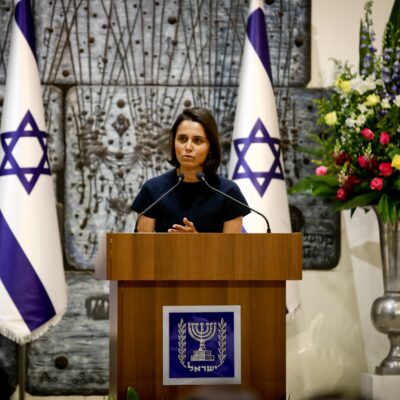
The debate took place on the main stage following a commemoration of the 30-year anniversary of the murder of Israeli Prime Minister Yitzchak Rabin, who was assassinated in 1995 in the midst of the Oslo Peace Accords process, during which Rabin’s granddaughter, Noa Rothman, addressed the plenary.
“He taught me that disagreement is nothing to fear,” she said. “On the contrary, it is the oldest Jewish sport to engage in debate. One must stand firmly by one’s convictions and lay things out clear before the other side. Agreement is not required,” Rothman said.
Related News

ADVANCING A VISION
N.Y. federation donates $1M toward building shared-society center named for peace activist killed on 10/7

EXCLUSIVE
Detroit-based philanthropists Nancy, James Grosfeld donate $8M to renovate JDC’s Israel campus

MAGICAL EXPERIENCE
Shefa launches psychedelics retreat for Jewish professionals suffering burnout
PRESIDENTIAL REBUKE
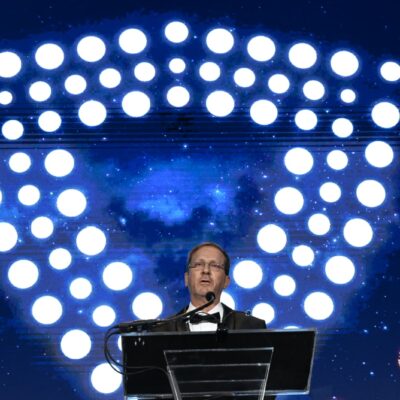
Israel’s Herzog: Mamdani ‘makes no effort’ to hide disdain for Israel, Jews must fight back

EXIT INTERVIEW
Elizabeth Sokolsky, longtime EVP of Birthright Israel, to retire next year