WHAT YOU SHOULD KNOW
JFNA survey finds LGBTQ+ Jews want more than just a Pride Shabbat dinner
COURTESY/JFNA
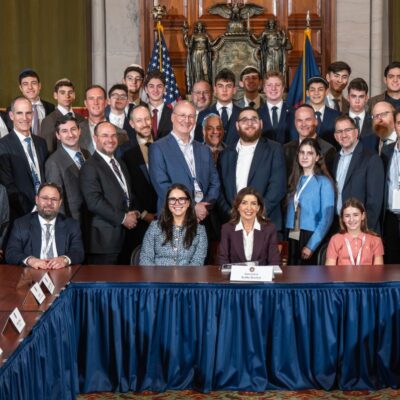
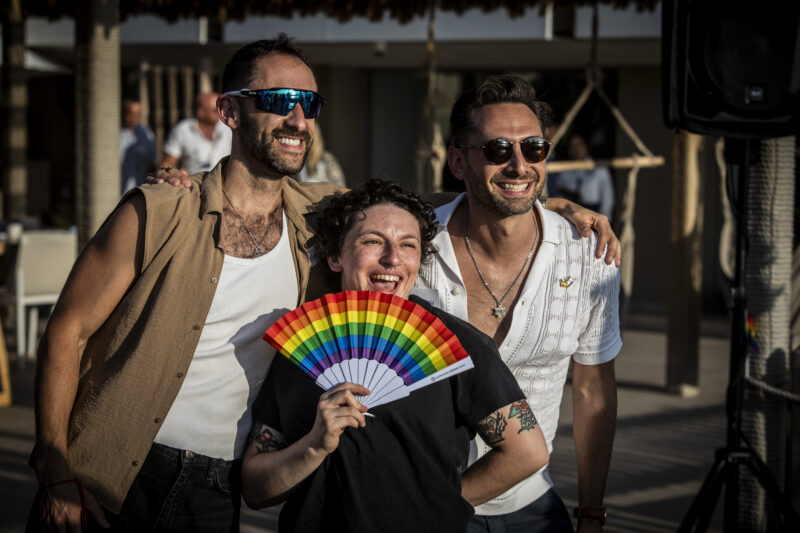
Attendees of the Jewish Federation of North America's Pride mission to Israel in June 2025.




 Add EJP on Google
Pride celebrations are supposed to be places where members of the LGBTQ+ community can be their true selves, but post-Oct. 7, many queer Jews no longer felt safe attending.
Because of this need for community, last June, the Jewish Federation of North America held its first LGBTQ+ Pride mission to Israel in nearly a decade, with almost 100 participants making the trek, 15 of whom were visiting Israel for the first time. (The landmark mission also ended up being one of many trips that were temporarily stranded in Israel due to the outbreak of the 12-day war with Iran last summer.)
Most of the attendees didn’t have a relationship with their local federation, but yearned for one. This realization prompted a study, the 2026 LGBTQ+ Jewish Engagement Report, the first of its kind, released last week by JFNA, which looked at how the Jewish community can better connect to and support LGBTQ+ Jews.
After the Oct. 7 massacres in Israel, queer Jews surged into Jewish life at a rate higher than the general population, but they also retreated more quickly, previous JFNA surveys found.
“It shows that No. 1, [LGBTQ+ Jews] are hungry for [Jewish community], but it creates the question of what is it that makes them run away, and how do we approach this opportunity?” Nate Looney, JFNA’s director of safety and belonging, told eJewishPhilanthropy.
The survey of 136 LGBTQ+ Jews connected to the federation system was conducted between Jan. 21 and Feb. 28. One of the core findings was that 90% of queer Jews’ first contact with Jewish life was at events specifically marketed towards them.
“It’s nice to have a Pride Shabbat, but they’re hungry to see the engagement year-round and not just limited to one month,” Looney said. “The Pride Shabbat gets them in the door, but it doesn’t retain them; what keeps them coming back is small-group interactions.”
The survey revealed that social gatherings were respondents’ preferred format of programming, followed closely by educational panels, small-group discussions, workshops and retreats. Respondents wanted both identity?specific programming and programming with the entire Jewish community. Additionally, 87% of respondents preferred programming focused on LGBTQ+ Jewish identity and community, followed by 60% who preferred Jewish learning, 56% who preferred arts and culture, and 54% who favored relationship building.
Respondents especially yearned for places that were welcoming to them as LGBTQ+ Jews and Zionists, something Looney said was possibly based on the pool surveyed — every respondent was connected to the JFNA already and may skew Zionist.
“We know that the estimates around our queer Jewish population in North America is somewhere between 400,000 and 550,000, and so for this particular survey, we were able to capture a snapshot of 136, so it’s nowhere near the bigger picture,” Looney said. “But it sort of opens a window to what’s going on within that world.”
Further research, he said, would help the Jewish community connect with a larger proportion of LGBTQ+ Jews. “Not all LGBTQ Jews are Zionists, and if in our research, we’re not capturing [anti-and non-Zionist] sentiments and what the pain points are that exist there, it limits our ability to either address or engage with folks that have that belief system,” he said.
Another finding that the study showed is that when a federation has LGBTQ+ leaders on staff, it makes it easier to engage with the broader LGBTQ+ Jewish community. Federations also have better results when leaders across the board have an understanding of gender diversity and the diversity of family structures. To cultivate a welcoming community, Looney said, be “curious when you’re asking someone about their life, what it actually looks like versus assuming what that family unit would look like.”
The same way Judaism and LGBTQ+ identities intersect, many members of the queer Jewish community belong to other communities, too, with many who are Jews of color, financially vulnerable or disabled. More than half of respondents stated that there were barriers to their participation, including accessibility and lack of visible LGBTQ+ leadership. For younger respondents, the cost of attending programming was an issue.
“Jews that have marginalized identities, oftentimes in order to exist in spaces, you have to compartmentalize who you are and that takes a lot of energy,” Looney said. “It makes me curious about how much stronger our community could be if people [who] were devoting their energy around compartmentalizing their identity, who they are, could devote that energy into strengthening our community. We’d be in a whole different ballpark.” Different cultures and communities are “all seasoning to add to our Jewish pot.”
Looney recommends leaders lead “with a sense of empathy and compassion, because as Jews we’re all navigating antisemitism. However, if there is someone [who] also is holding other marginalized identities, they’re also at the same time navigating other -isms. In particular, if we’re talking about Jews of color, people in their lives [who] are not Jewish may not still be in relationship with them as a result of Oct. 7, and so there’s a loss of community from that other major part of their life. And as our Jewish community continues to evolve, we have to make sure that we’re creating the spaces that fill up what’s lost by these other areas of their community.”
It’s also important that the Jewish community recognizes that queer Jews practice differently from one another, Looney said. “If a federation is trying to reach out to LGBT Jews, and they want to also engage with Orthodox LGBT Jews, they need to understand that the challenges and pain points [for a queer Orthodox Jew] look different than someone [who’s] completely secular. For someone [who’s] Orthodox and continuing to exist in community and in a gendered environment, especially if they’re trans, there’s a lot more nuance there.”
Looney recalled being at an event co-hosted by the federation where kosher meals were served. “One person came up to me with tears in his eyes,” he said. “That was the first time that he’d been at an LGBT event and had something to eat.”
Over the past decades, the Jewish community has made “significant improvements” with engaging the LGBTQ+ community, Looney said. Only five years ago, his job position, focusing on JFNA’s LGBTQ+ work, didn’t exist.
“The fact that, one, we had the Pride mission last year heavily subsidized and well attended is significant, that’s a game changer,” he said. “Two, the fact that our leadership from top down is so in support of us doing this work is also really important because if we think about the federation 50 years ago, would there have been a Pride mission? Would a report like this have even come out?… We’ve come a long way, and at the same time, we still have a long way to go.”