COMMUNAL REACTION
Jewish groups rally behind Trump’s Gaza peace plan, call for pressure on Hamas to accept
Organizations from J Street to AIPAC laud the proposal, which would see the rapid release of all hostages and an end to the war
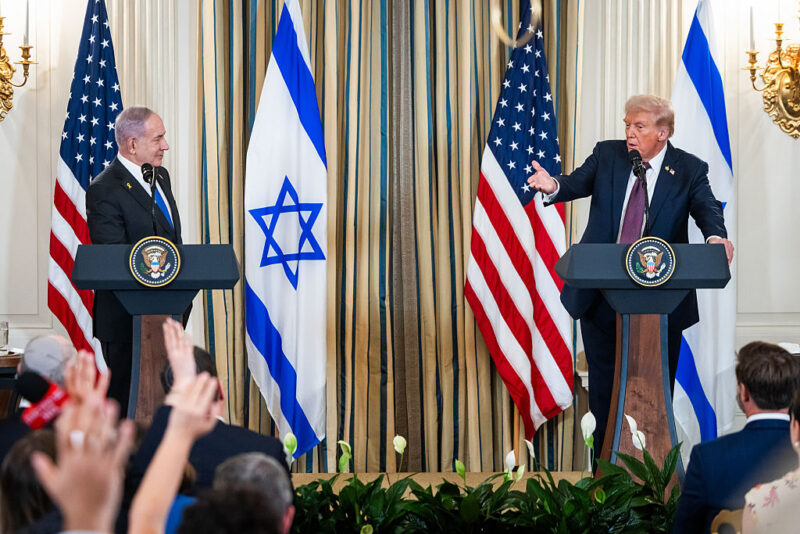
Jim Lo Scalzo/EPA/Bloomberg via Getty Images
President Donald Trump, right, and Israeli Prime Minister Benjamin Netanyahu hold a press conference in the State Dining Room of the White House in Washington, on Sept. 29, 2025.




 Add EJP on Google
Jewish groups are rallying behind President Donald Trump’s 20-point peace plan to end the war in Gaza, with organizations from J Street to AIPAC voicing initial support for the proposal.
The plan would see the release of all the remaining Israeli hostages within 72 hours in exchange for an immediate end to the war and the release of more than 2,000 Palestinian convicted terrorists and detainees, 250 of whom are serving life sentences in Israeli prisons. Hamas would also be removed from power in Gaza, with its members either expelled or allowed to remain if they “commit to peaceful co-existence and to decommission their weapons,” according to a copy of the agreement released by the White House.
The agreement would also serve as the foundation for a wider regional peace plan that — if fully implemented — would include recognition of a Palestinian state, something that the current Israeli government strictly opposes. These longer term portions of the deal are conditional on a yearslong process of Palestinian deradicalization and governmental reform, as well as economic development.
Standing beside Trump when he announced it, Prime Minister Benjamin Netanyahu said that Israel accepts the framework, despite expressed opposition to certain parts of it — particularly regarding the prospect of an independent Palestinian state — and the furious denunciations by members of his coalition. The plan also has the backing of a number of Arab countries, including Jordan, the United Arab Emirates, Indonesia, Pakistan, Turkey, Saudi Arabia, Egypt and Hamas’ patron, Qatar. Hamas, however, has yet to weigh in on the matter, though officials from the terror group have told Arab media that the organization is considering it.
Mainstream Jewish organizations almost universally embraced the agreement, while groups on the further fringes of the political spectrum have largely stayed mum on the matter.
“We welcome today’s announcement of a framework to end the war in Gaza, dismantle Hamas and secure the return of all remaining hostages,” Betsy Berns Korn and William Daroff, the chair and CEO of the Conference of Presidents of Major American Jewish Organizations, said in a statement. “This proposal offers a credible path forward and the prospect of a new reality in Gaza and the broader Middle East. The burden now rests squarely on Hamas.”
AIPAC similarly said that it “welcomed” the proposal and called for international pressure on Hamas to push the terror group to accept it.
“Every day for nearly two years, our community has lived with the pain of knowing our people are suffering in captivity, and watched Israel come under attack as it tried to defend itself from a genocidal terrorist group on its borders,” the Jewish Federations of North America said in a statement. “We hope and pray that this deal will come to fruition and bring the remaining hostages home to their families.”
Philanthropist and World Jewish Congress President Ronald Lauder, a GOP donor and conservative proponent of a two-state solution, hailed the proposal, particularly for leaving open the possibility of a Palestinian state. “For the first time, there is a clear framework that ensures all hostages will be freed, Hamas will be disarmed, Gaza will be demilitarized, and Israel’s security will be preserved. Critically, it finally opens the possibility for the Palestinian people to live free of radical terrorist rule that has brought them only misery and destruction,” Lauder wrote on X. “After months of unimaginable suffering, the world must unite behind this plan. The future of the region — and the chance for Israelis and Palestinians alike to live in peace and dignity — depends on it.”
The Israeli-American Council applauded the proposal, calling it “bold,” and thanked Trump and his team for putting it forward. “We pray that this moment ushers in a new era in which the Abraham Accords expand throughout the Arab and Muslim world and in which Israel and all her neighbors come to live in peace and prosperity,” the group said.
On the political left, officials from the J Street advocacy group called the plan “really good,” with its policy chief, Ilan Goldenberg, noting that it bears similarities to similar proposals that were put forward early in the war by the Biden administration.
Goldenberg specifically hailed the immediate aspects of the plan, namely the rapid end of the war and release of the hostages — as opposed to the slow release schedule seen in the previous ceasefire agreements — as well as the large-scale infusion of humanitarian aid to the Strip. “I thought that part of the proposal — great. Also, [there is] a very good second part of the proposal, which is really all the post-conflict plans that are part of this, things that, frankly, also were reflected in proposals put forward by [former Secretary of State] Tony Blinken previously and we were working on the Biden administration.”
However, J Street officials expressed skepticism at the prospect of Hamas agreeing to disarm and of the Israeli government’s willingness to see through the secondary aspects of the agreement.
In Israel, the proposal was viewed far more critically, including within the government, whose far-right members blasted it. Finance Minister Bezalel Smotrich, leader of the Religious Zionism Party, referred to the proposal as a “tragedy” and expressed hope that Hamas would reject it so that it would not go forward.
Einav Zangauker, whose son, Matan, was taken captive by Hamas on Oct. 7, 2023, and has emerged as one of the fiercest voices among the relatives of hostages, expressed skepticism at the implementation of the plan, noting that similar ceasefire proposals had fallen apart.
“Until Matan is with me and every hostage and hostage is home, we don’t buy Netnayhu’s empty words,” Zangauker wrote on X. “He promised me to my face two months ago to bring back everyone, and then he blew up the deal. Over the past two years, he has sabotaged every chance to reach a comprehensive agreement and end the war. He chose to blow up hostages instead of saving them.”
The plan was, however, welcomed by most corners of Israeli society. The Hostage and Missing Families Forum issued a statement in support of the framework, calling it “historic” and pushing for international pressure on Hamas to accept the deal. Israeli President Isaac Herzog said the proposal “offers real hope for the release of the hostages, for ensuring the security of Israel, for ending the war and for changing the reality in the Gaza Strip and the Middle East toward a new era of regional and international partnership.”
Opposition Leader Yair Lapid, head of the centrist Yesh Atid party, called the proposal “the correct basis for a hostage deal and an end to the war.”
Related News

ADVANCING A VISION
N.Y. federation donates $1M toward building shared-society center named for peace activist killed on 10/7

EXIT INTERVIEW
Elizabeth Sokolsky, longtime EVP of Birthright Israel, to retire next year

PRESIDENTIAL REBUKE
Israel’s Herzog: Mamdani ‘makes no effort’ to hide disdain for Israel, Jews must fight back
CLOSING WORDS
In AZM address, Cosgrove links communal ‘orthodoxy’ on Israel to rising anti-Zionism among young Jews

HIGHER EDUCATION
As Jewish donors reconsider academia, Jan Koum doubles down, endowing Israel studies at Stanford