Q&A
Israeli First Lady Michal Herzog: ‘After Oct. 7, thank God for philanthropy, thank God for the Jewish world’
Having worked in philanthropy for more than 30 years, Herzog has continued working closely with foundations and donors in the wake of the Oct. 7 terror attacks
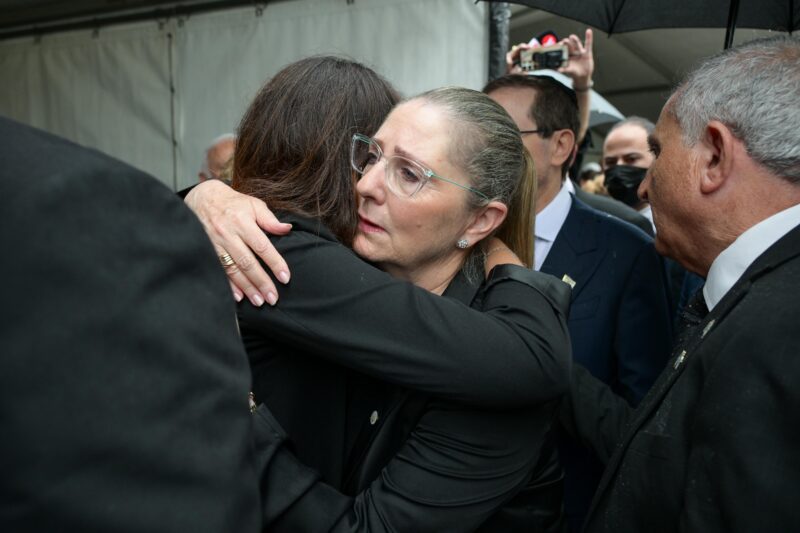
Mayaan Toaf/Government Press Office)
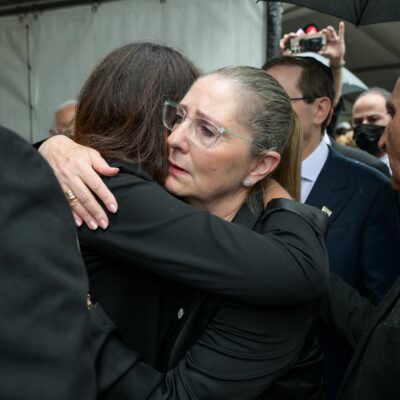
Israeli First Lady Michal Herzog embraces a member of the Australian Jewish community at a memorial event for the Bondi Beach terror attack in Sydney, Australia, in February 2026.




 Add EJP on Google
Long before she became Israel’s first lady, Michal Herzog, was a philanthropy professional, serving for more than a decade as the Israel director for the Wohl Legacy, the British Jewish family’s charitable foundation that supports a wide array of causes in Israel.
Through that work and in many other roles over the past 30 years, she built deep ties to the Israeli and foreign philanthropic field. When her husband, Isaac Herzog, was elected president in 2021, she stepped down from the role, but maintained her connections to philanthropy, helping connect the office of the president to Israeli and Diaspora foundations and organizations.
This escalated in the wake of the Oct. 7 terror attacks and the resulting wars in Gaza, Lebanon and Iran, as the country faced grave new challenges, as well as those that preexisted the massacre but were accelerated by it.
This week, eJewishPhilanthropy sat down with Michal Herzog in her office at the President’s Residence in Jerusalem to discuss her efforts post-Oct. 7, how philanthropy in Israel has changed and how Israel is maintaining its relationship with world Jewry.
The interview has been lightly edited for clarity.
Judah Ari Gross: First of all, thank you for agreeing to speak with me. It was important for me to hear from you ahead of the third anniversary of the Oct. 7 attacks as I understand that you play a particularly significant role in coordinating the President’s Residence’s work with philanthropy.
Michal Herzog: I’m a lawyer by profession, by training, and I’ve been in the philanthropic world for, wow, 30 years by now. And I think once you get the bug… I was a professional. Not the philanthropist herself. But I think it’s a wonderful and growing community in Israel. And I think in many ways it has also changed civil society in Israel. And these are my closest friends. This is my milieu. and I still consider myself part of it because in many ways my work in the philanthropic field prepared me for the role of the first lady: getting to know so many initiatives in Israel. I worked in the health field and social field and educational field. I used to visit projects all over Israel. So, as I wrote in my farewell letter to the trustees of the Wohl Legacy when I resigned from my position as the Israel director of the Wohl Legacy, I felt that this was in a way a preparation for my role here.
JAG: How has that come into play in the past three years specifically, in the wake of the Oct. 7 attacks? I know you’ve had a few specific areas and causes that you’ve taken on.
MH: So let me refer to the very beginning of the term of the president. [Isaac] took office in July 2021, so we have to remember it was still COVID. In emergency times, it’s the time that the philanthropic world rises to the occasion. So even during COVID, it was a very busy time for philanthropists because everything was an emergency. So you had to readjust your giving, your doing, and you had to make sure that those NGOs that your foundation supported would still go on. These were difficult times.
From the very beginning of the term of the president, I took upon myself the issue of mental health, which is something that — I don’t come from that field — but it is something that I dealt with in my philanthropic work. And I looked around, and I saw the need, especially for young people and children who were really affected by social distancing, and I decided that this would be one of the main issues that I will deal with, especially breaking the stigmas of people asking for help and not being shy about asking for help. And then came Oct. 7.
Oct. 7 is something that I feel has changed all our lives. Whether you were in the immediate circle affected by the atrocities on that day, or whether you were just a regular Israeli citizen, we were all affected by it.
And of course, if we speak about mental health, this is an issue that has taken on a whole new meaning because now we deal a lot with [post-traumatic stress disorder]. We deal a lot with trying to prevent PTSD or treat PTSD, the way it has affected children, entire communities that were evacuated, both in the North and the South.
And it’s been three years now since that terrible Shabbat. And sometimes I feel that time has not made it easier. On the contrary, I was just talking to a member of a bereaved family this morning, and I said that it feels like the time makes it even more difficult to grasp what happened, to go on with our lives. And it’s not really about going on with our lives because the war is still going on. So in many ways it’s very difficult. In many other ways, it’s uplifting to see these Israeli people and Jewish people abroad and the way they got closer, the way they collaborate, the wonderful initiatives that have grown out of the pain.
And yet there’s not a day that goes by that we’re not reminded of what happened on Oct. 7 and how our lives have changed. But we also have to think about the happy moments that we have experienced, especially in the past year since the live hostages have been back.
A few months ago, we attended the wedding of Sasha Tropanov and Sapir Cohen, and to stand with them under their chuppah, I pinched myself. I wasn’t sure that it was actually happening. And a couple of weeks ago, we hugged the Ben Ami family at the wedding of Yulie, their daughter — the daughter of the two parents, Raz and Ohad Ben Ami, who were both kidnapped.
To see her with the entire family in happy moments after seeing them in so much sorrow and pain. We have to be thankful for those moments as well.
JAG: I know that mental health has been a particular area of focus for you. You have also been involved in a lot of the efforts to raise awareness and get justice for victims of sexual violence? Why did you take that on specifically?
MH: So a few days after Oct. 7, I didn’t understand the scope and the numbers and those affected — especially women but men as well — by the use of sexual violence as a weapon of war on Oct. 7.
A few days later, I met a group of women, and they told me that there are victims [of sexual violence], that it’s under the radar at that time.
It was just a few days after, and I said, “We have to do something about it.”
And Nov. 25 is the international day for fighting violence against women.
In the years before 2023, I dealt with it in relation to domestic violence. And that year I said, “OK, this is a different story.”
I wrote a piece about this, especially the silence. Not only was it terrible that sexual violence was used against Israeli women as a tool of war, but what really hurt afterward was the silence of the international organizations that were set up with the purpose of protecting women, such as UN Women. And they just turned their back and ignored what happened here.
And I’m not an expert in the field — just the way I’m not an expert in mental health. I always turn to those who are experts. So I work with a group of women who now work as The Dinah Project. They are international law experts.
JAG: They’re having a conference at Brandeis [tomorrow], if I’m not mistaken.
MH: Yes, and they were just part of a U.N. conference with WIZO in Abu Dhabi, and [sexual violence in the Oct. 7 attacks] was finally raised as an issue in a U.N. conference. And they were given the stage to present the case.
They have developed a legal mechanism to bring a perpetrator to trial. Because it is very difficult to do so, according to regular criminal law. You have to show the connection between the perpetrator and the act, but they put together a legal mechanism in which you can actually bring justice to the women who were attacked.
So it is very important, and they demonstrated that at the conference. And so I’ve joined them, and I learned from them. My role is to bring this to the world stage, bringing it to such stages as the World Economic Forum or the Munich Security Conference — every place where I can speak about it.
And I always say it’s a universal issue. It’s not only Israeli women. We are part of the world, and there are so many women who are hurt by sexual violence in many other conflicts. And what experts tell me is that in each conflict, there’s an escalation in the use. It gets worse and worse and fiercer. We saw it in Ukraine, we saw it in our conflict. And we saw a terrible attack on women in Sweida, the Druze women in southern Syria. So it’s not going away, but we have to try our best to prevent it and to speak about it and to fight against it. So I see this as a very important role.
JAG: To shift topics a bit, as you said, you’ve been in the field of philanthropy for roughly 30 years. How have you seen shifts in philanthropy in Israel, both in terms of domestic Israeli philanthropy and that coming from Diaspora? How has the Israeli field grown and how do the two sides interact with each other?
MH: First of all, I think it’s a question of education. And I think more Israelis, and especially young Israelis, must learn about the importance of philanthropy. And tzedaka has always been a part of Jewish life, but in modern life, you have to understand that you have to give back to the society that has nourished you in many ways. So I would say that there’s a learning curve in Israeli society.
I was part of Maala, which was set up in the 1990s to teach businesses to give back to society, what we call corporate social responsibility. And when Maala was set up, you had to teach the businesses and the companies and the big corporations how to give back. I think they have learned that since then. At the time, you did not have in each such big corporation a person who was responsible for that field. Now you do.
Just this afternoon [on Sunday,] we will have a big event here called Tav Miluim, in which we will be putting together a ceremony for big businesses that have been friendly to reservists. This is also part of the shift. I see this as part of philanthropy as well because they understand that they have to give back to those employees and to those who fight for all of us, who defend all of us.
There’s much more understanding and much more Israeli funding and matching. It used to be quite rare decades ago because most of the philanthropy came from either private Jewish families from abroad or organizations — federations of course — and they always used to say, “Do you have Israeli funders as well?” And it was a little bit rare at the time, but I think nowadays it has really changed.
I think in many ways the Israelis have caught up. And as I said before, I think it’s a question of education. I see the second generation of Israeli philanthropists and how they understand that they are part of society and they have to give.
And we saw that especially immediately after Oct. 7. You saw the surge of initiatives, of willingness, of support, of enthusiasm. We really saw the areivim zeh b’zeh [“We are responsible for one another”]. We really saw the arevut hadadit [“mutual responsibility”].
And I think what we also saw was the sudden understanding that anything that happens here affects every Jew in the world. And this is something that I think people really understood, seeing the encampments on campuses, the riots, and, of course, the rise in antisemitism. It made Israelis understand that we are all in this together. And the appreciation for the immediate, immediate help of the Jewish world, the communities in every aspect, the solidarity that we saw immediately, people helping in any way they could.
When I speak to farmers in the South and they tell me, “‘They were lifesavers, the volunteers who came here the month following Oct. 7. It was a miracle for us. It was a lifesaver.”
So I think this understanding that we’re all together is also part of the understanding of philanthropy, and working together, and a lot of collaborations that happened after Oct. 7, between philanthropists, between Israeli philanthropists among themselves and with foundations from abroad. And the collaboration between Israelis and the Jewish world.
I think we’ve seen the very wonderful side of philanthropy during this time.
JAG: One of the trends that has come out of Oct. 7 that Israel is going to be dealing with for a long time to come is the issue of trust in the state, both in terms of the military and the government more broadly, because there was the initial failure to prevent and respond to the attacks by security services and then as hundreds of thousands of people were displaced, much of the immediate assistance was coming from civil society as the government was unprepared to handle it. How have you encountered that as a figure who is a sort-of representative of the state?
MH: So first let me correct you. I’m not a representative of the state.
People do look at the president and at me as a symbol. And we feel that we have to do our utmost to listen to every citizen and to help in any way. That’s what we’ve been doing since Oct. 7, every single day, not only meeting bereaved families and the wounded in hospitals. And of course, speaking of the question of trust, we were the first ones who opened our home to the families of the hostages.
Before it was called the Hostage Family Forum — before they had a name — we gathered them here. At the time there was such havoc, such balagan, that most of the families that gathered here on Tuesday just following the Shabbat ended up unfortunately finding out that their dear ones were murdered and were not taken hostage.
But since then this has been the home of the hostage families in every way possible: individual help sometimes, whether it was just to listen to them, whether it was the president undertaking international efforts with leaders around the world.
There was not a single time we went abroad in the last three years that we did not take someone from a hostage family with us. To bring that message to every leader we met. I think in a way we were there, let’s say in the first few weeks, we went to the kibbutzim, of course. We went to the hotels or wherever the evacuees were. Just to meet, to hug, to listen. And of course, in many ways, we were seen as the representatives of the state despite the fact that we don’t have executive powers.
But we felt that we needed to be there for them and not shy away from criticism, because people were allowed to criticize. They went through the worst experience people could go through. They went through the most terrible pains and tragedies people can go through, and they were allowed to say whatever they wanted. We were there for them to listen.
And I think they appreciated it very much. We see this as a mission to listen to everyone, to help in every case we can. And there are some families, bereaved families, families of hostages, wounded, that have become our friends over the past three years, have become very close to us, and we feel part of communities.
My husband in his office has an employee card from the [Kibbutz] Be’eri printing plant because he pushed a button a few days after Oct. 7 to reignite the whole process of printing. And we were there so many times that they see us as part of their effort to go back to being a community again, a vibrant living community.
The community of Kerem Shalom, for instance, has become very, very close to our hearts. We visit there as often as we can. They come over here. The kids think we’re part of the kibbutz. And I think this is the way to bring back trust.
You have to listen to the critics. Try and help in every way you can. Hug when you need to hug, cry with them when we need to cry with them. And I think for many of them, this is what they tell us, we were a source of consolation.
We were a source of support, and this is our mission.
JAG: But there is a way in which philanthropy and civil society can complement the government and support it and make it better and more efficient, and there’s ways in which it can replace government when there is a vacuum. Have you seen that dynamic during this period?
MH: So first of all, let’s be honest, in the first days and weeks after Oct. 7, this country relied upon the forces of civil society and philanthropy to fill in the gaps, though not in every way.
Let’s look at our medical system. Thank God we have a wonderful, wonderful medical system that stood up to this moment of trial and trauma. And yet, it was also with the help of philanthropic forces. But they did not replace the system, they complemented the efforts. In other ways, you saw that many communities immediately relied on philanthropic forces to help them in the very beginning.
I think the government did step in in some ways afterwards. It took them some time, and I’m grateful for the philanthropic forces, whether it be the federations or private philanthropists or foundations, that were there to help immediately, to offer immediate help. But one has to also understand that, for instance, the Tekuma Authority that was set up immediately started working as well. And in many ways it was supported by, but worked with, the philanthropic entities that were active in the field. They complemented each other. At the end of the day, there are efforts that cannot be done only by philanthropy.
JAG: Of course, the orders of scale between government and philanthropy are vastly different.
MH: Exactly. I think that such efforts as rebuilding Be’eri in the Kibbutz Hazerim — only the state could actually make it happen. Or putting up Kibbutz Nir Oz in Carmei Gat. It’s an act of state, and that’s the way it should be.
I am a believer that philanthropy has to complement, has to support. It shouldn’t replace [government]. It should have an added value. It should have new initiatives that maybe the state authorities cannot take the risk of trying and failing, but philanthropy can do that. It can fail and learn.
But in such moments as we had after Oct. 7, thank God for philanthropy, thank God for the Jewish world coming together.
And we have to remember that it was following a very difficult period [with the government’s judicial overhaul and the protests against it]. From the beginning of 2023 until Oct. 7… the Jewish communities from abroad were looking at us and the demonstrations and the sights from Israel and they didn’t quite understand and grasp what was going on.
And that turned in a few hours on Oct. 7. It’s terrible that a tragedy had to take place in order for us to understand that we should work together, but I’m grateful for the understanding and the support of the Jewish communities from around the world, and I think we have to support our Jewish brothers and sisters all over the world, and I always say that in many ways.
I feel that one of the most important trips abroad the president and I made was to Australia following the Bondi Beach massacre. And I think that was also a message not only to our Israeli citizens, but also to our sisters and brothers abroad. That we are there for them, that the State of Israel is for them, and in that case, we, as representatives of the State of Israel, gave it immense importance to come as soon as we could to hug the Australian community, and we felt it was very, very important.
JAG: On the question of Israel-Diaspora relations, you mentioned seeing Israeli philanthropy grow over the years. There’s also been massive support from American donors post-Oct. 7. But the issue of Israel, especially in the United States, is becoming polarizing in the Jewish community. Is that something that you’ve seen or that you’ve experienced?
MH: Well, first of all, there were people who did not feel that their Jewishness was an important part of their life or have a connection with Israel, and that really changed after Oct. 7, and of course with the rise of antisemitism even more.
But I do not deny the fact that we also see a lot of controversy. I think we should get so much better in our hasbara [public diplomacy] and the way we explain ourselves. And I think Jewish education is a key factor because what we see is especially younger generations that have more difficulty understanding what Israel is all about and its importance. And they’re affected by the media, affected by what they see in social media. It is a very difficult battle.
I think we can’t shy away from that. And we have to face [it], if you have a movie like “NAZA,” you have to confront it.
You’re allowed to express criticism. We are a democratic state and I’m a great believer in freedom of speech. But you have to base it on facts, and you can’t hide behind people in disguise and not show who they are and speak out openly. For me this is not really a documentary. You have to show real facts, and I think now the IDF has shown facts, and I know how careful the IDF is about every act they take, especially in very densely inhabited areas.
But I think this is an example of how we have to fight back in every arena we have. And this is an important one. And I’m so glad that we have so many influencers and people that take on, unfortunately some do it privately, but they take on the fight and the explanation. But I think this is a failure. This is a failure that we have to correct, both in education and in explanation and in bringing a story.
JAG: I don’t want to get too deeply into Israeli politics — I don’t think it’s your primary area of focus and I don’t think you would talk about it anyway — but I do want to push back on the idea that this is purely about perception. Earlier this year, there was an initial vote passed that would have made it a crime punishable by seven years in prison to hold egalitarian prayer at the Western Wall. And Jews who are not Orthodox, which is the majority of Jews in the United States, see that and it feels alienating to them. And that’s not something coming from a documentary of questionable authenticity, that’s something that the Israeli government, the Knesset, and its representatives are doing.
MH: So let me just say, both my husband and I were fortunate enough to live abroad, and this has taught us a lot. And I think the fact that there’s so many Jewish streams, especially in North America but all over in Jewish communities around the world, I think it is something that Israelis understand more because we now have a growing spectrum of beliefs and religious life. It used to be black or white. Either you’re religious or you’re not. And I think now there’s a bigger understanding of the religious spectrum in Israel itself.
We have to allow, we have to give room to all our Jewish sisters and brothers without hurting any one of them and without making anyone feel that they are not welcome here. And I wish that we could open our doors and our hearts in a much more generous way, let’s put it this way, without putting boundaries on the way you practice your Judaism. I think it is very important for us to understand it.
There’s a lot of conflict within Israeli society itself — between the Haredim and national-religious, between religious and secular, but we’re all here. We all have to continue living here together, always. And this is a major part of what we do here in the President’s Residence, under the president’s initiative of Time to Talk, of bringing everyone, everyone from every single part of Israeli society, from Arabs to Haredim to religious and non-religious, so that they all feel comfortable. Because we understand this.
We all have to continue living here together. And this is part of what we’re trying to do, especially as we’re not such a young state anymore. We’re approaching 80. Not that I’m saying 80 is old.
JAG: If I can just one more question that’s philanthropy focused. When you were working in the field, with the Wohl Legacy, on the one hand, you were limited as you were just representing a specific foundation, but on the other, as a foundation, you could do serious due diligence on organizations and projects. And now, in this capacity, you’re able to shine a light more effectively and publicly and give a vote of confidence in different causes and programs and groups, but now you don’t have the same ability to do that kind of due diligence, to request documentation and reports. How do you manage that difference and ensure that you are spotlighting worthy causes?
MH: First of all, there’s no money involved now.
JAG: No, but it’s a certain stamp of approval, which means a lot to a lot of large family foundations and private donors, that, “OK, the president’s office is saying this is a good cause.”
MH: OK, so one thing is that I always make sure that I work with and support initiatives that are being done by very serious professionals. As we mentioned in the mental health field, I tell people, “Be careful. Check before you go in.” And I’m always in favor of supporting professionals that have already proven themselves. If you have wonderful NGOs that have shown their effective work and that have been around for a long time, we don’t have to reinvent the wheel.
I don’t come out with recommendations. I don’t tell people who to support. I work with NGOs that have proven themselves. But also, what does it mean to work with? We have a ceremony for the International Mental Health Day, so clearly I do it with the Ministry of Health.
This is not my private home. This is a public home. This is a symbol for others to follow.
So I try to work with ministries, with state-funded initiatives as much as I can. I don’t do due diligence the way I used to. I don’t go into financial due diligence. Of course not. It’s not a question of that. But I do work with professionals in every field I work with. As I said, I’m not a professional in all these fields, so I work with and I listen to their advice.
JAG: I’d love to stay longer to speak, but I understand you have a busy schedule.
MH: But can we do a final word of optimism?
JAG: Yes, please. I think we all could use it.
MH: We’re marking three years since Oct. 7.
I think in many ways we’re a more mature society, and despite disagreements and despite the very tense days before elections, I think the majority — the vast majority — of Israelis understand that they will all be here the day after our elections.
Elections are just a day, but we’ll have to continue living here together, working together, supporting each other, so that we have a much brighter future for our children and grandchildren moving forward, and hoping for much more peaceful days and calmer days.
Related News
CLOSING WORDS
In AZM address, Cosgrove links communal ‘orthodoxy’ on Israel to rising anti-Zionism among young Jews
HIGHER EDUCATION
As Jewish donors reconsider academia, Jan Koum doubles down, endowing Israel studies at Stanford

MAGICAL EXPERIENCE
Shefa launches psychedelics retreat for Jewish professionals suffering burnout
EXIT INTERVIEW
Elizabeth Sokolsky, longtime EVP of Birthright Israel, to retire next year
PRESIDENTIAL REBUKE
Israel’s Herzog: Mamdani ‘makes no effort’ to hide disdain for Israel, Jews must fight back