MEMORY’S MANDATE
October Council kicks off a week of remembrance, demands to hold government accountable
Families of Oct. 7 victims, hostages open exhibition commemorating loved ones with the objects they left behind
courtesy
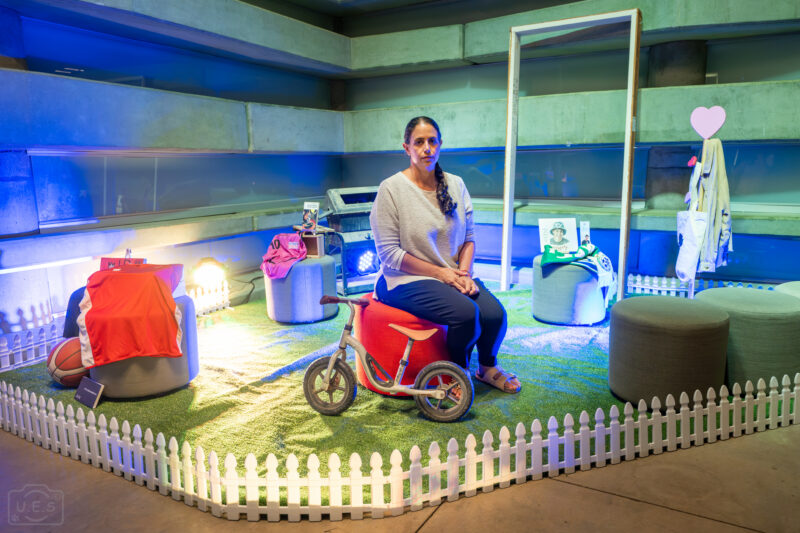
Ofri Bibas, the aunt of slain 4-year-old hostage Ariel Bibas, sits next to his balance bike at an exhibit of objects connected to Oct. 7 victims at the Peres Center for Peace and Innovation in Jaffa, on Oct. 3, 2026.


 Add EJP on Google
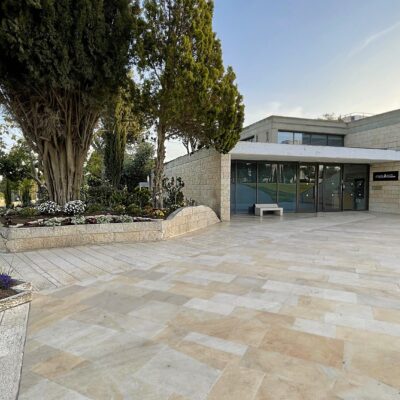
TEL AVIV-JAFFA — More than 700 people — among them bereaved families and friends, former hostages and opposition lawmakers — attended the opening on Saturday evening of “The Space That Remains,” an exhibition at the Peres Center for Peace and Innovation in Jaffa organized by the October Council, a volunteer-run nonprofit founded by many bereaved families of Oct. 7 victims and hostages.
The opening kicked off a week of memorials marking three years since the Oct. 7 terror attack. For the October Council, the memorials are not only a matter of personal remembrance but also — as its leaders see it — represent a duty to hold accountable those responsible for the intelligence and military failures that allowed the atrocities to occur.
With an election just over three weeks away, the organization and the bereaved families behind it are calling for a new government, believing that the current government will never establish the state commission of inquiry that they consider critical for understanding the attacks that claimed their loved ones.
The exhibition, which is open to the public through Oct. 10, features objects connected to victims of the attack. It is arranged chronologically, from daily life before the attack to its aftermath. At the heart of the exhibition is the armchair of Itzik Elgarat from Nir Oz. Elgarat was alive when he was taken hostage and is believed to have been killed in captivity during the first year of the war. It is “an empty chair that tells, without words, the story of a man whose presence and spirit entirely fill the space, even when he is physically gone,” curator Emek Keidar Jumah said in his remarks.
Paramedic Amit Mann’s uniform and stethoscope are also on view, as is the beret of Roni Eshel, a soldier killed at the Nahal Oz army base, and the balance bike that belonged to Ariel Bibas, who was 4 when he was taken hostage with his infant brother and mother and was killed in captivity.
In part due to its political nature, the October Council is not as well known in the American Jewish philanthropic world, receiving most of its funding from domestic donors, as it sits at the center of a painful fight within Israel over memory and accountability. On Sunday afternoon, the October Council launched a crowdfunding campaign to support its grassroots activities, raising more than NIS 100,000 ($32,700) from over 760 donors in the first day.
Founded by a coalition of bereaved families and survivors — including Liad and Nirit Baram, Eyal and Sharon Eshel, Rafi Ben Shitrit, Menashe Manzuri, Reut Recht-Edri, Avishai Edri, Hila Abir and Ofri Bibas — who channeled their shared tragedies from the Nahal Oz base, Nova festival and Kibbutz Be’eri into a unified grassroots movement demanding a fully independent state commission of inquiry into the failures of Oct. 7.
Reut Recht-Edri, a history teacher in Rehovot for 30 years who lost her oldest son, Ido, at the Nova festival, is one of the October Council’s co-founders. All of the families are volunteers, and each lost a first-degree relative, she said. More than 2,000 families have signed on, urging the government to establish an investigation into the attacks.
Members of Prime Minister Benjamin Netanyahu’s ruling coalition have dismissed the need for such an inquiry, which is overseen by jurists, saying it would serve as a political witch hunt and that most of the public does not trust the courts. (A 2024 Israel Democracy Institute survey found that 39.5% of the Israeli public trusts the courts; the poll also found that Israelis trust politicians even less, with 25% saying they trust the government and 16% saying they trust the Knesset.)
The exhibition’s Hebrew name draws on halal, a word that means a person fallen in battle, a void or outer space, Recht-Edri said. “The void that was left. The holes in the heart that were left.”
The four sections of the exhibit simulate some of the areas hit hardest on Oct. 7: a children’s play area, the Nova festival, the soldiers and the Gaza border communities. Visitors are asked to be silent and breathe deeply, Recht-Edri said. “If you are silent, you will see that your senses are attacked from every direction, and you can see not only the horrors, but also the life that was here and gone.”
In the months after the Oct. 7 attacks, the council began with one demand, Recht-Edri explained: a state commission of inquiry. “We went to the Knesset three times a week for two years,” she said. “We did all we could, but we understood that it was not going to happen.”
“We did not start out political. We had only one aim,” she said. “If [Netanyahu] had ordered a state commission of inquiry, I wouldn’t have done anything. I would have shaken his hand and said, thank-you.”
Ofri Bibas, sister of former Israeli hostage Yarden Bibas and one of the co-founders of the October Council, spearheaded the exhibit.
“Through the families, I understood how important it was for them that people know the loved ones they lost. Who they were, what they loved and what dreams they still hoped to fulfill in their lives,” she told eJP. “They wanted their loss to be seen and acknowledged for the profound tragedy that it was.”
Bibas said the council’s demand for an official inquiry relates to the military as well as the political leadership. “We demand accountability from everyone who held a position of responsibility, from the political leadership to the military leadership,” she said.
She said the government has tried to portray the families as partisan. “Our criticism of the conduct of the prime minister, the political leadership and the military leadership has always stemmed from the responsibility inherent in the positions they held toward every citizen of the State of Israel,” she said. “Our struggle for change, for a more ethical, moral, united and better Israel, is far from over. We need support for the October Council and for the continuation of our struggle.”
Attendance at the opening was largely along partisan lines. Opposition Leader Yair Lapid; former Prime Minister and Byachad party leader Naftali Bennett; Yashar leader Gadi Eisenkot; and Blue and White’s Benny Gantz were all at the event. No members of the current coalition government attended.
Throughout the event, nearly a dozen bereaved family members who are part of the October Council took the stage detailing the horrors their family members endured — and the unanswered questions that have tortured the families for nearly three years.
Among the speakers was former hostage Sagui Dekel-Chen.“It’s not easy for me here. I’ve walked over the living objects of dead people. It triggers me. Books say that there are elements that may trigger distress,” Dekel-Chen said to the hundreds who gathered.
“And recently I realized that there are things related to the disaster that I didn’t imagine how complex [would be] to encounter again. Like building a sukkah. It’s not just sadness; it really makes me anxious. Sometimes I initiate small encounters with these triggers, like today. For now, it doesn’t help. But this is the life of those who survived.”
Recht-Edri said the unanswered questions about Oct. 7 keep the bereaved from healing, and she sees a state commission of inquiry as the key to answering them. “We cannot pass from trauma to post-trauma because we are still in it,” she said. “The unknown is so much more difficult than the knowledge. Our imagination is running wild. I don’t know what happened to my son in his last minute.”
Many of the attendees saw the event and the exhibit as a spark they hope will lead to change.
Noam Tibon, a former IDF general running on Bennett’s Byachad slate, who rescued his son, Haaretz journalist Amir Tibon, and Amir’s family from Kibbutz Nahal Oz, told eJP, “This event means only one thing: We will never forget Oct. 7, and we will never forget the people who lost their lives. And we will never forget who is responsible.”
“Three weeks from now, we will replace the government and build a new recovery government in Israel.”
The event was sponsored in part by the Henry S. and Mala Dorfman Family Foundation. “As the children of Holocaust survivors, we were raised to understand that memory and accountability are inseparable. To remember is to insist that the truth be known and never denied,” Tova Dorfman, the family foundation’s executive director and a former president of the World Zionist Organization, told eJP.
“This exhibit gives the families of those murdered on Oct. 7 a space to share with the public their loved ones’ names, faces, and the lives they lived, and it ensures that what happened that day will never be forgotten.”
The exhibition will not go on tour, as did the Nova exhibition, Bibas explained. “As the personal belongings are far too precious to the families, and we cannot take the risk of them being damaged or, God forbid, lost.”
Recht-Edri called the fight a matter of survival: of Jewish culture, Jewish memory, the Jewish people and the country. “We need to rehabilitate our lives,” she said. “We need flowers to grow here again.”
Related News
MAGICAL EXPERIENCE
Shefa launches psychedelics retreat for Jewish professionals suffering burnout
HIGHER EDUCATION
As Jewish donors reconsider academia, Jan Koum doubles down, endowing Israel studies at Stanford
EXIT INTERVIEW
Elizabeth Sokolsky, longtime EVP of Birthright Israel, to retire next year
ADVANCING A VISION
N.Y. federation donates $1M toward building shared-society center named for peace activist killed on 10/7
CLOSING WORDS
In AZM address, Cosgrove links communal ‘orthodoxy’ on Israel to rising anti-Zionism among young Jews