Your Daily Phil: U.K. Jews fume as Greens adopt anti-Zionism


 Add EJP on Google
Good Monday morning!
IIn today’s edition of Your Daily Phil, we spotlight an ongoing discussion on social media about what America’s Orthodox Jews “need” in order to make aliyah. We report on Community O’s efforts to build a shared organizational infrastructure for Israeli social entrepreneurs and a new JINSA report recommending a fundamental shift in the U.S.-Israel relationship. We feature an opinion piece by Mike Leven and Hadara Ishak about leveraging the “great wealth transfer” for Jewish causes, and a piece by Alyza D. Lewin breaks down the significance of a recent federal court ruling for the American Jewish community. Also in this issue: Amy-Jill Levine, Ken Daniels and Lisa Daniels-Goldman, and David Danieli.
Today’s Your Daily Phil was curated by eJP Managing Editor Judah Ari Gross, Israel Editor Justin Hayet and Opinion Editor Rachel Kohn. Have a tip? Email us here.
What We’re Watching
The State of Israel is officially marking the third anniversary of the Oct. 7 terror attacks today. In the U.S., the Israeli Embassy in Washington is holding its ceremony this evening for the victims of the Hamas-led massacre.
Jeffrey R. Solomon, co-founder of Birthright Israel and a Jewish philanthropy veteran, will discuss “Critical Issues in Jewish Life: Leadership, Philanthropy, and Defining a New Zionism,” this evening at the JCC of Central New Jersey in Scotch Plains.
The Anti-Defamation League is hosting its Spotlight on Hope event this evening in Washington, honoring “artists fighting hate.”
Brazil is headed to a runoff election later this month as neither incumbent Luiz Inácio Lula da Silva nor Flávio Bolsonaro, son of former President Jair Bolsonaro, received a majority of the votes.
What You Should Know
A QUICK WORD FROM eJP’S JUDAH ARI GROSS
British Jews are railing against a motion passed yesterday by the country’s far-left Green Party, declaring that “Zionism is racism” and affirming support for violent Palestinian “resistance” against Israel, with figures and organizations from across the political and religious spectrum decrying the resolution as a form of antisemitism.
Even before the motion went up for a vote, Jewish communal groups denounced it, with the British Board of Deputies warning on Friday that such a measure would “fan flames of hatred, justifying violence against Israelis and Jews.” This morning, British Chief Rabbi Sir Ephraim Mirvis said he was “appalled” by the motion, calling it “poisonous antisemitism, a threat to British Jews and to Britain.” The Israeli government also condemned the resolution, saying the Green Party was no longer a political party but “an organization that supports terror.”
While these responses by the Jewish mainstream were anticipated, the motion also drew particularly fierce condemnation from progressive and liberal Jewish groups and figures. This includes those who recently spoke favorably — or at least understandingly — of the British government’s declaration that it planned to boycott and sanction Israeli settlements. In doing so, these left-wing groups appear to be drawing a clear line between what they consider to be legitimate criticism of Israeli policy and antisemitism.
Read the rest of ‘What You Should Know’ here.
News
MEMORY’S MANDATE
October Council kicks off a week of memorials, demands to hold government accountable
More than 700 people — among them bereaved families and friends, former hostages and opposition lawmakers — attended the opening on Saturday evening of “The Space That Remains,” an exhibition at the Peres Center for Peace and Innovation in Jaffa organized by the October Council, a volunteer-run nonprofit founded by many bereaved families of Oct. 7 victims and hostages, reports eJewishPhilanthropy’s Justin Hayet from the event.
In need of answers: Reut Recht-Edri, a history teacher in Rehovot for 30 years who lost her eldest son, Ido, at the Nova festival and is one of the October Council’s co-founders, said the unanswered questions about Oct. 7 keep the bereaved from healing, and she sees a state commission of inquiry as the way to answer them. “We cannot pass from trauma to post-trauma because we are still in it,” she said. “The unknown is so much more difficult than the knowledge. Our imagination is running wild. I don’t know what happened to my son in his last minute.”



EXPLAINER
What the new ‘Education Freedom’ tax credit guidelines mean for Jewish day schools
With the Treasury Department’s release last week of the long-awaited proposed regulations on the new federal “Education Freedom Tax Credit,” set to take effect in January, major Jewish organizations are gearing up to use it to transform Jewish education in the United States, reports eJewishPhilanthropy’s Nira Dayanim.
Double the fund: Unclear until now, one of the most significant elements of the guidelines is that, for married couples filing jointly, each partner can claim the $1,700 tax credit, for a potential total of $3,400. “Now that it’s $3,400, it just expands the opportunities, the amount of money that’s going to be available, the probably higher amounts of scholarships that will be available,” Sydney Altfield, national director of the Orthodox Union’s Teach Coalition told eJP.
Opinion
THE 501(C) SUITE
The Emergent Strategy: Turning innovation into a discipline
In the latest installment of eJewishPhilanthropy’s exclusive opinion column, “The 501(C) Suite,” Barry Finestone, the Jim Joseph Foundation’s president and CEO, offers a window into the foundation’s R&D initiative, Common Era.
“In practice, Common Era invests in and conducts research outside usual channels, funds small experiments before knowing if they will succeed, identifies new talent and partnerships, and gives innovators the runway to test and iterate under uncertain conditions. Most experiments fail to scale. When an initiative ends, it either captures lessons for the next attempt, stays small and localized, gets handed off to an established partner or scales into a standalone entity.”
READER RESPONDS
Stop measuring money. Start measuring impact.
In an opinion piece for eJewishPhilanthropy, nonprofit consultant Steve Rosenberg observes that Jewish federations are not immune to “an old organizational trap that affects businesses, governments and nonprofits alike: Once you have built the infrastructure to do something, you begin believing you should keep doing it.”
“Last month in eJewishPhilanthropy, Steven Windmueller offered an important challenge to the federation system, arguing that the model needs to be remade for the 21st century. Shira Hutt and Mimi Kravetz of Jewish Federations of North America responded that the federation model has never been static and that adaptation has always been part of its DNA. There is truth in both arguments, but I think the conversation still avoids the most uncomfortable question: What if the federation model of the future needs to do less?”
READER RESPONDS
A Jewish take on AI and social media
In an opinion piece for eJewishPhilanthropy, Rabbi Sid Schwarz, founding rabbi of Adat Shalom Reconstructionist Congregation in Bethesda, Md., and director of the Clergy Leadership Incubator (CLI), argues that social media and AI have left American society struggling with not merely a loneliness epidemic but a “dehumanization epidemic.”
“To ‘re-humanize’ means that spiritual communities prioritize how members care for one another. To ‘re-humanize’ means that spiritual communities promote chesed — lovingkindness — and compassionate listening. To ‘re-humanize’ means that spiritual communities commit to the pursuit of justice for all of God’s children, regardless of race, creed or color, holding fast to the belief that every human being deserves to live a life of dignity.”
Worthy Reads
Defending the 5%: In Philanthropy Roundtable, senior vice president Claudia Cummings argues that higher foundation payout mandates would shortchange future generations, defending the federal 5% formula and perpetual endowments in response to the Institute for Policy Studies’ Gilded Giving 2026 report. “A growing charitable endowment is not money removed from society. Properly stewarded, it is a continuing source of charitable capital whose benefits compound over time and protect future generations.”
Jews Venture South: In The Conversation, associate professor of Jewish studies at the College of Charleston Ashley Walters writes that the growing number of Jewish students choosing Southern colleges is the next chapter in a Jewish presence in the region that dates back centuries. “Jews have called the South home for centuries. Yet many people struggle to reconcile popular images of the Christian Bible Belt and white supremacist violence with their understanding of who American Jews are and under what conditions they are most likely to thrive.”
Manners Matter: In his Subtack “Ponderings of a Professional Jew,” Jewish educator Jonathan Cannon urges Jews to reclaim civility. “In my humble opinion, the single most destructive force in our community is the unmoderated WhatsApp group chat. It is a place where the malicious minority are given a platform to perform.”above dollars, metrics or efficiency. “Several years ago, a donor with whom I had developed a relationship over time told me something I have never forgotten. After discussing our community’s needs and future aspirations, they said, ‘I don’t give because you asked. I give because I trust.’ Those six words crystallized everything I had come to believe about philanthropy.”
Major Gifts
The Healthcare Foundation of New Jersey awarded $150,000 to the Jewish Educational Center and $130,000 to the Rabbinical College of America for a third year of its Office of Emotional Wellness…
Transitions
Word on the Street
Ninety years after the Battle of Cable Street, British Jewish leaders warn the central Jewish role in the anti-fascist stand is being erased…
Reuters spotlights Oct. 7 family members running for the Knesset in this month’s election, including Michal Hirsch Negri, Noam Tibon, Shira Shapiro, Sharon Sharabi and Talik Gvili, with most of them running in parties opposing Prime Minister Benjamin Netanyahu…
Brooklyn’s P.S. 321 ended nearly 20 years of graduations at Congregation Beth Elohim citing discomfort surrounding the congregation’s support for Israel…
In The Marker, Hebrew University President Tamir Shefer said it is a “miracle” that Israeli universities still rank in the world’s top 100 amid brain drain concerns and calls for academic boycotts against Israel…
In Calcalist, outgoing Israel Innovation Authority CEO Dror Bin calls the current wave of tech layoffs necessary “creative destruction” driven by the stronger shekel and artificial intelligence…
Simchat Torah dancing at the Nova massacre memorial sparked angry confrontations with bereaved families after police and Keren Kayemeth LeIsrael-Jewish National Fund, which manages the site, declined to approve the gathering…
A building in Radin, Belarus, that housed the Chofetz Chaim‘s yeshiva until Soviet authorities seized it in 1939 is reopening as a Torah center, with a dedication planned for Wednesday…
Pic of the Day
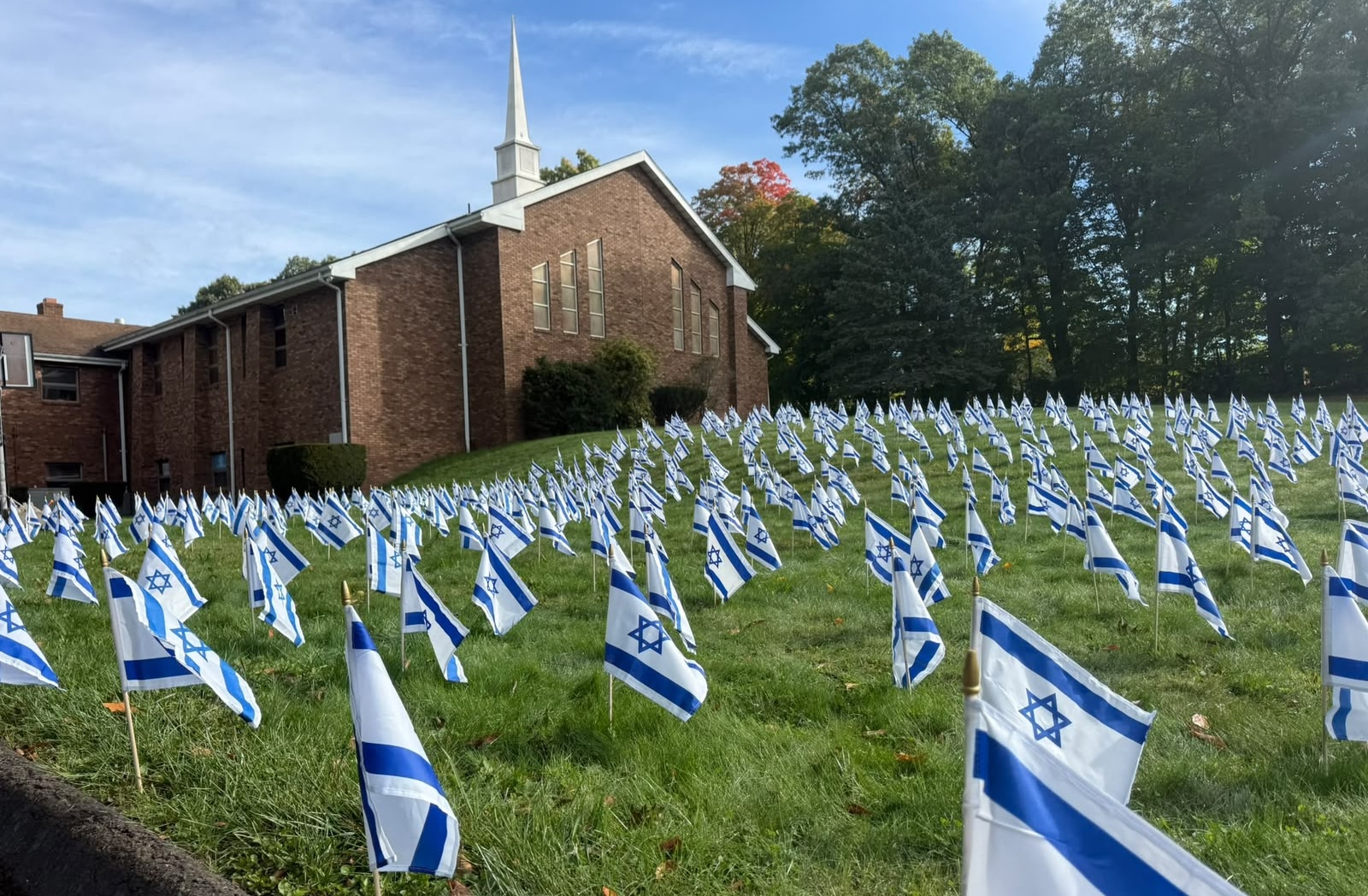
Israeli flags are seen recently planted into the ground outside Hope Christian Church in North Haven, Conn., as part of the International Fellowship of Christians and Jews’s third annual Flags of Fellowship campaign commemorating the Oct. 7 terror attacks.
“More than 4,375 churches, universities, and organizations across 14 countries are taking part in the campaign, planting more than 5.2 million Israeli flags and holding events, prayer services, and gatherings in solidarity with Israel,” IFCJ said. This year, the campaign will take place in the United States, Canada, Australia, England, Kenya, South Africa, India, the UAE and more, according to the organization.
Birthdays

Eden Golan, Israeli singer, she represented Israel in the Eurovision Song Contest in 2024, turns 23
Eli Jacobs, investor and board member of many companies, he was the owner of the Baltimore Orioles from 1989 to 1993, turns 89
Morton Meltzer, psychiatrist in Cameron, N.C., affiliated with WakeMed Health and Hospitals
Theodore Steiner, Fairfax, Calif., resident
Robert Winer, Long Beach, Calif., resident
Ben Cardin, former U.S. senator (D-MD), turns 83
Jonathan Dobrer, author, lecturer and journalist, turns 82
Brian Lehrer, talk show host on New York City’s public radio station WNYC, turns 74
Alan Cohen, founder of several pharmaceutical companies, he was the owner of the NHL’s Florida Panthers, turns 72
Madeleine “Mandy” Grunwald, political consultant and media advisor for the Democratic Party, turns 69
Andrew Cushnir, president and CEO of The Associated: Jewish Federation of Baltimore, turns 63
Michael Jacobs, former editor of the Atlanta Jewish Times, now a consultant, turns 57
Jesse Adam Eisenberg, actor, producer and playwright, he played Mark Zuckerberg in “The Social Network,” turns 43
Charlotte Kaye, past president of the Congressional Jewish Staff Association, turns 32
Gladys Bendahan, Canary Islands native, she is a former coordinator at Israel’s Mission to the United Nations
Daniel Rubenstein, Israeli tour guide and educator
Dalila Bela, actor known for her role as Agent Olive on the TVOKids/PBS series “Odd Squad,” turns 25