LIKE A TREE IN THE FIELD
In the hills near the sites of two Oct. 7 massacres, a new forest looks to memorialize fallen, instill hope
In the coming weeks, families of victims will come to plant a sapling in memory of their loved ones in the 'Iron Swords Forest' outside Kibbutz Beeri
Judah ari gross/ejewishphilanthropy
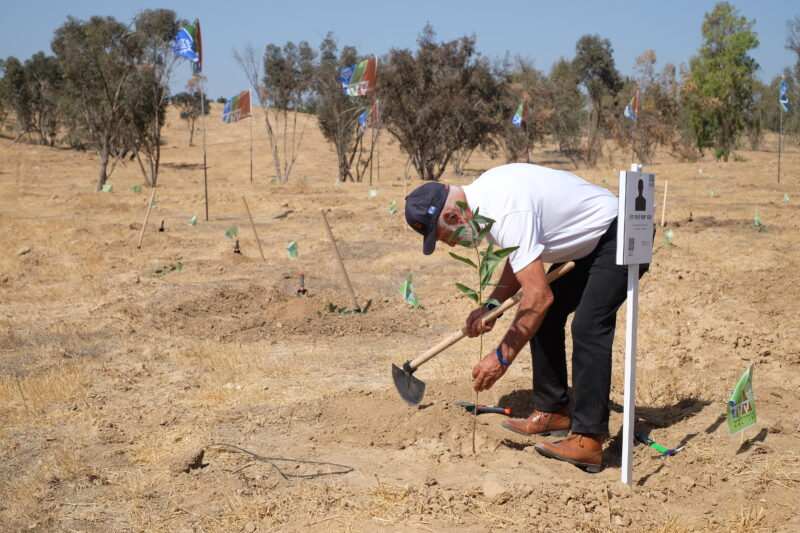
Eli Taher, the chairman of Yad L’Banim, which commemorates fallen soldiers, plants a tree in honor of his son, Yossi Taher, who was killed in the Oct. 7 terror attacks, in the Keren Kayemeth LeIsrael-Jewish National Fund’s ‘Iron Swords Forest,’ which was inaugurated outside Kibbutz Beeri on Oct. 21, 2025.




 Add EJP on Google
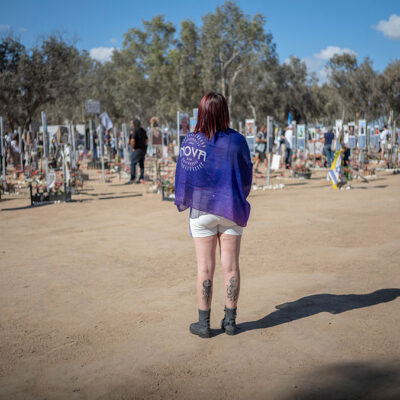
On the rolling, yellow hills just south of the homes being built on the devastated Kibbutz Beeri and just north of the site of the Nova Music Festival massacre, some 2,000 green and white flags mark where eucalyptus trees are being planted to serve as a memorial to the roughly same number of people killed in the Oct. 7 attacks and the resulting two years of war in Israel. In a certain sense, this forest will also commemorate the many years of war and strife that this small, sun-drenched corner of the Western Negev has experienced.
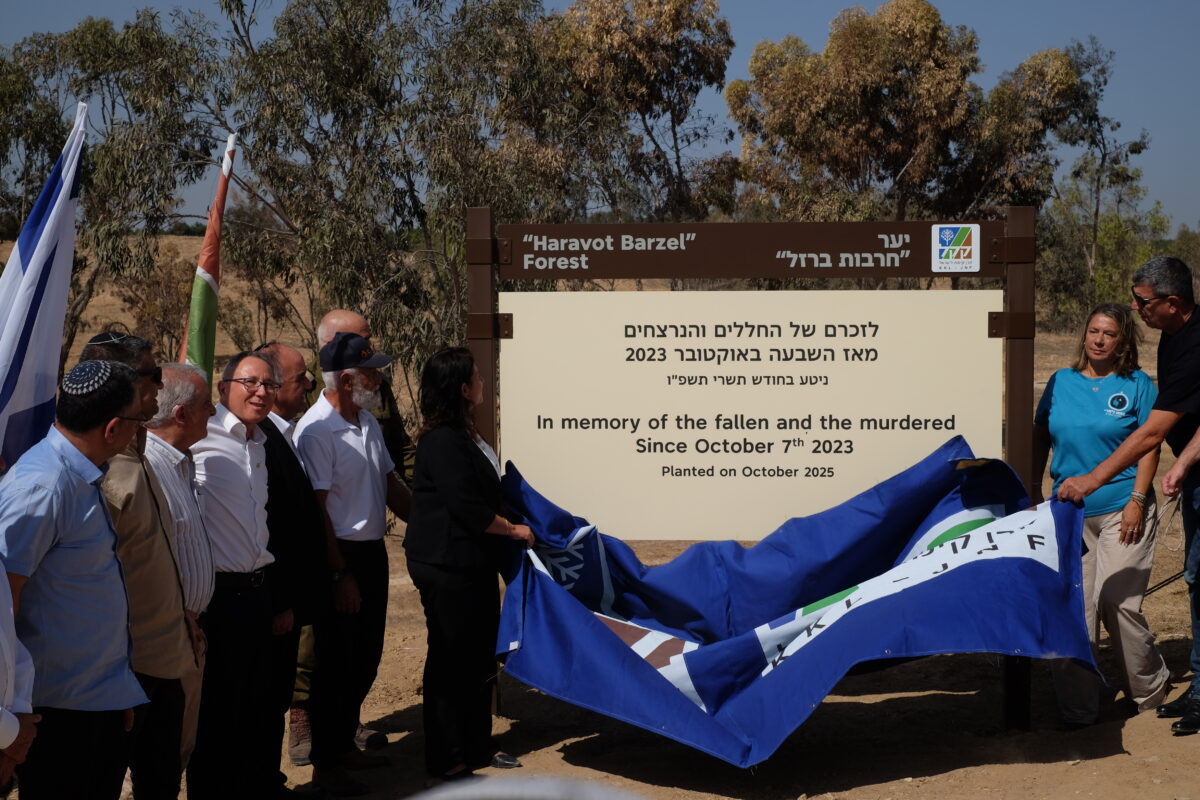
The “Iron Swords Forest” — as the forest is known, at least for now — was inaugurated on Tuesday morning by Keren Kayemeth LeIsrael-Jewish National Fund, which owns much of the undeveloped land in the area, with families of several victims planting some of the first trees, joined by representatives of organizations that support bereaved families and officials from the country’s security and emergency services. (Though the main sign for the forest was unveiled on Tuesday, the name of the forest may change as the government recently renamed the conflict “The Tekuma War,” or “War of Revival.”)
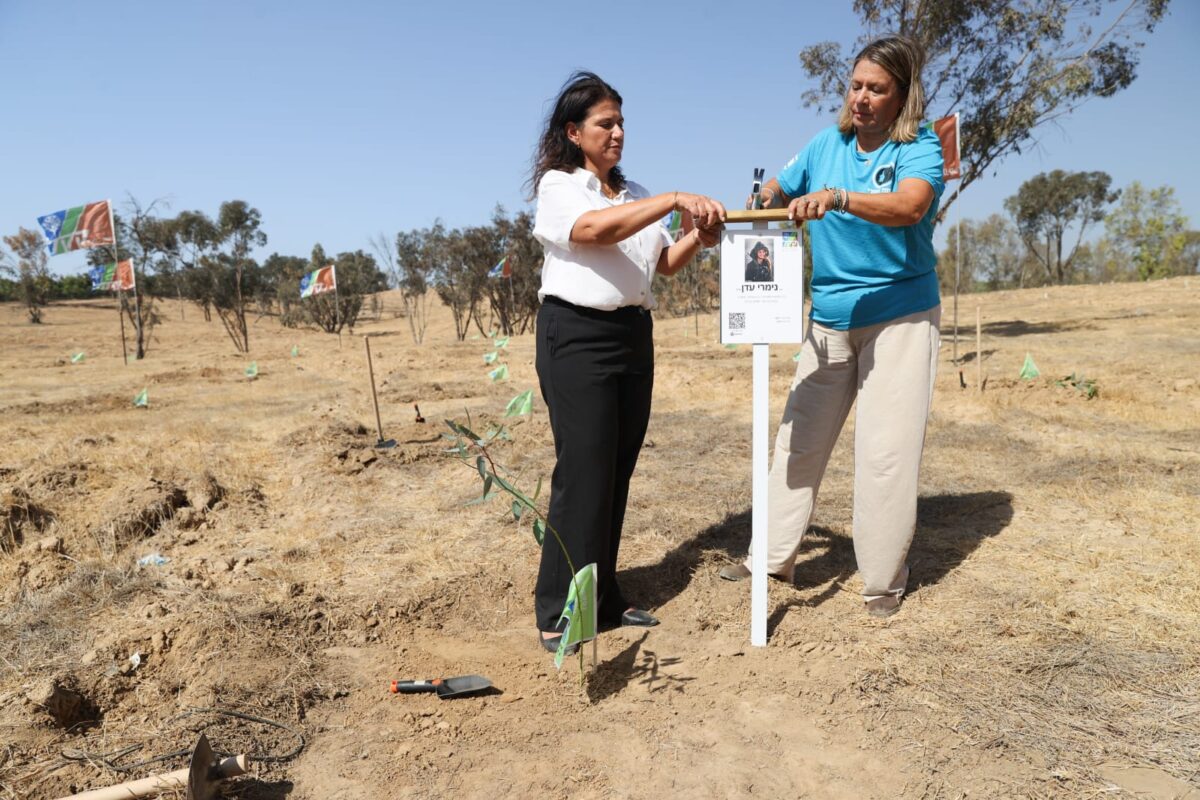
In the coming weeks, the families of the remaining victims are invited to plant saplings and hammer small markers next to the trees featuring their loved ones’ names, photos and other basic details, along with a QR code linking to their favorite song.
“If there’s one thing that our history teaches us, it is that we know how to stand up, how to recover and how to grow anew,” Ifat Ovadia-Luski, KKL-JNF chair, said at the ceremony. “Planting this forest is a clear expression that we do not surrender, we are not leaving. We are planted here forever.”
In the mid-1960s, KKL-JNF first planted a eucalyptus forest in these hills, supplementing a small existing cluster of pine trees that had been planted in the area by the British. Nearby, there are also groves of tamarisks.
“And then, in 2018 and 2020 and 2021, there were all the rounds of ‘balloons.’ It was nuts, and the forest was destroyed,” Michael Sprintsin, a forest manager for KKL-JNF, told eJewishPhilanthropy, referring to the periods in which terrorist groups in Gaza repeatedly launched incendiary balloons and kites into Israel, sparking massive wildfires.
Soon after these arson attacks, KKL-JNF, decided to restore the Western Negev forests, “from Nahal Oz — that’s the northern border of where we operate — down to Kerem Shalom and Kissufim,” said Sprintsin, who specifically focuses on this region.
KKL-JNF teams had only just started their work when Hamas launched its deadly attacks on the region, which included further arson attacks. The organization, which has also supported reconstruction efforts in the nearby Gaza border communities, decided to turn the forest into a memorial site.
Tuesday’s ceremony was originally scheduled nearly a year ago, around the tree-focused Tu B’Shevat holiday in early 2025, but the fighting in Gaza was raging at the time, so it was postponed to the summer. And then Israel launched preemptive strikes against Iran’s nuclear and ballistic missile programs, sparking a 12-day conflict, which further delayed the inauguration. Though Ovadia-Luski noted that the war in Gaza was not yet fully over, with two soldiers killed in a rocket-propelled grenade attack two days prior, the current armistice allowed the inauguration to go ahead.
“The Iron Swords Forest is not just another forest. It’s a forest of pain, but also of hope. It will stand here for generations, telling the stories of the heroes who died defending their nation, their lands and their homes,” Ovadia-Luski said in her speech at the ceremony.
One of those trees will tell the story of Capt. Eden Nimri, an officer in the elite Sky Rider Unit, which operates small drones to assist special forces on missions. Nimri, a nationally ranked swimmer with aspirations of studying and competing for an American college, was days away from completing a stint on the IDF’s Nahal Oz base, adjacent to the Gaza border, when Hamas launched its attack in the early hours of Oct. 7, 2023, sending scores of terrorists into the poorly defended outpost. As the base came under heavy mortar fire, Nimri led her team of four female soldiers into a bomb shelter, along with some 30 other unarmed soldiers, her mother, Sharon, a KKL-JNF employee, told eJP.
Standing in her pajamas and armed with her rifle, Nimri positioned herself at one entrance to the bomb shelter and directed her soldiers to the other. She held off a group of terrorists, allowing her soldiers and seven other troops in the shelter to escape out the other side, saving their lives, the survivors later told the family.
“She kept them off until she ran out of ammunition, and then — may their names be erased — the monsters entered. With her bare hands, she fought them off. And they killed her, spraying her with bullets,” Sharon Nimri said, noting that the details of her daughter’s final acts were provided by the female soldiers who were taken captive from the shelter and freed in January.
“From the moment they returned, after 477 days, that is what was important for them to say,” she said.
Nimri said that while the tree and marker are the first permanent memorial for her daughter, she plans to further honor her through different initiatives connected to swimming.
Another tree was planted in honor of Yossi Taher, a senior figure in the Shin Bet security service, who independently rushed to the Gaza border area after Hamas launched its attack.
Taher’s tree was planted by his father, Eli, who serves as chairman of the Israeli organization Yad L’Banim, which commemorates fallen soldiers and supports their families. Eli Taher is thrice-bereaved; in addition to his son Yossi, Taher’s brother Yossi died during his military service in 1981, and his other son Roi in a motorcycle accident during his service in 2001.
Eli Taher said that he takes solace from the fact that his son, who was shot dead by terrorists in an ambush outside of the nearby Kibbutz Mefalsim, was killed after saving the life of a critically wounded soldier, preventing a deadly invasion of Mefalsim and helping to halt an attempt by 150 terrorists on motorbikes to reach central Israel.
“My solace is that he succeeded on that day. That wasn’t easy. When you look at what happened at other kibbutzim, [even when] there were soldiers who fought like lions… but at least whatever Yossi touched, succeeded,” Taher said in a speech at the event, holding back tears.
“This view, which looks a bit like the Garden of Eden now, was hell on Oct. 7,” Taher said, standing on a hill overlooking the new forest.
Several of the speakers noted the multiple times in the Bible that people are compared to trees, including Taher, who discussed his struggles to overcome the grief of losing his brother and two sons.
“Every day when I wake up, I set for myself a hill to climb. I imagine my two boys sitting on that hill, with a bonfire and a bottle of beer. And every day, I climb that hill. I fall, I get hurt, I yell, I cry, I laugh, but at the end of every day, I drink that beer with my kids. Every day, I overcome that fracture and destruction,” Taher said. “Like a tree can grow, so can we, bereaved families, continue to grow despite the pain.”
According to Sprintsin, who has a Ph.D. in environmental physics, it will take decades before the Iron Swords Forest is fully mature, though KKL-JNF hopes to speed the process along by installing irrigation lines to give the saplings an initial boost.
The eucalyptus trees were chosen for the area as they do well in the desert-adjacent region, soaking up whatever water they can and holding on to it through dry spells. The eucalyptus trees chosen for the forest can also tolerate fires. Sprintsin pointed to one of the still-standing older trees from the original KKL-JNF forest that was recently burned in a fire. “That tree may not die. It can recover, especially now with the winter rains coming,” he said.
Related News

MAJOR GIFTS
Center for Jewish History celebrates 25 years with a $25M matching grant

MAGICAL EXPERIENCE
Shefa launches psychedelics retreat for Jewish professionals suffering burnout
CLOSING WORDS
In AZM address, Cosgrove links communal ‘orthodoxy’ on Israel to rising anti-Zionism among young Jews
HIGHER EDUCATION
As Jewish donors reconsider academia, Jan Koum doubles down, endowing Israel studies at Stanford

EXIT INTERVIEW
Elizabeth Sokolsky, longtime EVP of Birthright Israel, to retire next year