Opinion
FOOD FOR THOUGHT
Tu B’Shevat: A winter reminder of our roots




 Add EJP on Google
Most people think of Tu B’Shevat as the holiday of the trees. We learn about fruits, we eat dried figs and dates, we talk about ecology and planting. All of that matters. But for me, Tu B’Shevat has always been about something else: belonging.
Growing up in New York and later living in Cleveland, Tu B’Shevat always came in the heart of winter. In school, they would hand out little plastic bags of dried fruit. Inside were raisins, maybe a dried apple ring, and almost always a piece of carob — the bukser. You’d think it was chocolate. You’d take a bite. And you’d be disappointed.
Hans/Pixabay
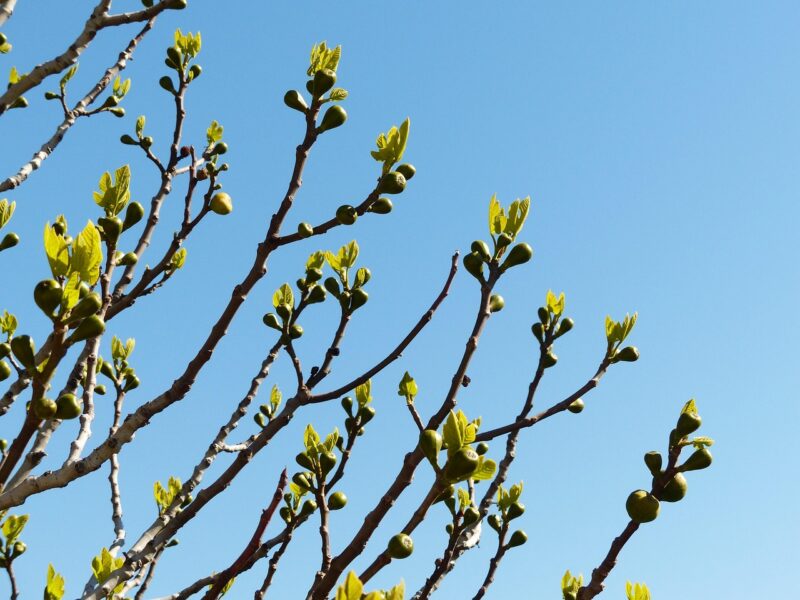
A blossoming fig tree.
But then something strange would happen. Somewhere between the dried fruit and the cold February air outside, I would feel a kind of longing I didn’t yet have words for. Why were we eating fruit in the middle of winter? Why were we marking growth when everything around us was frozen?
And the answer, even if I didn’t articulate it at the time, was clear: because somewhere else, it wasn’t really winter.
In Israel, Tu B’Shevat arrives as the trees begin to blossom. The land is already warming. Fruits are sprouting. Growth is visible. And sitting there in North America, holding that bag of dried fruit, I felt — long before I could explain it — that I was out of sync. That maybe it shouldn’t be winter for us anymore. That maybe I belonged somewhere else.
That feeling has deep roots in Jewish history and Jewish language. Centuries before me, Rabbi Yehuda HaLevi wrote, “Libi baMizrach v’ani b’sof Ma’arav” — “My heart is in the East, and I am at the far end of the West.” It’s one line, but it captures an entire Jewish experience: physically present in one place, emotionally and spiritually oriented somewhere else.
Modern Hebrew poetry gives that feeling even more texture. Chaim Nachman Bialik’s poem “El HaTzipor“ imagines a Jew in the cold of Eastern Europe speaking to a bird that has returned from the warmth of Israel. He asks about dew and fruit and flowers. He wonders whether the plants “I planted” are flourishing or withered like he feels himself to be, so far from the nourishment of home. Bialik was writing in a world shaped by persecution and exile, which I did not grow up with. But the longing he describes — the pull toward warmth, toward life, toward home — felt familiar to me even as a child.
Shaul Tchernichovsky gives that longing another image when he writes of “eretz sh’churat shemesh” — a land drenched, even drunk, with sun. Where is that land? Where is that sun? the poet asks. Tu B’Shevat, for me, was always a reminder that such a place was real. That it wasn’t just poetry. That it existed, and that I was connected to it.
That connection shapes how I think about my work and about the young people I teach. For years as a teacher in Cleveland, I often brought these texts about the landscape of Israel into my classroom, hoping to guide my students to better understand their natural connection to the Holy Land.
I continue to treasure and appreciate this concept now that I have made aliyah myself. I recently helped launch Nelech, a new semester-long program that brings Modern Orthodox high school students from North America into Israeli schools — not as visitors, but as students fully embedded in Israeli life. In this formative moment in their lives, my hope is that these youth will come to know Israel, this sun-drenched land, as a place where they belong. Where they have history, and a future.
But my wish is not only for my students. It’s for all of us. Am Yisrael and Eretz Yisrael are bound by a profound connection that has shaped Jewish life for centuries, wherever Jews have lived. For two thousand years, we’ve dreamed of return; in our lifetime, that dream became reality. Tu B’Shevat invites us to pause from our busy lives and reflect on what that connection means for us today. How does Israel shape our Jewish identity, our spiritual lives, and our sense of belonging to the Jewish story? And just as importantly: how do we help the next generation feel that connection, that rootedness and belonging, in their bones?
This Tu B’Shevat, I encourage families and communities to take the time to lean into these questions. Sit around the table and talk — not just about trees, but about memories. About your first trip to Israel. About a place that stayed with you. About a biblical story whose landscape you can still picture. And if you haven’t been yet, talk about where you hope to go. What you want to see. What you want your children to feel.
Take a walk outside. Notice what is growing where you are, and think about what is growing in Israel at the same moment. Let Tu B’Shevat remind us that Jewish life is rooted not only in memory or metaphor, but in a real land and a living people — and in a sense of belonging that, once planted, continues to grow.
Rabbi Rick Schindelheim is an educator at Ohr Torah Stone and the founding director of its Nelech Program, a semester-long Israel immersion experience for Modern Orthodox high school students, developed in partnership with the Tzemach David Foundation.