MAJOR GIFTS
In first national grant to Chabad, Marcus Foundation gives $3.8M to Rohr Jewish Learning Institute
This grant will go to Jewish education, which the foundation’s president tells eJP is an ‘antidote’ for antisemitism

Courtesy
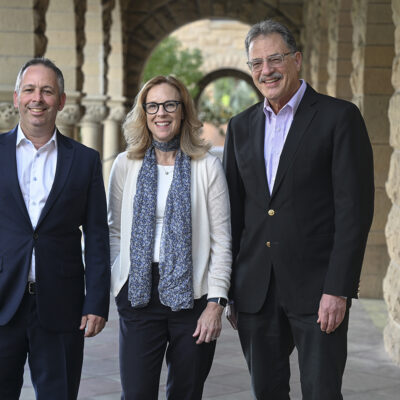
From left, George Rohr, Dennis Ratner and David Heller speak about philanthropy in a panel moderated by Susan Kramer at the Rohr Jewish Learning Institute summit in Palm Beach Gardens, Fla., in January 2026.




 Add EJP on Google
In its first major national grant to Chabad, the Marcus Foundation has donated $3.8 million to support the Rohr Jewish Learning Institute, the adult education arm of the Chabad Lubavitch movement, the foundation’s president told eJewishPhilanthropy.
A portion of the donation was announced at JLI’s annual leadership summit, which drew some 120 Jewish philanthropists and thought leaders to Palm Beach, Fla., earlier this week.
The donation to JLI represents a shift for the Atlanta-based foundation. Its founder, Bernie Marcus, was a longtime member of a local Reform congregation, which received $360,000 from the foundation in 2024, and the grantmaker has generally supported nondenominational initiatives, such as Hillel International, RootOne and Honeymoon Israel, among many others. In 2024, the most recent year for which data are available, the Marcus Foundation donated roughly $1 million to three Chabad-affiliated groups — out of $227.5 million in total giving — all of them located in the Atlanta area, where the foundation supports a wide array of Jewish institutions.
According to Jay Kaiman, president of the Marcus Foundation, the grant to the national Chabad program comes after years of observing JLI’s work, fitting into the foundation’s long-standing focus on Jewish education.
“They have been both diligent and transparent in terms of the work that they’re doing, and we felt they deserved the opportunity to explore a partnership with us and a relationship… We have always been impressed with the quality of their curriculum, and also believe that they have a great distribution portal that we can take advantage of in terms of adult Jewish education,” Kaiman told eJP. “The best antidote for antisemitism is Jewish education, Jewish pride and security, not security in the sense of institutional security, but knowing ourselves. And the best way to know ourselves, we feel, is to be educated, understand text and understand who we are as a people, and we think that JLI helps do that.”
Chabad’s “entrepreneurial” operational approach makes a “great impact on the ground,” but funding Chabad’s national programs can be complicated for large funders, Kaiman said. He described the foundation’s recent grant as a “great experiment.”
“There’s a lot of talk in the foundational world about funding Chabad programs and how it’s structured. I think this is a great experiment for us. We trust [Rabbi Efraim Mintz, executive director of JLI], and we think he’s going to do great things,” said Kaiman. “We’re trying to combine the entrepreneurial approach to the bigger picture.”
According to Mintz, the summit raised $6.3 million in donations from several funders, nearly double the amount that the organization raised at last year’s gathering. Only about a third of the Marcus Foundation’s donation was included in the total for this year, as the full grant will be distributed over three years, Mintz said.
The funds will support JLI’s ongoing efforts to scale, as well as the organization’s Center for Universal Values, a new division of JLI, Mintz told eJP. Now in close to 2,000 communities, and 11 languages, JLI hopes to engage more teenagers, college students, young professionals and adults of all ages, he said.
“We are the largest provider of adult Jewish education today,” said Mintz. “Our goal is to reach even more than we are reaching with engaging Jewish content that will allow more and more Jews to identify as Jews, to embrace a Judaism that that resonates with them, so that they can carry their Judaism with pride, and when they do so, become cherished, informed, educated and proud Jewish ambassadors of Judaism to the world.”
The role of Jewish education, including day schools, in combating antisemitism was a core focus of the summit, which also covered topics ranging from how Jewish ethics can strengthen American civil society to the loneliness epidemic, David Heller, national campaign chair at Jewish Federations of North America, who spoke at the summit, told eJP.
“One of the prevailing discussions was how antisemitism should be fought through education as opposed to through antisemitism funding. And if we don’t have an educated Jewish community, what are we fighting for?” said Heller. “My opinion is that we’re spending an inordinate amount to fight antisemitism when we should be spending that money on education and social services in our communities.”
Related News

EXIT INTERVIEW
Elizabeth Sokolsky, longtime EVP of Birthright Israel, to retire next year

MAGICAL EXPERIENCE
Shefa launches psychedelics retreat for Jewish professionals suffering burnout
CLOSING WORDS
In AZM address, Cosgrove links communal ‘orthodoxy’ on Israel to rising anti-Zionism among young Jews
ADVANCING A VISION
N.Y. federation donates $1M toward building shared-society center named for peace activist killed on 10/7
EXCLUSIVE
Detroit-based philanthropists Nancy, James Grosfeld donate $8M to renovate JDC’s Israel campus