Opinion
NOT OVER FOR THEM
The invisible war Nova survivors are still fighting




 Add EJP on Google
In Short
Remembering the Oct. 7 attacks should include an ongoing commitment to the people who lived through it and who continue to carry its consequences.
Since the Israel-Hamas ceasefire took shape, a quiet assumption has taken hold. The lives of Israelis have begun to stabilize, and the worst is behind us. But for the survivors of the Nova music festival and the bereaved families who lost loved ones on Oct. 7, 2023, this assumption could not be further from the truth. Though Ran Gvili’s body has been returned to his loved ones and the hostages are officially all home, survivors of the Nova music festival still face an invisible war: one of trauma, grief and a mental health crisis that continues to worsen more than two years later.
As the CEO of the Tribe of Nova Foundation, I work every day with survivors and bereaved families from the festival, and what I see is not recovery, but exhaustion. Many are struggling with severe depression, post-traumatic stress, anxiety and disconnection from the lives they once knew. The foundation supports survivors whose challenges present on a spectrum from acute to debilitating, each requiring tailored care and support.
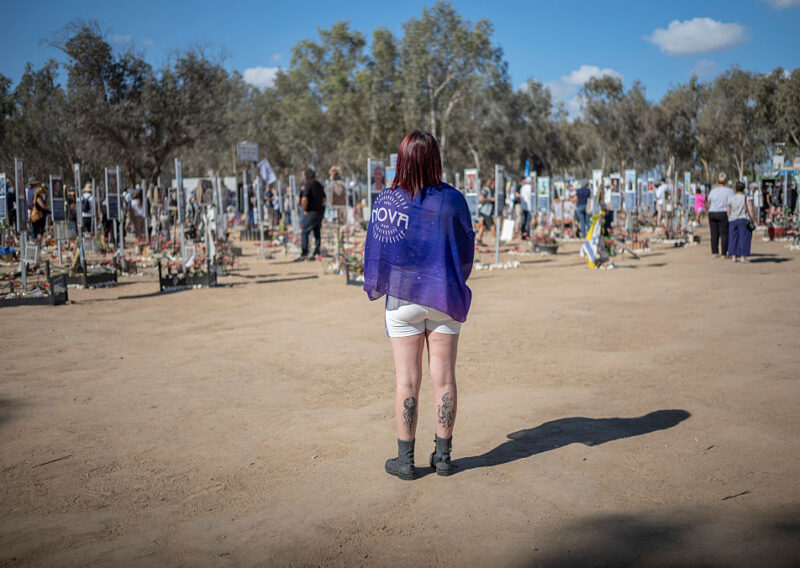
Ilia Yefimovich/picture alliance via Getty Images
A woman wears a flag with the Nova festival logo at the Nova festival site in Re'im during a ceremony to commemorate the 2-year anniversary of the Oct. 7 attacks.
The struggles to return to work, care for children and live daily lives are often unseen, misunderstood or minimized by a tired world eager to move on. The quiet stability of a routine is out of reach when every day feels like a battle.
The traditional wisdom that time heals all wounds is not true for all Nova survivors. Trauma does not follow headlines or end when the news cycle shifts. For many survivors, the opposite is actually true. The passage of time can complicate recovery, as support systems fade and the expectation to return to normal intensifies.
The tragic loss of Roei Shalev underscores this painful reality. Roei survived the Nova attack but witnessed the murder of his girlfriend. He took his own life in October 2025, nearly two years later. His death was not an isolated tragedy, but rather the result of unaddressed or potentially misunderstood trauma. He is just one of many whose lives are forever and irrevocably changed by the Oct. 7 massacre. His father, Ronen Shalev, has been adamant about the need to recognize the mental health crisis among survivors as a national emergency. Ronen is working with the foundation and our partners on interventions for this startling mental health crisis and to prevent other parents from feeling this pain.
A critical part of the solution is scaling the response to meet the size and scope of the challenges. We recently held the ribbon-cutting of UJA New York Beit Nova outside Netanya, Israel. The facility will be a safe haven when it opens later this year and will be a physical reminder that they are not alone. Beit Nova will be a centralized location for survivors and bereaved families to access programming, treatment and, most importantly, a sense of community, rooted in solidarity, compassion and mutual understanding.
There was an audible sigh of relief after the ribbon was cut, of anxiety and stress kept inside out of fear that the world had moved on from a tragedy they cannot seem to escape. With each breath they take, the cycles of loneliness and trauma veer off-course.
The Tribe of Nova Foundation helps meet these ongoing needs and serves as an outlet to support the survivors and bereaved families facing this invisible war. The foundation is a lifeline, providing mental health support and spaces where survivors and families can process what they have endured without judgment or pressure.
At the foundation, we work with our partners to fill in the gaps and ensure no one is left behind, regardless of the challenges they face. We have not lost sight of the urgency of these challenges and the gravity of work still needed to address them.
What has become increasingly clear is that healing is not linear. Recovery is often measured in years, not months or days. Responding to mental health challenges after a traumatic event cannot be rushed or simplified. It requires compassion, patience and an understanding that some wounds are not immediately visible.
Remembering the Oct. 7 attacks should include an ongoing commitment to the people who lived through it and who continue to carry its consequences. By recognizing the invisible war Nova survivors are still fighting, it becomes loud and clear that they are not facing it alone.
Seth Davis is the CEO of the Tribe of Nova Foundation. He is a social entrepreneur with expertise in social change, charitable philanthropic practices and giving, mainly for Israel-related causes and within the Jewish community.