LIVE AT JFN
JFN conference highlights new voices as next generation of philanthropists join the conversation
San Diego gathering bulks up security in light of rising antisemitic threats; early sessions focus on collaboration, need for philanthropic action
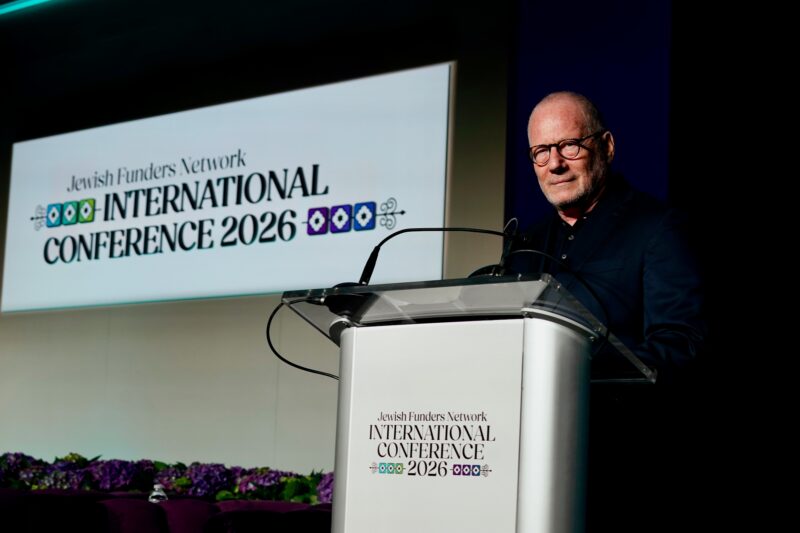
COURTESY/JFN
Ronnie Douek, Israeli businessman, philanthropist and co-chair of the 2026 JFN International Conference, addresses the opening plenary in San Diego on March 15, 2026.




 Add EJP on Google
It was the same temperature as every day in San Diego — a crisp 70 degrees, not too hot, not too cold — as over 600 attendees, individual funders and representatives of family foundations and large grantmakers, from nine countries made their way to the Jewish Funders Network’s 2026 International Conference. Actor and activist Jonah Platt even broke out the linen suit and gilded glasses for the event, the first time the convening has returned to California since 2019.
Last year’s JFN conference, which was held in Nashville, Tenn., concluded with Jon Polin and Rachel Goldberg-Polin, whose son Hersh was taken hostage on Oct. 7, 2023, and murdered in captivity almost a year later, vowing to secure the release of the remaining 59 hostages held in Gaza. This year, the hostages are all home, many having returned for burial, but the conference was held as the U.S. and Israel entered their third week in the war with Iran and days after a violent attack at a Reform synagogue in suburban Detroit.
In a sign of the fraught moment, this year’s event was initially meant to have a team of six security guards. By the time the event kicked off on Sunday, 17 guards were on premises, many wearing bulletproof vests and armed with pistols.
“That’s a new reality,” Andrés Spokoiny, president and CEO of JFN, told eJP. “The times in which you could have a Jewish event without security are gone. This is a new normal, and that has to be something that funders need to consider.”
Pivoting philanthropy away from changing the minds of antisemites and towards security and resilience was one of many topics funders were discussing at this year’s event, often while philanthropists sipped coffee by the fountain or lounged under umbrellas in the California sun. Other discussions included the need to bring overt politics into the philanthropic world, rebuilding Israel, supporting human service agencies after recent government cuts. The topic at the top of many attendees’ minds was best exemplified by a quote that was repeated regularly and independently throughout the day: “Jewish education is my passion.”
While security guards were ever-present at the conference, Israeli funders were harder to find, as dozens who had planned to attend were unable or unwilling to make the trip in light of the closure of Israeli airspace due to ongoing Iranian and Hezbollah attacks.
“Shalom, everybody,” Ronny Douek, the Israel-based co-chair of the conference, who serves as president and chairman of Sheatufim, an Israeli organization that addresses social challenges through multi-sector collaboration, began his speech during the event’s opening plenary. “I can’t believe I’m here today, especially with my son, Ariel, about to enter Lebanon with the commander brigade.”
Most of the Israelis who were able to attend did so by leaving Israel through one of its land crossings and catching a flight from a neighboring country. Those who didn’t make the trip are joining parts of the conference via Zoom.
“There is no separation between Diaspora and Israel,” Douek said. “What happens in Israel affects the entire Jewish world and vice versa. Protecting our people, fighting antisemitism, saving democracy, building a broad coalition to impact critical issues and educating our children about Jewish solidarity, these challenges are all connected.”
The opening plenary emphasizes the need for new voices, new leaders and shifting how things are done.
“I’m honored to stand before this extraordinary group of funders at a defining moment in the history of Israel and the Jewish people,” banker Zoya Raynes, chair of JFN, said. She immigrated to the U.S. from Kyiv in 1979, supported by a combination of philanthropy, activism and government policy. “It was coordinated power, not passive generosity,” she said.
“There has been much criticism lately about the establishment. Let’s be honest, if you are in this room, you are establishment,” she said, as some of the 600 in the audience grumbled. “That is not an accusation, it’s an obligation, and it’s also a blessed opportunity. One day, our children and grandchildren will look back at this period the way we look at 1948, 1967 and the Soviet Jewry movement.”
Doing things the old way will not suffice, she said, eliciting applause. “Routine grant cycles will not be enough. Maintaining legacy allocations because they feel safe or because we aren’t comfortable having uncomfortable conversations will not be enough. Remaining confined to a 5% payout model in a civilization inflection point will not be enough. In normal times, incrementalism is prudent, but these are not normal times.” (Raynes made a similar plea at last year’s conference.)
The core programming in the plenary was a Q&A, led by Lisa Eisen, co-president of Charles and Lynn Schusterman Family Philanthropies, with actor and activist Jonah Platt, Iranian American businesswoman Mandana Dayani and investor Marc Rowan.
“How do you get a group of very well-intentioned, very well-networked people to be effective,” Rowan asked the audience, deciding the answer was through networking and collaboration. Instead of running 50 initiatives aiming to accomplish similar goals, he said, philanthropists should find which two work best.
“We have yet to understand the power of this room and the power of other rooms like this,” Rowan said. “And we’re uncomfortable talking about power, because it’s one of the [most harmful] things that people say—the Jewish cabal that controls the world. Well, if you’re going to live with the insult, you might as well actually get some benefit.”
Even though the levels of current antisemitism can feel shocking, Dayani said, the community now knows what they are dealing with. “Sometimes it feels like we shut the refrigerator and cockroaches came out. At least now we know where they are, and now we can address them.”
After a series of students were pushed out of college newspapers, Dayani brought the students together to start their own online newsletter. “Every time you try to push Jews out, we just build something bigger and better,” she said. “We don’t have to beg for permission, sometimes, to be part of these old, stupid institutions.”
The post-Oct. 7 world can feel hopeless, Platt said. “It’s quite the opposite. There’s so much to do, and all of it is helpful. We just have to really not blow this opportunity… Either we goof this opportunity, we don’t capitalize on all the people who are engaged in this moment and really lean into that, or we do, and we start to create new institutions, or reprioritize our current ones in the way that they’re operating, and bring in all these other people who have not been engaged and want to be and don’t necessarily know how or what to do, but want to do it.”
When the UJA-Federation of New York, which Rowan is chair of, holds programming for young Jews, “it is sold out the minutes it’s posted,” he said. “We’re out of capacity almost everywhere. The outpouring of energy, the outpouring of interest, the outpouring of support, is unbelievable.”
The theme of new voices in the philanthropic world was a topic throughout the day, beginning with an invite-only session before the conference, attended by nearly 20 young philanthropists and titled “NextGen: Leadership in Motion.”
Young philanthropists are “showing up,” Stefanie Rhodes, CEO of Slingshot Fund, told eJP. “They believe that we are going to get through this [period of darkness post. Oct. 7] and be stronger and better. And the question is, how do we do that? How do we work together with our peers, with other organizations that we sit on the boards of or are supportive of, how do we feel the complexities of the moment and not shy from them?”
Rebecca Bloch, who represented Philip and Muriel Berman Foundation at the event, told eJP that she has had disagreements about philanthropy with her father — but he had disputes with his father about philanthropy, too. “There are things they have done that brought us here,” she said. “We need to lean into the things that worked. We all have to grow. And tackle the problems of our time.”
The sessions also represented a diversity of voices from the philanthropic field. At the session for “Jewish Economic Vulnerability: When the Exception Becomes the Norm,” led by Rachel Sumekh, CEO of TEN, Together Ending Need, a San Diego State University student named Kim Kritzer told her story of overcoming homelessness and the death of both her parents through support that she received from Jewish Family Services and Hillel. Today, she has a 4.0 GPA and is studying social work.
This was philanthropist Jeremy Lautman’s first time attending the JFN conference. He went “to try and figure out how to do this,” he told eJP, referring to philanthropy.
His grandfather, Irving Lautman, died three years ago, and he wants his wealth “to be a unifier in my family and a driver. We want to make sure that philanthropy will be a thing that adds value. Thinking along those lines about, ‘How can I do things and use my family’s name and have it be something they’d be proud of?’”
In the years before his grandfather passed away at 97, the elder Lautman gave each of his grandchildren $500 each year to causes they believed in. “One of my grandfather’s greatest wishes was that we continue this tradition of philanthropy,” Lautman said. “He didn’t live to see it, but he wanted us to continue this responsibility.”
Related News
ADVANCING A VISION
N.Y. federation donates $1M toward building shared-society center named for peace activist killed on 10/7

MAGICAL EXPERIENCE
Shefa launches psychedelics retreat for Jewish professionals suffering burnout

MAJOR GIFTS
Center for Jewish History celebrates 25 years with a $25M matching grant
HIGHER EDUCATION
As Jewish donors reconsider academia, Jan Koum doubles down, endowing Israel studies at Stanford
CLOSING WORDS
In AZM address, Cosgrove links communal ‘orthodoxy’ on Israel to rising anti-Zionism among young Jews