MUSCULAR JUDAISM
New partnership aims to help disabled veterans play sports ahead of this summer’s Maccabiah Games
Tikkun Olam Makers and Maccabi World Union sign agreement to develop and highlight rehabilitation solutions for athletes
courtesy/TOM
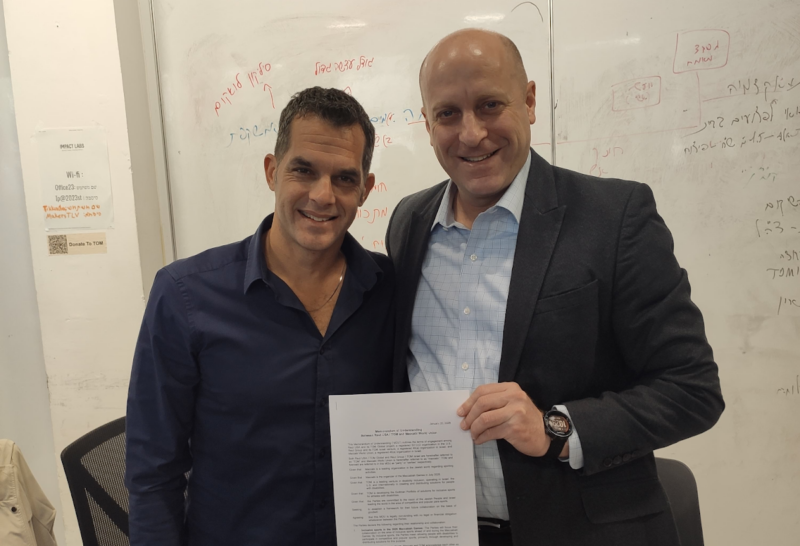
Roy Hessing, CEO of Maccabi World Union (left), and Gidi Grinstein, founder of Tikkun Olam Makers, which creates open-source solutions for people with disabilities, sign a memorandum of understanding head of this summer’s Maccabiah Games in Israel, at TOM's Tel Aviv headquarters in January 2026.




 Add EJP on Google
A new memorandum of understanding signed last week aims to make sports more accessible to people with disabilities, particularly for injured IDF veterans wounded over the past two-plus years of war and other competitors in this summer’s Maccabiah Games in Israel.
The agreement was signed by Tikkun Olam Makers, which creates open-source solutions for people with disabilities, and Maccabi World Union. As part of the arrangement, the two groups will also collaborate with the Israeli Defense Ministry’s Rehabilitation Division, its MAFAT research and development department and the IDF’s Casualties and Disabled Soldiers Department. The organizations will also work with other nonprofits, including the IDF Disabled Veterans Organization, Beit Halochem rehabilitation centers and the Paralympic Association and Committee, map needs from the field and identify barriers preventing people with disabilities — first and foremost wounded veterans — from participating in sports.
The partnership will be showcased at this summer’s World Maccabiah Games, which kick off in late June, having been postponed last year due to the 12-day Israel-Iran war.
“The partnership with TOM and the IDF Disabled Veterans Organization is designed to ensure that no physical barrier prevents our heroes — men and women alike — from returning to the field. We are building a pathway that begins with rehabilitation and ends on the Maccabiah podium,” Roy Hessing, CEO of Maccabi World Union, said in a statement.
“This collaboration with Maccabi World Union will create the largest portfolio of solutions in the world for participation in sport by people with disabilities,” Gidi Grinstein, the founder of TOM, said. “It is a true breakthrough for IDF disabled veterans and for people with disabilities in Israel and around the world.”
The partnership comes as TOM and other organizations are looking to both address Israel’s growing need to support the rehabilitation of the thousands of soldiers and civilians injured over the past two years of war and to turn Israel into a world leader in the field of rehabilitative medicine.
Dana Gur Gelbard, who manages TOM’s innovation center in Tel Aviv and leads its community-based solution development, is also a former Olympic-level rower who represented Israel in European and World Championships. Bringing both athletic and technical expertise to the field — she holds degrees in industrial design and has years of high-tech product management experience — Gur Gelbard told eJewishPhilanthropy that the focus on sports is critical for rehabilitation.
“Sports provide enormous advantages both for mental well-being and for rehabilitation,” she said. “Many of our wounded soldiers and war victims do not have the ability to return to the sport they practiced before — at least not in a way that’s intuitive and accessible. What’s simple for people without disabilities requires overcoming many obstacles. That’s the gap we’re bridging.”
When an injured soldier approaches TOM looking to return to basketball or to take up surfing, the organization develops assistive devices and solutions that will enable them to participate — whether recreationally, competitively or as part of rehabilitation. The process begins with market research to identify existing solutions or off-the-shelf products that can be adapted. “Many requests are resolved at this stage,” Gur Gelbard said. “We’ve become a knowledge hub — sometimes people simply don’t know which solutions already exist.”
When custom development is required, TOM employs a multidisciplinary approach. Development teams always include three components: technical experts (designers, engineers, textile specialists, depending on the project), clinical professionals (physiotherapists, occupational therapists), and what TOM calls the “need knower” — the person who will use the solution and knows best what works. For injured athletes, this often includes coaches alongside the athletes themselves.
“The users and need experts are integral to the development process from the very beginning,” Gur Gelbard said. “We don’t wait until there’s a solution and then go check with them. They’re with us from day one.”
Current projects include rock climbing (through specialized gloves for gripping), surfing (surfboard modifications), kayaking, rowing and cycling. By using technologies like 3D printing and relying as much as possible on off-the-shelf components, TOM hopes to make it quick and easy for its products to be manufactured anywhere around the world and for an affordable price.
“It’s a very short development process compared to the traditional, off-the-shelf product industry,” Gur Gelbard noted. “But it still takes time, which is why we need athletes to come forward early.” Gur added that there is an open call for submissions, and athletes can already come forward and begin working with TOM.
The portfolio of sports-related solutions will be named after professor Sir Ludwig Guttmann, a Holocaust survivor who founded the Paralympic movement, connecting Jewish historical trauma to contemporary innovation in disability rights.
“It’s about honoring the past,” Gur Gelbard said of the name. “Guttmann was a leading Jewish figure who was significant in this field. There’s continuity here.”
Ahead of the Maccabiah opening, an international innovation conference on inclusive sports will convene global leaders. At the Games, “Maccabiah City” will feature a “Master Workshop” where athletes and the public can witness the development of Paralympic equipment in real time.
“Athletes will visit and can be inside it, like a live occurrence of the development,” Gur Gelbard said. The Master Workshop concept aims to demystify assistive technology creation while demonstrating Israel’s rehabilitation innovation capacity to a global audience.
Greenstein and Gur Gelband are intent on bringing Israeli rehabilitation to the global stage. “Paralympic sport in Israel is very developed,” Gur Gelbard said. “There’s something in the character of Israelis and our Paralympic athletes — they are very intuitive and very motivated. Our achievements in the Paralympic field relative to the world, and especially relative to our percentage of the population, are crazy.”
Founded in 1921 in Czechoslovakia as an umbrella organization for Jewish sports associations, Maccabi World Union brings networks, credibility, and emotional connection across 50 countries. By embedding TOM’s rehabilitation innovation into the Maccabiah narrative, the partnership creates natural bridges for funding, volunteer engagement, and global awareness.
“Israel is among the global leaders in rehabilitation, and we are proud to contribute to that leadership together with Maccabi World Union and Jewish communities worldwide,” Grinstein said in a statement. “For us, this is a mission and a partnership with one of the most significant Jewish organizations in the world.”
Related News

MAJOR GIFTS
Center for Jewish History celebrates 25 years with a $25M matching grant

MAGICAL EXPERIENCE
Shefa launches psychedelics retreat for Jewish professionals suffering burnout
EXIT INTERVIEW
Elizabeth Sokolsky, longtime EVP of Birthright Israel, to retire next year
EXCLUSIVE
Detroit-based philanthropists Nancy, James Grosfeld donate $8M to renovate JDC’s Israel campus
HIGHER EDUCATION
As Jewish donors reconsider academia, Jan Koum doubles down, endowing Israel studies at Stanford