COMEBACK KID?
Hebrew Union College boasts best-ever fundraising year, highest enrollment since 2010
The school raised over $50 million for scholarships, furthering its online program and finishing new Manhattan home
Courtesy/HUC
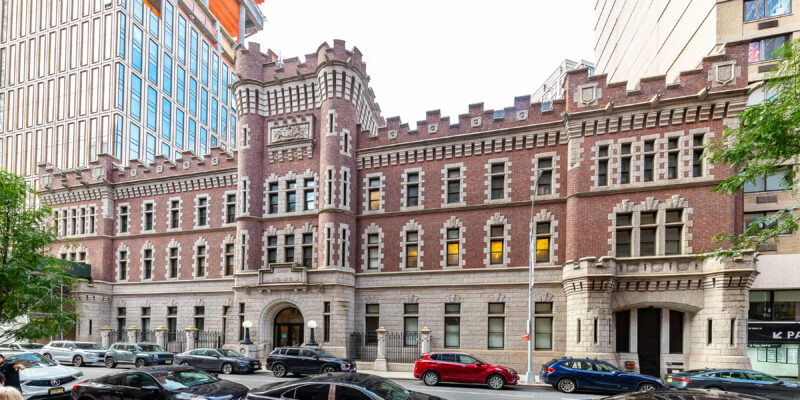
Hebrew Union College's new building on Manhattan's Upper West Side.




 Add EJP on Google
Hebrew Union College announced on Wednesday that it had raised over $50 million in the 2026 fiscal year — its most successful year yet. The fundraising haul comes as the Reform seminary, which has navigated financial strains and held its final graduation in May at its historic Cincinnati campus, also announced its largest incoming rabbinical class in 15 years. Forty-one students will start school this fall, up from 31 last year.
And the school also has a growing online program, launched last year, with 16 students starting in the fall, and is preparing to move its Manhattan location from Greenwich Village, its home since 1979, to the Upper West Side.
“We’re in the middle of changes because our board has the courage to face the future based not on recreating the past or what always has been, but by being true to the values that got us here in the first place,” Andrew Rehfeld, the president of HUC, told eJewishPhilanthropy.
Those values, he said, include “producing innovative and dynamic leaders [who] are committed to a Jewish future based on an academic model where we have outstanding academic and pastoral faculty,” as well as a commitment to Reform Judaism and to integrating Israel and North American Jewry.
“We’re repositioning ourselves for the future without giving up those three values,” Rehfeld said.
The seminary has faced growing criticism from within the movement for its acceptance and tolerance of anti-Zionist students. “Any seminary that either in word or deed, in principle or impression, acquires the reputation of being hostile to Zionism – a seminary that ordains anti-Zionist clergy – has no future in America,” Rabbi Ammiel Hirsch of Manhattan’s Stephen Wise Free Synagogue declared in May at the Re-Charging Reform Judaism conference.
At the same gathering, Rehfeld defended these ordinations as the price that the movement must pay for academic freedom.
Speaking to eJP this week, Rehfeld decried those who condemn the school for ordaining anti-Zionist rabbis as a sign of “a growing Jewish McCarthyism.”
“I have been asked to name names,” he said. “I’ve been asked to fire students, staff, and faculty who sign this petition or support that candidate. You are seeing the anti-intellectualism of McCarthyism applied to the Jewish community, this dogmatic ideology. Nobody’s accepted or admitted to HUC that’s looking to destroy the Jewish People… McCarthyism undermined the entire values that it was trying to protect, and that’s what’s happening now with Jewish McCarthyites, particularly [who] call themselves Reform leaders.”
The record-breaking fundraising year is anchored by three major donations, all of them anonymous. Though HUC has not disclosed the precise amount raised in previous years, its public donor rolls indicate that the $50 million raised last year exceeds the levels from the previous year and far surpasses the amounts reported the year before.
This year’s donations includes gifts of $15 million and $5 million, both of which will help complete the renovation of the school’s new Manhattan home at the First Battery Armory on West 66th Street. The location was purchased in February 2025 for $32 million and is in the neighborhood that housed the Jewish Institute of Religion, a once-rival school that merged with HUC in 1950. The move will take place in 2027.
“HUC needs to create a still sacred space for growth and reflection, for prayer and for study, in the middle of a chaotic and demanding world,” Rehfeld said. The Manhattan location will serve rabbinical, cantorial and graduate students and partner with surrounding congregations and Jewish institutions “to bring the community and raise the level of academic learning for continuing education, partnering with congregations to be a space outside of their own space, right there in the neighborhood.”
Anonymous donors also endowed the Tisch Initiative for Clergy Excellence, a rabbinic and cantorial fellowship program, with $15 million. Additional funds will also go to ensuring HUC is financially accessible to anyone who wants to study, Rehfeld said, and will support “democracy labs” in Israel, including a recent initiative that brings Palestinians and Israeli Jews together to learn.
The new HUC moves come in the wake of a 2025 Atra – Center for Rabbinic Innovations study that showed a changing U.S. rabbinate, in which students are earning ordination as a second career, are shying away from demanding pulpit posts and are increasingly studying at rabbinic schools based on convenience, not denomination.
By the turn of the decade, Rehfeld hopes that HUC will also launch an online cantorial program.
“We have so many people who are cantorial soloists who are desirous of a first-rate education and don’t have access to our faculty,” he said. “We need to provide that access.”
The donors are supporting HUC because they understand that the school and the Reform movement need to remain dedicated to its values but cannot remain static, Rehfeld said. “It illustrates the trust that [donors] have in our ability to steward their resources responsibly, ethically.”
Donors trust the board to make difficult decisions to “support continued growth and change, even if it’s painful,” Rehfeld continued. “They’re donors who are inspired by our vision of what HUC is and its importance to meet this moment for the Jewish future.”
Related News

EXIT INTERVIEW
Elizabeth Sokolsky, longtime EVP of Birthright Israel, to retire next year

MAGICAL EXPERIENCE
Shefa launches psychedelics retreat for Jewish professionals suffering burnout
CLOSING WORDS
In AZM address, Cosgrove links communal ‘orthodoxy’ on Israel to rising anti-Zionism among young Jews

MAJOR GIFTS
Center for Jewish History celebrates 25 years with a $25M matching grant

ADVANCING A VISION
N.Y. federation donates $1M toward building shared-society center named for peace activist killed on 10/7