Opinion
HUMAN INTELLIGENCE
The fundamentally human act of presence: A renewed commitment for the American rabbinate




 Add EJP on Google
On my first visit to Williamson, W.Va., during my student pulpit at B’nai Israel Congregation, the temple’s president handed me a map of the city’s downtown streets, marking the location of congregants’ shops. “On Shabbat morning,” he informed me, “our rabbis stop by to wish our congregants a ‘Good Sabbath.”’
The expectation startled me. “The congregation expects student rabbis to visit them in their stores on Shabbat morning?” I repeated, barely concealing my astonishment. After all, congregants belong in the synagogue on the Sabbath – but in Williamson, I was learning, the rabbi was expected to go to the congregants!
courtesy
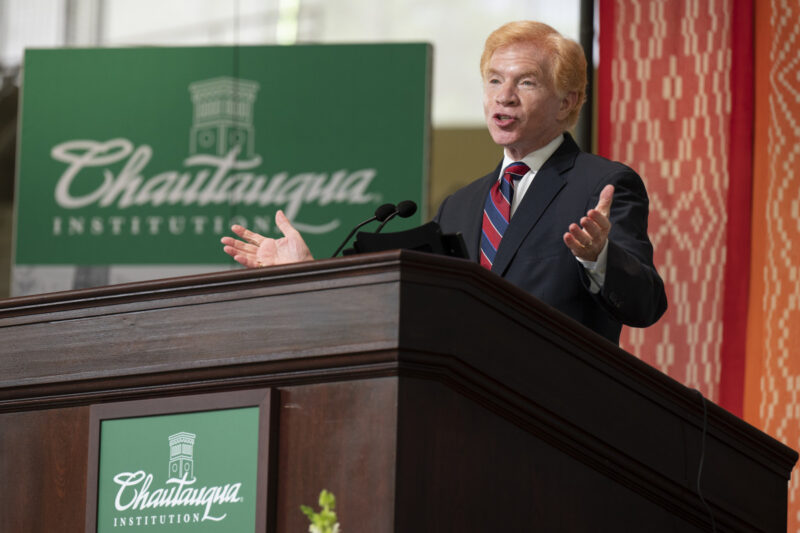
Rabbi Gary Zola speaks at the Chautauqua Institution’s Interfaith Lecture Series in Chautauqua, N.Y., on July 21, 2021/
The next morning, with misgivings, I headed downtown to Hess’ jewelry store, where Mr. and Mrs. Hess invited me to join their employees in the back office. There, they had arranged two Sabbath candles, a kiddush cup with wine and a challah covered with an embroidered “Shabbat Shalom.” “Rabbi,” they said warmly, “will you please lead us in the Shabbat prayers?”
A similar scene unfolded at every store I visited that day – and each time I traveled to Williamson, tucked into a bend in the Tug Fork River on the border with Kentucky, thereafter. After a few weekends, I suggested that everyone meet me at the temple for an abbreviated service before opening their shops. By year’s end, this had become our accepted practice.
The members of B’nai Israel of Williamson taught me an invaluable lesson about American Jewry: Rabbinic leadership begins with a willingness to meet people where they are. Only then – once a relationship is forged – can a rabbi build a community grounded in Jewish learning and living. The bond of a spiritual community speaks to a foundational human instinct.
I share this story now because it speaks directly to this urgent moment in Jewish life. The transformative power of human relationships has become an elusive commodity in modern America. A Pew Research Center study found that about 16% of Americans feel lonely or isolated all or most of the time, while another 38% report feeling lonely sometimes, with younger adults especially affected. A related Pew study found that despite widespread interest in building genuine neighborly bonds, only 26% of Americans say they know most of their neighbors. The technological era has eroded the local community ties that once anchored us.
Amid this loneliness epidemic, many turn to artificial intelligence in place of community. A recent Harvard Business Review analysis found that the primary use of generative AI tools is for therapy and companionship. This is a striking reflection of just how profound human longing for connection has become.
American Jews have been beset by circumstances adding to the emotional turmoil enveloping society at large. The tragic events that began on Oct. 7, 2023, constitute, in retrospect, a watershed moment in the history of Jewish life. American Jews are striving to cope with an intensified onslaught of antisemitism, bitter partisanship, a fragmented Jewish identity and ongoing political uncertainty — circumstances intensifying loneliness, anxiety and social isolation.
There is a substantial and growing body of literature demonstrating that participation in a faith community reduces feelings of loneliness and alienation through social contact, shared activities and networks of support. Faith communities furnish people with a venue for cultivating hope and fortifying the conviction that human existence, with all its upheaval and flaws, still has a transcendent purpose.
The ancient rabbinical sages insightfully warned: “Woe to the community that has a leadership deficit” (Horayot 10a). Successful communities must have capable and effective leaders. At this time in American Jewish history, there is an urgent need for such rabbinical leaders who will provide religious, spiritual and intellectual leadership for the Jewish community. To sustain connection amid algorithmic isolation and platonic AI companionship, it is our generation’s sacred duty to raise up a new generation of rabbis with the gumption and the courage to fight for the continuation of Jewish life in North America.
Isaac Mayer Wise, the founding architect of liberal Judaism in America, understood this imperative. One of his first rabbinical students, Max Raisin, later recalled that Wise was loved “not only because of the generosity of his spirit, his closeness to [his students] and his concern for their situations, but also and particularly because he treated Judaism and the rabbinate seriously. He saw theirs as the holy task of preserving Judaism and ensuring its perpetuity in the world…”
Wise remains an exemplar for our generation. He called his ordinands Atzilei B’nai Yisrael – “Israel’s noble ones.” This was not a mark of privilege or royalty, but a profound tribute to those who passionately dedicate their lives to a demanding yet deeply fulfilling vocation — one committed to learning, teaching and inspiring others to live with purpose, fulfillment and meaning.
At this moment in the history of American Jewry, the rabbinic mission that Rabbi Wise championed 150 years ago is a career of sacred service that remains as vital and timely as ever – and perhaps even more so.
Rabbi Gary Zola serves as the founding president of the College for Contemporary Judaism, a new rabbinical school being established in Cincinnati. He is also the executive director emeritus of the Jacob Rader Marcus Center of the American Jewish Archives and a professor emeritus of the American Jewish Experience and Reform Jewish History at Hebrew Union College.