Opinion
IMMERSIVE EXPERIENCES
What happens when we trade our desks for service and purpose?




 Add EJP on Google
On the bus ride from Yerucham, Miami’s partnership city deep in Israel’s Negev, to Tel Aviv on our final day in Israel, I looked around and realized something remarkable happened.
Just eight days earlier, the 17 of us, with me as the Birthright Volunteer trip leader, arrived in Israel as colleagues. We represented nearly every department of the Greater Miami Jewish Federation, including administrative support, accounting, data/technology, facilities, fundraising and planning. Some had visited Israel many times; others had never left the United States. Nearly half of our group was not Jewish. Our tenure at the federation varied widely, from three years to 25.
Courtesy/Oksana Cardini
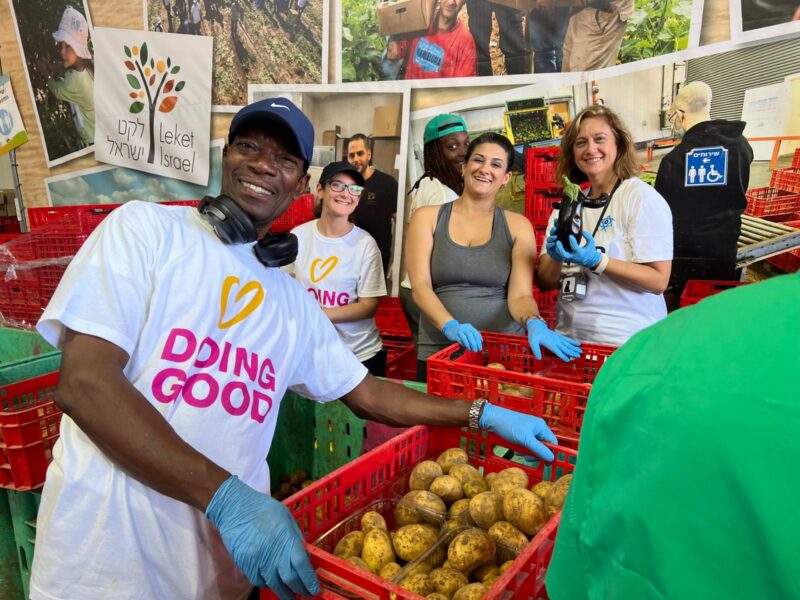
Greater Miami Jewish Federation employees pack vegetables at Leket Israel's warehouse in central Israel.
We were returning with a shared understanding of our mission, deeper relationships with one another and a renewed sense of purpose.
For 18 years, I have had the privilege of working with the federation’s partners in Israel. I’ve watched donors become inspired by missions after visiting projects they helped make possible and meeting the dedicated professionals of the various nonprofits we support. I’ve seen committee members return home transformed after spending time with communities rebuilding after crises.
This experience was different. This time, we were investing in our own team members; the people who show up every day and make the vision of the federation a reality.
We invest in staff development, hold training workshops and send employees to conferences. How often do we invest in helping employees at every level experience the mission they support every day? We may get to experience the work of the federation on the local level – a visit to one of our JCCs or the Kosher Food Bank as part of a staff retreat. Experiencing the totality of the federation’s work is often an opportunity reserved for a few professional staff.
We opened the Birthright Volunteer trip to staff across the organization, regardless of position, faith or age. Some had dreamed of visiting Israel for years but never imagined they would have the opportunity. For several participants, this wasn’t simply a professional development opportunity. It was a once-in-a-lifetime journey.
Watching my colleagues encounter Israel through the lens of service and relationships was one of the most meaningful aspects of the trip. They experienced not just a country, but a people. They met Israelis rebuilding their lives after trauma, volunteers serving their communities and partners working every day to strengthen Israeli society.
Israel was no longer an abstract place connected to their jobs. Nor was it the war zone depicted on the evening news or on social media. They saw how Israelis are trying to live their day-to-day lives, sending their children to school, going to work or out to eat. Yes, the country is in deep trauma, and they witnessed the resiliency of the people.
Within hours of landing, we visited Brothers for Life, where wounded combat soldiers shared their journeys of recovery and resilience. We then volunteered at United Hatzalah, assembling IV kits for Israel’s volunteer emergency medical service. The following day, we sorted thousands of pounds of produce at Leket Israel, helping provide food for more than 2,400 families.
We volunteered in different communities, gardening alongside Ethiopian-Israelis at the community garden in Pardes Hanna, painting a mural and gardening in Kibbutz Or HaNer (our Communities2Gether partnership), working with children at an educational farm and dancing with seniors at a local day center in Yerucham. Every stop and meeting connected us with organizations and communities supported through our annual campaign.
The work many only heard about at team meetings or read on budget reports suddenly came to life, with names, faces and stories.
We also encountered Israel’s complexity.
Through touring different sites, we experienced Israel’s importance to Christians and Muslims, to secular and Haredi.
Standing at the Nova music festival site, we listened as Tomer, a survivor, recounted the events of the Oct. 7 terror attacks. In Yerucham, Maor, the activities director at the senior center, shared the heartbreaking story of losing her sister, Noi Tiferet, who was murdered at the Nova festival. She told us that working with older adults, the very population her sister loved, is one way she keeps her sister’s memory alive.
Moments like these reminded us that there are individual people touched by our work,
Participants repeatedly reflected that the volunteer work, seemingly ordinary tasks, became extraordinary because they were connected to real people and real needs.
One participant shared, “I understood the federation’s work intellectually before this trip. Now I understand it emotionally.”
One of the most powerful realizations came as participants connected their daily responsibilities in Miami with the lives they were touching in Israel.
A budget line was no longer just a budget line. A grant recommendation represented providing families with food. An allocation supported mental health or helped communities still recovering from unimaginable loss. The work became tangible.
When we surveyed participants after returning home, the results reflected what we had witnessed throughout the week. Nearly every respondent said the experience strengthened their understanding of the federation’s work in Israel, deepened their connection to our mission and built stronger relationships with colleagues. And 95% of the participants rated the experience as “excellent.”
And the survey revealed something else.
Participants consistently wrote that one of the most meaningful aspects of the experience wasn’t only Israel, it was one another. Many spoke about conversations on long bus rides that never would have happened in the office. Others described seeing coworkers in completely different ways. People who previously exchanged only quick greetings in the hallway returned with genuine friendships and a deeper appreciation for one another’s contributions.
Shared service has a remarkable way of flattening organizational charts. When you’re packing food in a warehouse, standing silently at the Nova memorial or dancing with seniors in Yerucham, job titles don’t matter. That was one of the trip’s greatest gifts.
Organizational culture isn’t created during staff meetings or through strategic plans. It’s built through shared experiences. Humans connecting with one another gives deeper meaning and purpose to our holy work.
Months from now, participants may not remember every statistic they heard or the name of every person they met. But they will remember packing vegetables alongside one another, listening to stories of resilience, sharing meals, laughing on long bus rides and witnessing the impact of the federation’s work with their own eyes.
Those shared memories will continue shaping how they work together long after the trip has ended.
At a time when Israel is often viewed through headlines, social media posts and political debate, firsthand experiences have never been more important. For many participants, Israel became more than a place discussed in meetings or headlines in the news. It became a country filled with people they now know personally, communities they served and the different food and cultures that they experienced.
Birthright Israel has transformed hundreds of thousands of young Jewish adults through immersive educational experiences. A similar model can be equally transformative for nonprofit professionals.
When an administrative assistant meets at-risk children whose programs are supported through federation funding, when an accountant packs food that will feed Israeli families, when facilities staff hear firsthand from Oct. 7 survivors, or when fundraising professionals witness resilience in communities rebuilding after tragedy, every one of them returns with something invaluable. A sense of ownership and a sense of purpose.
Many of us know how transformative an Israel experience can be; we are investing a lot to ensure our teens and young adults connect to their Jewish identity through a trip to Israel. I felt such pride and joy sharing this trip to Israel with my colleagues and seeing the impact on them. Investing in our team strengthens our culture, deepens our mission and reminds us why this work matters.
I am hoping that we will offer the same experience to other colleagues in our federation. And I hope other federations and Jewish nonprofits do the same transformative for nonprofit professionals.
Dahlia Bendavid is the vice president of Israel and global impact at the Greater Miami Jewish Federation, where she has worked for 23 years.