ATHLETIC COMPETITION
Sylvan Adams bets $35M on Israeli Olympic success with cutting-edge Sport Science Institute at TAU
New center is aimed at improving Israeli athletes' abilities and connecting the sports field to academia
COURTESY/Yael Tsur
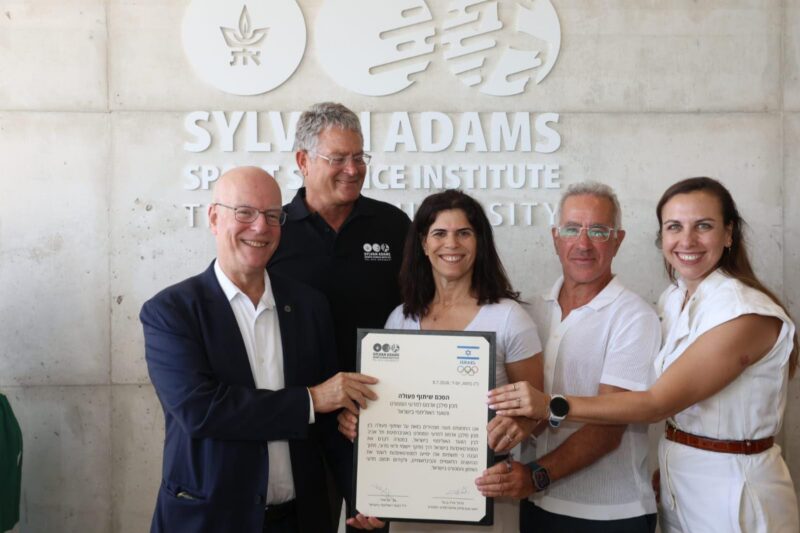
Prof. Ariel Porat, president of Tel Aviv University; Irad Ben-Gal, incoming head of the Sylvan Adams Sport Science Institute; Yael Arad, chair of the Israel Olympic Committee; philanthropist Sylvan Adams; and former Israeli Olympic swimmer Adi Bichman open the Sylvan Adams Sport Science Institute at Tel Aviv University on July 8, 2026.




 Add EJP on Google
It’s part gym, part science lab. A motion-capture system tracks how an athlete moves. A climate-controlled chamber can recreate the heat and humidity of a competition venue anywhere in the world. A dedicated flume lets swimmers train against a current instead of a fixed lane. And a hotel-style chamber replicates the thin air of altitudes as high as 5,000 meters — training conditions that would otherwise mean traveling abroad.
Welcome to the Sylvan Adams Sport Science Institute at Tel Aviv University, where Big Data meets big athletic dreams. The institute is a new research and training hub built to give Israeli athletes a scientific edge on the world stage. The center was funded by a $35 million gift from the Canadian-born businessman, philanthropist and cyclist who immigrated to Israel in 2015. It merges academic research with hands-on athletic support, aiming to translate lab findings into medals, records and lasting national sporting achievement.
Adams’ message at the opening of the institute on Tuesday even brought to mind gold-medal ceremonies: “In Israel, we are winners. We win at whatever we put our minds to.”
Olympic and Paralympic athletes, along with elite competitors across dozens of sports, will have standing access to the four story 1,700 square meter facility, which was built in partnership with Tel Aviv University’s Gray Faculty of Medical and Health Sciences and Faculty of Engineering. Inside, a cutting-edge gym full of advanced measurement equipment and motion-capture systems track how an athlete moves, while a climate-controlled chamber can recreate the heat and humidity of a competition venue anywhere in the world. A dedicated flume lets swimmers train against a current instead of a fixed lane, and a chamber replicates the thin air of altitudes as high as 5,000 meters — training conditions that would otherwise require traveling abroad.
Beyond the equipment, the Institute pairs each athlete with physiologists, engineers, data and AI specialists, physicians and public health researchers who build individualized plans covering everything from nutrition to mental performance, with the goal of converting that research into faster times and podium finishes.
The opening ceremony yesterday drew a roster of prominent figures, including Adams himself; Ariel Porat, president of Tel Aviv University; Yael Arad, chair of the Israel Olympic Committee and a member of the International Olympic Committee; Irad Ben-Gal, head of the Sylvan Adams Sport Science Institute; and Olympic track cyclist Mikhail Yakovlev.
At the launch, Porat said the university was “proud to launch the Sylvan Adams Institute today — a vision that would not have become a reality without Sylvan’s extraordinary generosity.” He added that the Institute is dedicated to “advancing health through physical activity, promoting research in exercise physiology, and, of course, in this context, fostering competitive sports.”
At the ceremony, Adams framed the Institute as part of a broader argument he has made for years: that sport is both a source of national pride and a unifying force inside Israel. “A sport is good for the country,” he said. “It nourishes the positive, nationalistic, Zionistic spirit.”
The gift to Tel Aviv University follows a pattern of Adams’ ramped-up philanthropy across Israel in recent years, which has included $100 million gifts to both Ben-Gurion University of the Negev two months after Oct. 7 as well as another $100 million to Soroka Medical Center after it was severely damaged in the June 2025 war with Iran, marking the hospital’s largest-ever philanthropic gift. Adams also personally financed the bulk of the roughly $33 million cost of bringing the Giro d’Italia’s 2018 Grande Partenza to Israel — the first time cycling’s second-biggest Grand Tour had opened outside Europe — and covered Madonna’s appearance fee, reported at over $1 million, to headline Eurovision 2019 in Tel Aviv.
Arad, who was Israel’s first Olympic medalist in 1992 at the Barcelona Games, praised Adams’ vision in building the center. “This place is really, for us, a game changer,” she said at the launch. “Your dedication to Israeli sports comes from your true passion and your desire to see the athletes on the podium.”
Arad also highlighted that the partnership between Tel Aviv University and the Israel Olympic Committee through the Sylvan Adams Sport Science Institute is designed to supercharge the pipeline between Israeli athletes and the Olympics.
The new Sylvan Adams Sport Science Institute sits at the intersection of Adams’ signature public diplomacy efforts and his capital gifts to major Israeli institutions. Adams sometimes refers to himself as “self-appointed ambassador-at-large for the State of Israel.” But with the new center, Adams is seeking to create more ambassadors through sports — pumping the pipeline of Israeli athletes into the Olympic ether not only to secure more medals, but also to use these athletes to better tell the world the mosaic of Israel’s story.
During his remarks, Adams appealed to wealthy Israelis and Diaspora Jewish philanthropists to invest in Israeli sport the way he has. Noting that Olympic competition spans 36 sports and that he has already “taken” cycling by funding his own professional team, Adams challenged other philanthropists to do the same.
“All we need to do is create the conditions where our character can be nourished,” Adams said from the podium to the crowd of nearly one hundred athletes, Tel Aviv University staff and board members alongside Adams’s friends gathered for the opening. “And, of course, we have less money here for sport because we have other priorities in this country, which are obvious to everybody. So, here’s my challenge. We have 36 sports. We only need to find 35 others because I’ve taken cycling. We need to find, in the Jewish world — this means outside of Israel but also inside of Israel — with many passionate people, wealthy passionate people, and I say, let’s get 35 others.”
Asked why sport should be a priority given Israel’s current challenges, Adams pointed to the outsized global attention paid to sport and music. “Sport and music are really the two most-watched things in the world — by far, they dominate everything else,” he said.
Mikhail Yakovlev, who moved to Israel from Russia four years ago and has competed at the Olympics, Paralympics, and world and European championships as a track cyclist, already trains at the facility twice a week. “It will help a lot through the collaboration with the Olympic committee so athletes can train here,” Yakovlev said. “The tests and science they add really enhance our ability to compete.”
Sitting down with eJP after the ceremony, Adams described his approach to philanthropy as fast-moving. “I don’t have a huge organization,” he said. “I don’t want to study something to death, because sometimes the lack of a decision is itself a decision. I’ve never operated any other way — I’m fast.”
The Institute writes another chapter in a long relationship between the Adams family and Tel Aviv University, where Adams serves as vice chairman. With pride, Adams told eJP: “I’m a second-generation Tel Aviv University donor — my parents established a relationship with the university before me, so it was natural for me to adopt the university when I moved here. I’m continuing my parents’ legacy. I’m not a tourist here — we’re family.”
Before heading to his next engagement, Adams teased to eJP: “You’ll see, we have another big announcement coming in the fall.”
Related News
ADVANCING A VISION
N.Y. federation donates $1M toward building shared-society center named for peace activist killed on 10/7

EXIT INTERVIEW
Elizabeth Sokolsky, longtime EVP of Birthright Israel, to retire next year
HIGHER EDUCATION
As Jewish donors reconsider academia, Jan Koum doubles down, endowing Israel studies at Stanford

MAJOR GIFTS
Center for Jewish History celebrates 25 years with a $25M matching grant
EXCLUSIVE
Detroit-based philanthropists Nancy, James Grosfeld donate $8M to renovate JDC’s Israel campus