HELPING HAND
Father of slain ‘lone soldier’ opens first American chapter of Israeli bereavement group Yad LaBanim
Led by David Lubin, whose daughter, Rose, was killed in a Jerusalem stabbing, the new branch is expected to be fully operational by early fall
courtesy
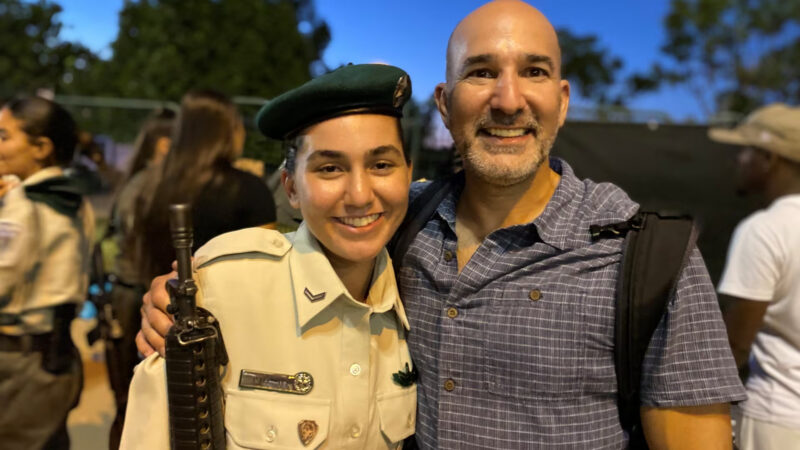
David Lubin stands with his daughter, Rose, an Israeli Border Police officer who was killed in a stabbing attack in Jerusalem in November 2023.




 Add EJP on Google
Yad LaBanim, the Israeli organization that supports bereaved military families, is opening its first North American chapter this fall, led by David Lubin, whose daughter, Rose, a lone soldier from Atlanta, was killed in a terror attack.
Rose, who made aliyah from Atlanta and became a sergeant in the paramilitary Israeli Border Police, was killed in a stabbing attack while on duty in Jerusalem in November 2023, weeks after she helped defend her adopted kibbutz in southern Israel during the Oct. 7 terror attacks. Rose is one of the roughly 50 foreign-born lone soldiers — those serving without immediate family in Israel — killed since the Oct. 7 attacks.
“After Rose died, we realized there was a need for it here [in North America],” Lubin said. “After you lose someone like that, and you come back home, you realize that you need a community.”
Founded in Israel by parents of fallen soldiers in the aftermath of the War of Independence, Yad LaBanim — literally, “monument to the sons” — operates dozens of branches across Israel, largely staffed by bereaved parents and siblings. The organization advocates on behalf of bereaved families to the Israeli Defense Ministry and welfare authorities, runs retreats and workshops, and provides scholarships and mentorship for bereaved siblings.
After returning home to the U.S. following Rose’s death, Lubin said he came to realize there was no support network for the estimated 1,100 bereaved relatives now living in the United States. He decided to help close this gap by starting a chapter of the organization himself. Historically, Lubin said, while families who lose loved ones in Israel’s wars can access support retreats and community through Yad LeBanim within Israel, no comparable resource existed for those based in the U.S.
“Yad LeBanim, for people there, it’s a part of the culture, it’s ingrained. You don’t receive that, and you can’t really receive that in the USA unless there’s an organization that’s helping put it together,” said Lubin.
Yad LaBanim USA will largely mirror its Israeli counterpart’s model, but Lubin said the country’s sheer size will force adjustments. Where Israeli branches can serve as local walk-in “clubhouses,” American bereaved families are divided by geography, and most communities are too small to support a local chapter.
Instead, said Lubin, the U.S. branch plans to lean on regional and multiday retreats, potentially convening families from the Southeast, the West and the Northeast separately rather than building out local hubs.
The organization will also be more reliant on local partners, such as Jewish federations and JCCs, he said. Specifically, the North American chapter will be supported by Yad LeBanim, Israel’s Ministry of Defense, Friends of the IDF and local philanthropic fundraising, according to Lubin.
Prior to launching, the organization already has three enrolled member families and expects to formally seat its board this month. The goal is to have Yad LaBanim USA be fully operational by early fall, he said.
According to Lubin, Yad LaBanim had long been interested in establishing a North American chapter, but lacked people on the ground to build the infrastructure.
“We now are putting the boots on the ground, and people are excited about it,” he said, noting that an organizing board is coming together and a membership program has already enrolled its first families.
Reflecting on the new chapter’s purpose, Lubin offered a bittersweet hope for its future — that Yad LaBanim USA will one day have no need to grow.
“It’s like starting an organization that you want to end,” he said.
Related News
HIGHER EDUCATION
As Jewish donors reconsider academia, Jan Koum doubles down, endowing Israel studies at Stanford
EXCLUSIVE
Detroit-based philanthropists Nancy, James Grosfeld donate $8M to renovate JDC’s Israel campus
ADVANCING A VISION
N.Y. federation donates $1M toward building shared-society center named for peace activist killed on 10/7

MAJOR GIFTS
Center for Jewish History celebrates 25 years with a $25M matching grant
PRESIDENTIAL REBUKE
Israel’s Herzog: Mamdani ‘makes no effort’ to hide disdain for Israel, Jews must fight back