Opinion
ZACHOR
Defensive vulnerability: Constructing Jewish identity in a post-Oct. 7 world




 Add EJP on Google
Several months after the Oct. 7 attacks, my 8-year-old daughter asked me a question about the war. We were walking to school on a Monday morning, reviewing the ordinary logistics of the day. They she suddenly furrowed her brow, exactly the way I do when I am deep in thought or concerned, and asked how many people on both sides had died in the war.
As we talked, I was struck by something I had not fully appreciated before: At 8 years old, she already possessed a remarkably clear sense of who belonged to “us” and who belonged to “them.” She understood herself as part of a people to whom she felt a strong allegiance, and she understood that those people had been hurt.

Nikada/Getty Images
Illustrative. A girl raises her hand in school.
While I was moved by the strength of her emerging Jewish identity, I also found myself wondering how she had come to see the world that way. What stories had shaped her understanding? What assumptions about belonging, vulnerability and responsibility had she already absorbed?
A few days later, my 10-year-old daughter woke up frightened by a dream. “They were coming for the Jews, and we had to hide,” she told me. After reassuring her that she was safe, I found myself asking many of the same questions. What had she heard? What had she internalized? What had found its way into her imagination strongly enough to emerge in her dreams?
In my attempt to help her process the dream, we began discussing what it means to be a Jew. The first word she chose was “special.” Then “strong.” For the third word, she hesitated.
“I don’t know the word for it,” she said. “But we’re hated by most people. Is there a word for that?”
I was taken not only by her response, but by what her answer revealed. Being Jewish, in her mind, was automatically associated with uniqueness, strength and persecution. None of those ideas had been explicitly taught together, yet somehow they had become deeply intertwined. Once again, I found myself wondering not only what my children knew, but what they were implicitly absorbing.
In many ways, this seemingly clear Jewish narrative my daughters are inheriting stands in sharp contrast to my own. Growing up in a secular Jewish household in Maine, Judaism was not the organizing force of my life. The robust Jewish narrative my daughters are developing is actually one I spent years constructing for myself.
By the time I arrived at college, I found myself caught directly in the conflict between Hillel and Students for Justice in Palestine, caring deeply about being Jewish but unable to fully articulate why. In the heat of those campus debates, I felt a deep, instinctual pull to advocate for the Jewish community and Israel, but I quickly realized I lacked the vocabulary and the foundational knowledge to do so meaningfully. I took it upon myself to study the historical experiences and narratives of both sides so I could develop an informed opinion of my own. This intellectual and personal curiosity set me on a path that eventually led me to Israel, into Jewish communal life and ultimately to the Committee on International Relations at the University of Chicago, where I studied with scholars whose views on Israel, Jewish memory and political power often sat in deep tension with one another.
Thirteen years ago, my master’s thesis explored how collective trauma shapes group identity. At the time, I was interested in questions about the Holocaust, Israel and the ways historical wounds continue to shape contemporary Jewish life, even among those who never experienced the original trauma themselves. Back then, these questions felt largely academic. Today, they feel entirely personal. I am less focused on how previous generations transmitted narratives to my generation and increasingly interested in the narratives my generation is transmitting to the next. What stories will children who are growing up during this period of heightened antisemitism and insecurity inherit from this moment?
The transmission of narratives and the construction of identity happen subtly. They occur through the commemorations we hold, the stories our schools emphasize, the fundraising campaigns that galvanize our communities and the language adults use to respond to children’s challenging and sensitive questions.
It also happens through the security measures that have become part of everyday Jewish life. When children pass armed guards on their way to school, participate in lockdown drills, attend Holocaust commemorations and watch adults rally in moments of crisis, they are absorbing more than information. They are learning something fundamental about what it means to be Jewish. Together, these features of everyday Jewish life communicate what our community believes is most urgent, most central and most worthy of protection.
The challenge arises when experiences of vulnerability become the primary lens through which identity is formed. No school teaches children to be afraid. No synagogue teaches victimhood. Yet children absorb far more than formal lessons; they absorb what adults worry about, what communities rally around, and where we direct our collective attention and philanthropic resources. They learn not only from what we teach, but from what we emphasize.
The Jewish people have compelling reasons to remain vigilant. History offers no shortage of evidence that threats can emerge suddenly and with devastating consequences. Yet my research years ago suggested that communities do not simply remember danger; they can also organize themselves around an enduring expectation of it. In that research, I described this tendency as “defensive vulnerability”: the process by which a community’s awareness of genuine threats can become the central organizing feature of collective identity.
And that is the question that increasingly occupies me as a parent and a communal leader. How do we teach children about genuine threats without allowing vulnerability to become the primary framework through which they understand who they are?
Historical wounds can easily move from being a chapter of our story to becoming the plot itself. Children do not absorb isolated messages; they assemble their own narratives from the world around them. From the rituals they participate in to the fears they witness, they gradually construct an understanding of where they belong. When security, vigilance and responses to threat dominate the communal landscape, children may begin to understand Jewish identity primarily through the lens of external threat, even as institutions intend to transmit something much richer, joyful and more expansive. The question is not whether the lessons of vigilance are wrong. The question is how they fit into the larger narrative children are building.
If this is true, then the task before Jewish educators, communal leaders, philanthropists and parents is not simply to strengthen Jewish identity, but to think carefully about how that identity is being constructed. Security, advocacy and vigilance remain essential. But so too are the experiences, relationships, rituals and values that help children understand how vulnerability fits within a larger understanding of what it means to be Jewish.
I am not advocating for less Holocaust education, less Israel education or less attention to security. Nor am I suggesting that advocacy and remembrance should occupy a smaller place in Jewish communal life. My concern is not the presence of these vital institutions and safeguards, but our awareness of how they are being weighed and transmitted.
My daughters are already constructing a story about what it means to be Jewish. So are countless other Jewish children. In many ways, that is a testament to the remarkable work of our schools, camps, synagogues and communal institutions. They are succeeding in transmitting a deep sense of Jewish belonging and peoplehood.
The question, then, is not whether children are absorbing a narrative. They are. The question is whether we are paying attention to the narrative they are constructing from the world around them — and whether it reflects the vibrant, purposeful Jewish life we hope to pass on.
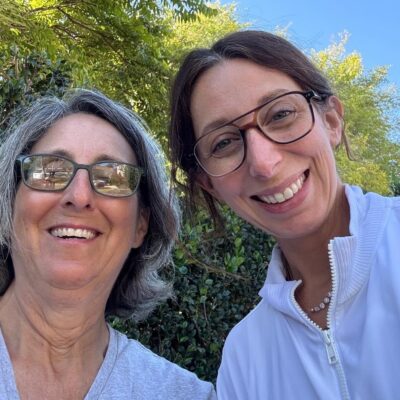
Anna L. Prager is a writer, researcher and Jewish communal leader serving on the board of trustees of Temple Beth Am and Pressman Academy in Los Angeles.