Q&A
Closing Haifa antisemitism confab, Bernard-Henri Lévy offers hope: ‘This battle is not lost’
The French philosopher and author tells eJP that even he was shocked by the immediacy of anti-Israel protests post-Oct. 7, but insists on the need for optimism
Yaniv Kopel
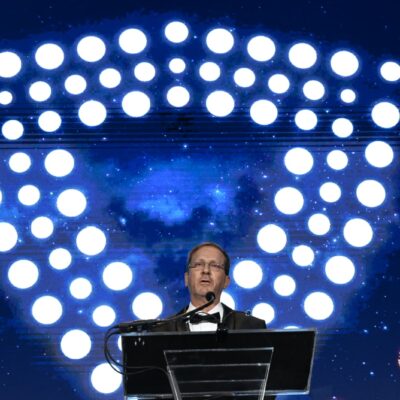
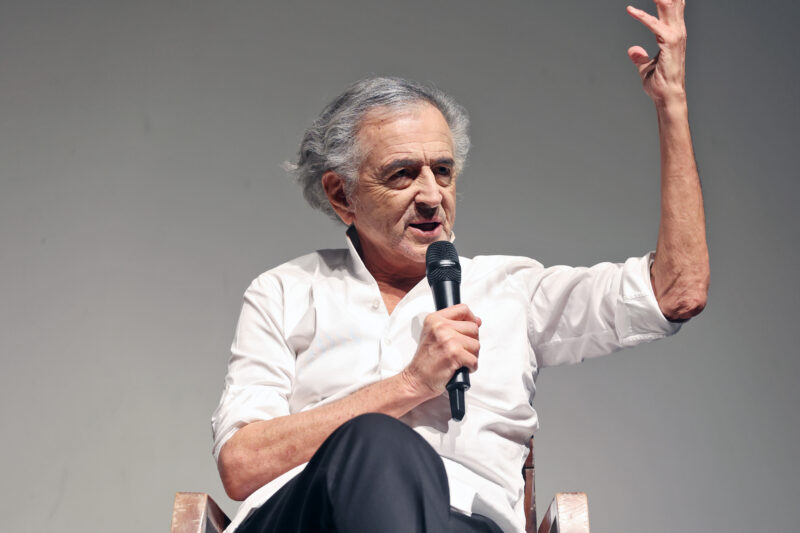
French philosopher and author Bernard-Henri Lévy speaks at the closing session of the Contemporary Antisemitism Haifa 2026 conference at the University of Haifa on July 9, 2026.




 Add EJP on Google
The French philosopher and author Bernard-Henri Lévy closed the Contemporary Antisemitism Haifa 2026 conference on Thursday evening with a stark warning — one that he has been sounding for 50 years now — but also with a glimmer of hope.
Antisemitism, he said, survives not through crude, discredited slurs but by reinventing itself as a grand accusation, one that casts Jews — and now the Jewish state — as responsible for the world’s ills. Lévy described confronting pro-Palestinian encampments on American campuses this past year and what he called a chilling new register of hatred cloaked in the language of solidarity.
At a time of growing concern, when he sees antisemitism rising all over the world, Lévy nevertheless stressed the need to continue the efforts to combat it. He also pointed to what he sees as durable allies — liberal democrats, Muslims who embrace Enlightenment values and Catholics.
Lévy’s remarks followed addresses by Haifa Mayor Yona Yahav and Cochav Elkayam-Levy, founder and chair of the Civil Commission on Oct. 7.
In his remarks, the public intellectual recalled turning down an invitation to a Jerusalem antisemitism conference last March after organizers planned to seat him alongside French far-right figure Jordan Bardella.
Speaking to eJewishPhilanthropy after his speech, Lévy reflected on why this moment feels unlike any other for Jews around the world, weighed in on what a conference and a new academic journal can realistically accomplish in the fight against antisemitism, warned about AI’s growing role in amplifying antisemitic narratives and shared what he wants Jewish philanthropists to understand.
This interview has been edited for length and clarity.
Justin Hayet: How is this moment different from other moments in Jewish history when it comes to rising antisemitism?
Bernard-Henri Lévy: What is different today, compared with the 1930s, is that a Jew facing persecution no longer has many safe places to go. In Israel, you are threatened on seven fronts. In the United States, antisemitism is surging — just as it is almost everywhere else. Europe, of course, is no exception; the entire continent is being swept by the fever. And as for the Global South, the situation may be even worse. For the first time, antisemitism is rising everywhere at once, at the same pace and with the same intensity.
JH: What is different about this conference and the new academic journal that’s come out of it? Can ideas like these actually change anything on the ground globally?
BHL: I do not know what a conference, by itself, can change. But one thing is certain: We must not give up, because the battle, contrary to what some believe, is not lost in advance. Jews, the friends of the Jewish people, the friends of democracy and genuine liberals can win this fight. And taking part in this conference is one of the simple yet meaningful things one can do if one believes that such a victory is still possible.
JH: Regarding artificial intelligence, what troubles you most about the impact it can have on antisemitic trends globally?
BHL: The problem with artificial intelligence is that it reproduces rather than invents. It repeats; it does not possess a genuine capacity for innovation. It reflects the world as it is, but not the momentum created by those who, for example, refuse antisemitism and are fighting against it.
In other words, if you ask an artificial intelligence application today, it will present you with the picture of a world ravaged by the fever of antisemitism. It will not show you the efforts being made by those who, in Haifa for example, are organizing the counteroffensive.
Take Wikipedia, for example. Look carefully at the articles devoted to subjects related to Judaism. You will often find there the worst prejudices, the most persistent clichés and some of the most destructive intellectual trends of our time. This is hardly surprising, because these powerful computational systems largely process and recombine content that already exists. They aggregate and synthesize it, but they do not truly judge it. They do not separate the wheat from the chaff. And since content portraying Israel and the Jewish people in a negative light is so widespread online, that is what tends to be echoed in internet searches and increasingly in AI-generated responses.
JH: What must Jewish philanthropists understand about antisemitism today, and how would you implore them to let it shape their giving?
BHL: Jewish philanthropists are already doing a great deal, and I even have the impression that many of them are operating at the limits of their capacity. If I were one of them, I would do everything I could to support public campaigns that affirm the pride of being Jewish, the nobility of the Zionist ideal, the measure of greatness that Israel still embodies and confidence in ultimate victory.
JH: What is the core message you want to convey to conference participants and eJewishPhilanthropy readers?
BHL: The most important message I tried to convey is that this battle is not lost and that, on the contrary, we must stand our ground with all our strength and with all our soul.
I am not a pessimist. I do not believe that Jews no longer have a future in Europe, or even in the United States. I do not believe that sheer numbers will inevitably prevail over a determined minority. I believe that a world without the Jews would be an uninhabitable world. That, in essence, was the message I sought to deliver in Haifa.
JH: What is something you learned or saw about antisemitism and the Jews this past year that surprised you, or was new to you?
BHL: What surprised me most, honestly, was the world’s lack of compassion for the victims of Oct. 7. I knew that anti-Zionism would, sooner or later, reassert itself. I knew that antisemites would find a way to turn the situation against the Jews. But I also thought there would be, at the very least, a period of mourning. I was convinced there would be a time for decency, for restraint, for shame and perhaps for grief. But that was not the case.
The day after Oct. 7 — or perhaps three days later — the event had already been forgotten. The Hamas murderers already had their excuses, and it was all being justified in the name of a so-called “resistance.” That is what surprised me so profoundly.
Related News
CLOSING WORDS
In AZM address, Cosgrove links communal ‘orthodoxy’ on Israel to rising anti-Zionism among young Jews

MAJOR GIFTS
Center for Jewish History celebrates 25 years with a $25M matching grant

EXCLUSIVE
Detroit-based philanthropists Nancy, James Grosfeld donate $8M to renovate JDC’s Israel campus

MAGICAL EXPERIENCE
Shefa launches psychedelics retreat for Jewish professionals suffering burnout

EXIT INTERVIEW
Elizabeth Sokolsky, longtime EVP of Birthright Israel, to retire next year