BACK-AND-FORTH
An ‘attack’ on Reform values: HUC president claps back after getting flak for anti-Zionist students
Andrew Rehfeld says it is ‘unfortunate’ that some students adopt anti-Israel positions, but says it’s a necessary risk for liberal education
Screenshot
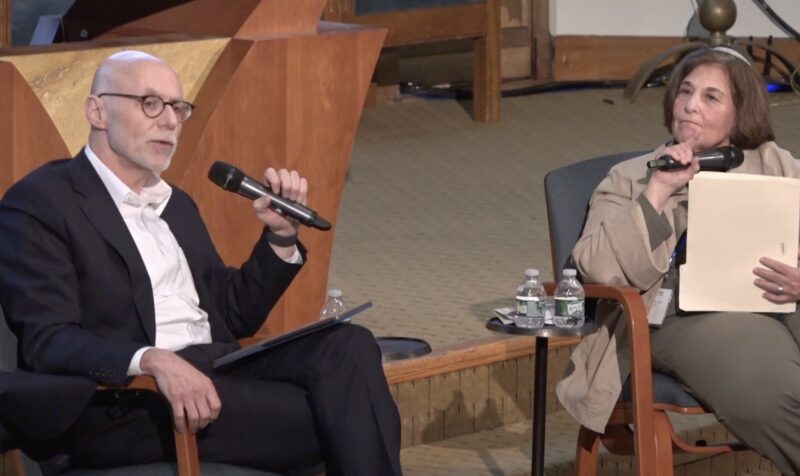
Andrew Rehfeld, president of Hebrew Union College, speaks with Rabbi Denise Eger at the Stephen Wise Free Synagogue in New York City during the Re-Charing Reform Judaism conference on May 27, 2026.




 Add EJP on Google
Hebrew Union College-Jewish Institute of Religion President Andrew Rehfeld hit back against Rabbi Ammiel Hirsch’s condemnation of the Reform seminary’s ordination of anti-Zionist clergy, calling his comments “an attack on the very Enlightenment principles that founded our movement” and accusing him of “anti-intellectualism.”
The public clash erupted on Wednesday at the Re-Charging Reform Judaism conference, which brought over 300 rabbis, educators and lay-leaders to the Stephen Wise Free Synagogue, where Hirsch is the senior rabbi.
Speaking on Wednesday, a few hours after Hirsch’s remarks, Rehfeld insisted that his institution was committed to liberal Zionism but said that a free education was equally important, even if that resulted in some graduates adopting beliefs that run counter to those of the Reform movement.
“What we heard this morning was an attack on the very Enlightenment principles that founded our movement. It was an embrace of anti-intellectualism that opposed the values that have defined not just Hebrew Union College but our entire Reform movement,” Rehfeld said in an onstage discussion with Rabbi Denise Eger titled, “Liberating Jewish Education.”
“We need to create environments in which students come to understand, on their own terms, the reasons why we believe the Jewish People has a right to a sovereign nation freely in their own homeland,” he said. “That process of liberal Jewish education cannot be done in a serious way with the threat of expulsion if they arrive at the wrong answer.”
He stressed that this was not his own belief, but was based on the principles of Stephen Wise, the founder of the Jewish Institue of Religion, which merged with Hebrew Union College in 1950, and the founder of the eponymous hosting synagogue.
“We must embrace Zionism, we must embrace Jewish peoplehood, and we also must embrace the liberal Jewish education that [Wise] championed,” Rehfeld said. “Every member of the teaching staff is free to see and state the truth as they see it, and in the same way, every student is free. Now, I want to be clear: those were his ideals, those were the ideals that founded the institution. You can’t have the Zionism and the commitment to Jewish people that he promoted without accepting that as part and parcel.”
Rehfeld acknowledged that this freedom can lead to “unfortunate” opposition to Zionism and the State of Israel.
“I don’t see it as a success if somebody comes out of our institution and says, ‘I’m proudly an anti-Zionist,’ and not only because I want to ask what they mean [by that], but also because I think that it’s insensitive right now in the Jewish community,” Rehfeld said. “It is an unfortunate but necessary risk that comes at the cost of openness that I believe is the only way we’re going to train future Jewish leaders for the challenges of the world today.”
Hirsch, whose vocal stance on Israel and Zionism has drawn pushback from some of his co-denominationalists who view him as deprioritizing a “big tent” approach in favor of Zionist orthodoxy, heavily criticized the flagship reform seminary for accepting students “hostile to Zionism,” during the conference’s opening plenary, stating that “a seminary that acquires the reputation of being hostile to Zionism – a seminary that ordains anti-Zionist clergy – has no future in America.”
Hirsch continued: “It is not enough to say to each other, “look, see, we are a Zionist seminary, our students spend their first year in Israel, but our commitment to liberal education requires us to ordain anti-Zionists.” Under what theory of liberal education are we required to accept outcomes we did not intend, and do not want?… Under what theory of liberal education is there a requirement on our part to even accept, let alone ordain, candidates for the rabbinate and cantorate who do not believe what our movement believes?”
Eger had asked Rehfeld specifically about an incident last year in which a small number of first-year HUC students, who study in Israel, had refused to stand for the Israeli national anthem, “Hatikva.”
Rehfeld said he was “offended” by their actions but also condemned those who had made the incident public.
“The reason people know about that story is because there was an expression within a classroom, within a sacred environment of learning, that was shared outward,” Rehfeld said. “I’m not defending the not standing, I’m offended by it, and I’m offended by what it says about our commitments and all the rest, but to do that to a student who’s in their first year, that’s a shanda.”
Asked if he would consider asking potential students if they identify as anti-Zionist as a condition for acceptance to the school, Rehfeld said that he would not, adding both that they could easily lie about it and that the requirement to study in Israel for a year acts as a natural barrier, particularly as the Israel campus is led by Nachman Shai, a former IDF brigadier general and Israeli government minister. Though he rejected the “litmus test,” Rehfeld said that the school did have certain red lines.
“Anyone that promotes the active overthrow of the State of Israel, anyone that promotes the relocation of the Jewish people out of the state, has no place at HUC. Anyone who promotes the relocation of any peoples from their historic land of origin has no place in HUC. Anyone that promotes the violent destruction of peoples has no place at HUC. That’s not the question,” he said.
“We need to create environments in which students come to understand, on their own terms, the reasons why we believe the Jewish People has a right to a sovereign nation freely in their own homeland,” Rehfeld said. “That process of liberal Jewish education cannot be done in a serious way with the threat of expulsion if they arrive at the wrong answer.”
Related News
HIGHER EDUCATION
As Jewish donors reconsider academia, Jan Koum doubles down, endowing Israel studies at Stanford

MAGICAL EXPERIENCE
Shefa launches psychedelics retreat for Jewish professionals suffering burnout

MAJOR GIFTS
Center for Jewish History celebrates 25 years with a $25M matching grant

ADVANCING A VISION
N.Y. federation donates $1M toward building shared-society center named for peace activist killed on 10/7
PRESIDENTIAL REBUKE
Israel’s Herzog: Mamdani ‘makes no effort’ to hide disdain for Israel, Jews must fight back